
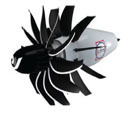
 Open Rotor
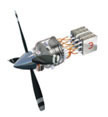 Alternative Propulsion
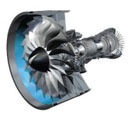 Ultra High Bypass Ratio
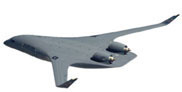 Blended Wing Body AeroDynamic Advisory
The aerospace market seems to really like a large single-aisle, or narrow-body, fleet strategy, according to Richard Aboulafia at AeroDynamic Advisory LLC, even for international flights. “More than half the flights over the Atlantic over the past couple of years have been on single aisles. That’s a major change.”
However, he noted, there are no concrete roadmaps for the next-generation narrow body from any of the OEMs, including Airbus, Boeing, Embraer and Comac. Those aircraft will depend on novel propulsion technologies, such as engines that employ an open rotor, ultrahigh bypass ratio or alternative propulsion.
In an open rotor engine, the forward propeller pushes the air backwards, while the rear one sucks it. “Open rotor is very promising. It was very promising when I started my career in the late 1980s.” Aboulafia said.
With a bypass ratio generally greater than 15-1, an ultrahigh bypass ratio engine is a close cousin to the open rotor design, he explained. In an ultrahigh bypass ratio arrangement, a large quantity of fuel goes around the engine core and does not get burned, significantly enhancing fuel efficiency. “You are getting all that thrust, all that power for free.”
Aboulafia added that alternative propulsion sources include electric-, hydrogen- and hybrid-powered engines, with hybrid designs likely to come first. “It’s really a slow road. Even with hybrid, we’re talking 2040. In the long run, who knows?”
A truss-braced wing design is another narrow-body option, he said, but it comes with numerous complications that cannot clearly be solved. The primary one is that fuel is stored in a plane’s wings, an aircraft with truss-braced wings has much smaller wings than a conventional narrow-body plane. “Where does the fuel go now?”
Also very promising is a blended wing body aircraft, but that might not make inroads until at least 2040, Aboulafia said. The BWB is an innovative configuration that merges the wings and fuselage into one aerodynamic structure to boost fuel efficiency and flight performance.
“The blended wing body is just a win-win,” he added. “If people can build it, someone will buy it. We don’t know when, we don’t know who, but it’s a great idea. Like everything else in this industry, major change happens very gradually and there is no guarantee it will happen.”
—A. Richter