

Training camps
All images courtesy QUAL-FAB
All images courtesy QUAL-FAB
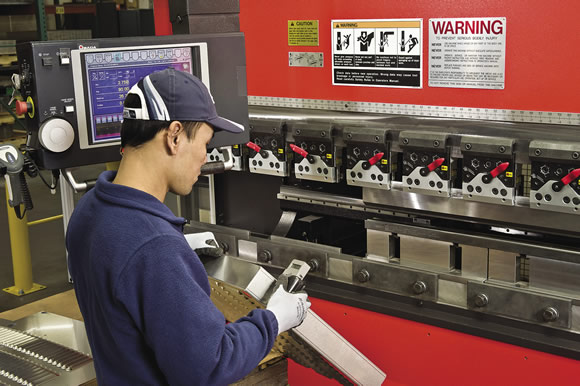
A machine operator performs a wireless digital measurement of a bend angle. This process includes live feedback into the machine that enables the equipment to automatically correct the back-gage controls and tonnage.
How a cooperative organization helps manufacturers train their employees in-house.
|

If you ask small and medium manufacturers (SMMs) what ongoing management issue is the most challenging, the answer is usually the difficulty of finding skilled applicants for job openings. This is not a new problem, and has been discussed for at least the last 2 decades.
The Center for Advanced Manufacturing Puget Sound (CAMPS), a nonprofit group based in Kent, Wash., helps its member-companies find solutions to the shortage of trainable applicants. One solution is based on collecting ideas and programs used within several companies, then developing those ideas and sharing them with a group of member-companies.
CAMPS, however, is not a training organization. We help our members determine what they are looking for and help them find existing programs or develop new ones to meet their needs. CAMPS’ mission is to be the “connector.”
In or Out
In a survey of CAMPS members, 75 percent indicated they have training budgets. In addition, 50 percent of the time our members train internally with employees as the trainers, 25 percent of the time they train internally using outside trainers, and the remaining 25 percent of the time they rely on external education and training resources.
Many reasons exist for these training approaches. Manufacturing companies are diverse and continually install new equipment. Adopting this new manufacturing technology, however, widens the skills gap, challenging training institutions to keep pace. Many schools simply do not have the budgets to buy the latest equipment and support manufacturers’ training needs in developing new potential workers. In other words, they tend to lag in the skills development needs of manufacturing operations. Another challenge is training incumbent workers. Companies often feel a sense of loyalty to help incumbent employees climb the career ladder, and off-site programs are not always available after work hours.
Many CAMPS member-companies perform metal cutting and fabrication processes. These companies are involved in many industries, including aerospace, defense, energy, transportation, marine, medicine/life sciences and food processing. The skills required include meeting military specs, developing lean processes and establishing a variety of quality and process standards. Add to that the complexities of the equipment, processes and parts, and the needs become even more demanding.
Training Declines
As economic conditions and the industrial outlook changed throughout the 1990s and early 2000s, industry-driven workforce training organizations such as the Washington Precision Metal Fabrication Association ceased operations. This organization, led and staffed by industry insiders with a direct stake in the training of the next generation of sheet-metal workers, played a pivotal role in developing the workforce by providing basic skills training, applicant screening and matching candidates with companies. After it ceased operations, there was a gap in the training pipeline.
The subsequent economic turnaround in the mid-2000s, driven by normal cyclic economic improvement and strong sales by Boeing—the most influential manufacturer in the region—exacerbated the problem. Manufacturers that survived the economic turmoil were left with a critical new challenge: Constrained by a lack of qualified candidates to fill open positions, these companies stood to lose out on revenue-generating opportunities. To survive, the industry had to develop innovative solutions to overcome the skilled-labor shortage.
As a result, many companies developed structured on-the-job training (SOJT) models that address specific company needs. This is called a “pull system,” which is an integral part of lean manufacturing and can be difficult to implement.
Review the print ads from this magazine to continue
This quick advertiser review unlocks the rest of the article and keeps the full-screen reader focused on the ads instead of the page chrome.
Advertisers included in this article experience
Print placements connected to this article
Sumicarbide
r b i de
li d C a S o GS Series Drill • RUN FASTER – with the new wear resistant DEXTM coating! • BETTER CHIP CONTROL – due to our new flute geometry! • HIGH ACCURACY – great precision with an excellent finish! • QUALITY REGRINDS – demand a factory-made regrind! SMD ceable Replarills Tip D WDX able Index V Deep Drills X H Drills Hole.
r b i de li d C a S o GS Series Drill • RUN FASTER – with the new wear resistant DEXTM coating! • BETTER CHIP CONTROL – due to our new flute geometry! • HIGH ACCURACY – great precision with an excellent finish! • QUALITY REGRINDS – demand a factory-made regrind! SMD ceable
Visit Sumicarbide View this placement in the issue recordPrint ads from this magazine
li d C a S o GS Series Drill • RUN FASTER – with the new wear resistant DEXTM coating! • BETTER CHIP CONTROL – due to our new flute geometry! • HIGH ACCURACY – great precision with an excellent finish! • QUALITY REGRINDS – demand a factory-made regrind! SMD ceable Replarills Tip D WDX able Index V Deep Drills X H Drills Hole.
r b i de li d C a S o GS Series Drill • RUN FASTER – with the new wear resistant DEXTM coating! • BETTER CHIP CONTROL – due to our new flute geometry! • HIGH ACCURACY – great precision with an excellent finish! • QUALITY REGRINDS – demand a factory-made regrind! SMD ceable
Continue reading
January 2014
Specifically, an effective pull system takes into account the proper connections of sequential processes or operations, which may involve other equipment and operations. All processes must be in alignment to meet customer quality and delivery requirements. To train in one process area and not another does not fulfill the entire manufacturing requirements. An effective pull system allows manufacturers to develop programs internally by identifying the core skills required and basing training around specific needs.
Training to Grow
One example of a company using this approach is QUAL-FAB Inc., a sheet metal shop in Seattle. This second-generation company has had difficulties finding qualified job applicants as it continues to grow. Owner and President John M. Williams came to CAMPS with this challenge: The company had reached a point at which, to continue to maintain its high-precision practices and comply with its ISO 9001:2008 certification, it needed to upgrade its workforce with in-house training programs. Williams and Operations Manager Ray Henry understand they cannot simply go out into the market and attract enough experienced workers or recent graduates to find the skills they need and want. The only solution for them was to formalize a SOJT program.
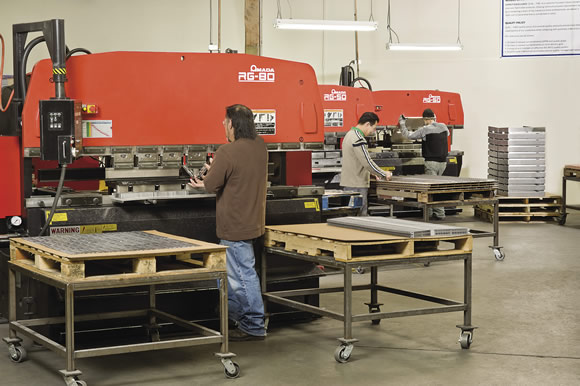
A press brake forming process in which the operator produces a part with six bends that must meet a specified tolerance of ±1° for angle accuracy and ±0.020″ for size.
QUAL-FAB is early into the formalization of the SOJT program, but is using a program approach tested and effectively used at other companies. In many instances at SMMs, training is informal, with an incumbent employee or supervisor showing how an operation is performed. The hope is that a new employee absorbs most of what is needed to do the job. Formalizing the training process creates templates for the operations and includes metrics to measure progress. By accessing other CAMPS member-company templates, the value of best practices is an added benefit.
Another approach is for manufacturers to invest in automation technology that obviates the need for more workers, but this poses its own set of problems. Automation is expensive, both in terms of the initial capital investment and the costly, highly skilled labor required for implementation and ongoing support.
In addition, not all manufacturing jobs can be automated. In a sheet metal job shop, for example, adding hardware to a formed part in a specified sequence poses challenges automation does not easily solve. To effectively automate processes involves adding multiple hardware items and requires automated feed controls. Unless there is enough volume, the cost vs. benefits derived normally don’t pencil out. Williams pointed out that he has invested more than $3.5 million in capital equipment, of which $1 million is tooling. Employees must know how to select, use and handle this equipment before they turn it on to cut or form material.
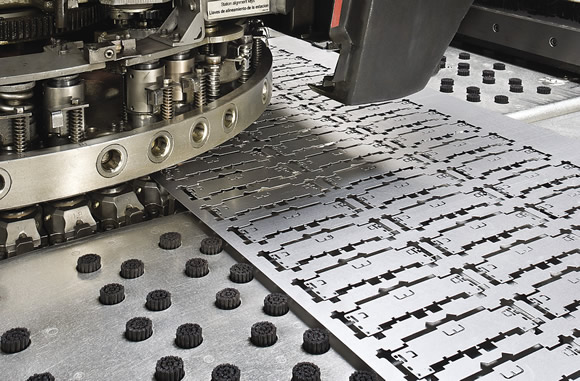
A CNC turret punch press stamps a cassette chassis in a nested blank to a ±0.010″ tolerance.
As a result, when companies like QUAL-FAB invest in new technology, they must still rely on comprehensive SOJT programs. Investing in modern equipment that combines manufacturing processes, such as laser cutting with traditional turret punch presses, provides an opportunity for lean process improvement in a shop. Furthermore, the introduction of new technology has a noticeable positive impact on workplace morale, according to Williams. It demonstrates the company’s commitment to its customers and workers while providing a new challenge for those workers to demonstrate their continued mastery of manufacturing processes.
Leveraging Resources
Smaller manufacturers usually do not have the resources to develop and implement SOJT programs by themselves, making an organization like CAMPS an ideal venue for SMMs to leverage shared resources. Red Dot Corp., a Seattle manufacturer of HVAC equipment for heavy-duty commercial and military vehicles and one of the larger manufacturers in the CAMPS organization, is helping to organize such an effort.
Through the CEO Council, a subgroup of CAMPS member-companies composed exclusively of owners and CEOs and led by Red Dot President and CEO Randy Gardiner, CAMPS members are directly sharing SOJT resources, including curricula, manuals, best practices and lessons learned. This allows the smaller manufacturers in the CAMPS organization to benefit from the greater resources of larger manufacturers. It also allows larger companies to strengthen, develop and vet the capabilities of smaller manufacturers, expanding opportunities for successful vendor relationships in the future.
As SMMs continue to address the challenge of workforce development, many are recognizing the critical role of SOJT in solving this problem. Organizations like CAMPS can amplify and simplify their efforts, sharing programs and best practices to help SMMs get the most value out of their individual SOJT programs. CTE
Glossary terms in this article
Related



Subscribers can use MFGAxis notes, saves and discussion tools with their innoNET account.


