
Gantry milling machine's modular design offers versatility and customization

Published Date
December 01, 2025
Gantry milling machine's modular design offers versatility and customization

The FZP37 gantry milling machine from Zimmermann has a modular design that allows the use of different operating ranges and the use of different brands of CNC controls. Its gantry construction makes it possible to machine components of all kinds. This gantry milling machine boasts a substantial working range, from 118"-1575"; in the X-axis, 98"-236" in the Y-axis and 49"-118" in the Z-axis.
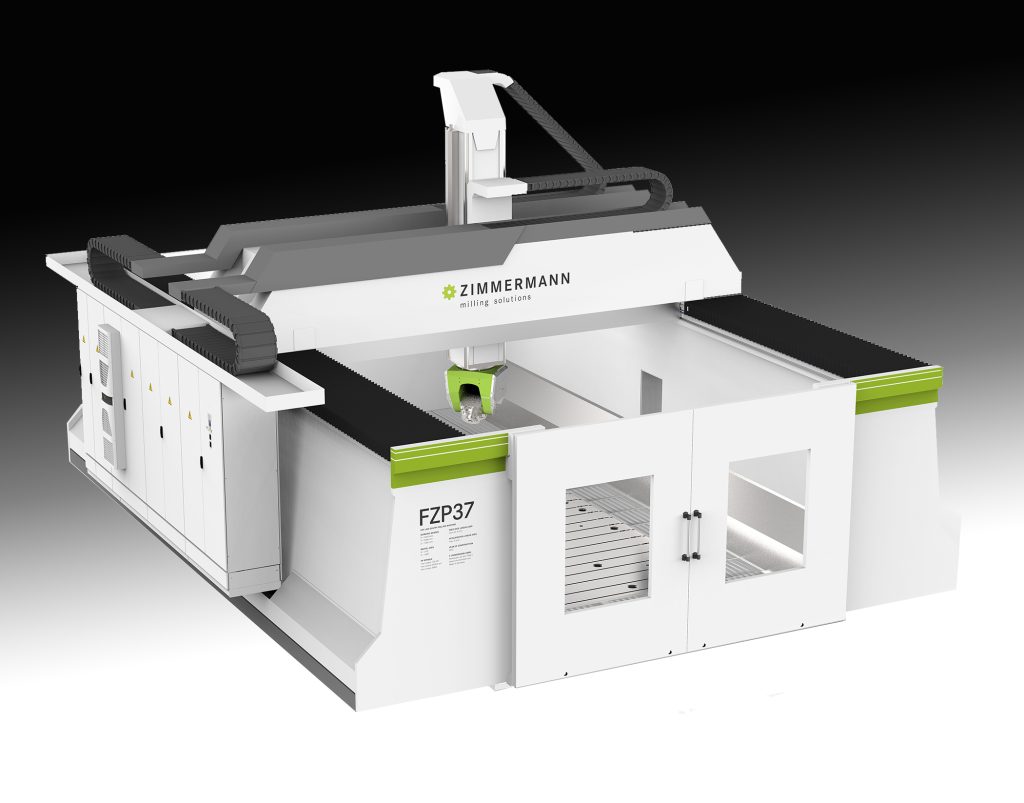
The length of the machine table ranges from 118"-1575”, with a width between 98"-236". It’s firmly anchored to the machine base, which the company says provides a stable cutting surface for material. The milling process is highly precise, regardless of weight and size, according to the company.

Its structurally rigid center lead portal, the cross- and Z-slides and the dynamic milling heads facilitate a consistent, efficient milling process. The feed rate is up to 2362 ipm with an acceleration rate of up to 197 in/s². Users can choose from either a Heidenhain TNC 7 or a Sinumerik One CNC control. Several milling heads are offered on the machine to suit a variety of applications.

Because of a combination of high thermal stability and structural rigidity, these machines meet all the requirements of model making, tool and mold construction, including the demands of the aerospace and automotive industries. Additionally, the company says its versatile 5/6-axis of the FZP37 is also suitable for machining workpieces in shipbuilding and the alternative energy industry.

Optional equipment includes a tool probe, tool measuring system, work area cover, tool changer, chip conveyor and a mist/dust extraction system. Also available are lubricant cooling, minimum quantity lubrication, vacuum system and a dust extraction bell.
Related Glossary Terms

  • computer numerical control ( CNC)

    computer numerical control ( CNC)

    Microprocessor-based controller dedicated to a machine tool that permits the creation or modification of parts. Programmed numerical control activates the machine’s servos and spindle drives and controls the various machining operations. See DNC, direct numerical control; NC, numerical control.

  • feed

    feed

    Rate of change of position of the tool as a whole, relative to the workpiece while cutting.

  • gang cutting ( milling)

    gang cutting ( milling)

    Machining with several cutters mounted on a single arbor, generally for simultaneous cutting.

  • inches per minute ( ipm)

    inches per minute ( ipm)

    Value that refers to how far the workpiece or cutter advances linearly in 1 minute, defined as: ipm = ipt 5 number of effective teeth 5 rpm. Also known as the table feed or machine feed.

  • milling

    milling

    Machining operation in which metal or other material is removed by applying power to a rotating cutter. In vertical milling, the cutting tool is mounted vertically on the spindle. In horizontal milling, the cutting tool is mounted horizontally, either directly on the spindle or on an arbor. Horizontal milling is further broken down into conventional milling, where the cutter rotates opposite the direction of feed, or “up” into the workpiece; and climb milling, where the cutter rotates in the direction of feed, or “down” into the workpiece. Milling operations include plane or surface milling, endmilling, facemilling, angle milling, form milling and profiling.

  • milling machine ( mill)

    milling machine ( mill)

    Runs endmills and arbor-mounted milling cutters. Features include a head with a spindle that drives the cutters; a column, knee and table that provide motion in the three Cartesian axes; and a base that supports the components and houses the cutting-fluid pump and reservoir. The work is mounted on the table and fed into the rotating cutter or endmill to accomplish the milling steps; vertical milling machines also feed endmills into the work by means of a spindle-mounted quill. Models range from small manual machines to big bed-type and duplex mills. All take one of three basic forms: vertical, horizontal or convertible horizontal/vertical. Vertical machines may be knee-type (the table is mounted on a knee that can be elevated) or bed-type (the table is securely supported and only moves horizontally). In general, horizontal machines are bigger and more powerful, while vertical machines are lighter but more versatile and easier to set up and operate.

  • modular design ( modular construction)

    modular design ( modular construction)

    Manufacturing of a product in subassemblies that permits fast and simple replacement of defective assemblies and tailoring of the product for different purposes. See interchangeable parts.