

Light the beam: Trade Shows & Events
Laser machining has distinct advantages and disadvantages
Lasers and ray guns have been part of our lexicon since H.G. Wells published “The War of the Worlds” in 1898. For the common person in the early part of the 20th century, lasers were tools of destruction in novels and movies. For scientists, lasers were an idea born from a concept put forth by Albert Einstein, who theorized that it was possible to emit light energy from excited atoms.
Drawing from Einstein’s theory, scientists experimented with various methods to generate a working device that would turn theory into reality. Around 1960, the first functional laser was demonstrated, and development accelerated from that point.
Lasers have become ubiquitous in 21st-century life, and this technology that once was confined to laboratory environments can be found on the shelf at the local dollar store. For industry, the development and use of laser technology has altered the metalworking landscape.
Laser technology and the physics needed to explain its operation are complex. For those of us who do not hold a graduate degree in physics, lasers are simply a source of heat that can be controlled with extreme precision. As a heat source, they can be applied in the same manner as other heat sources used in manufacturing processes.
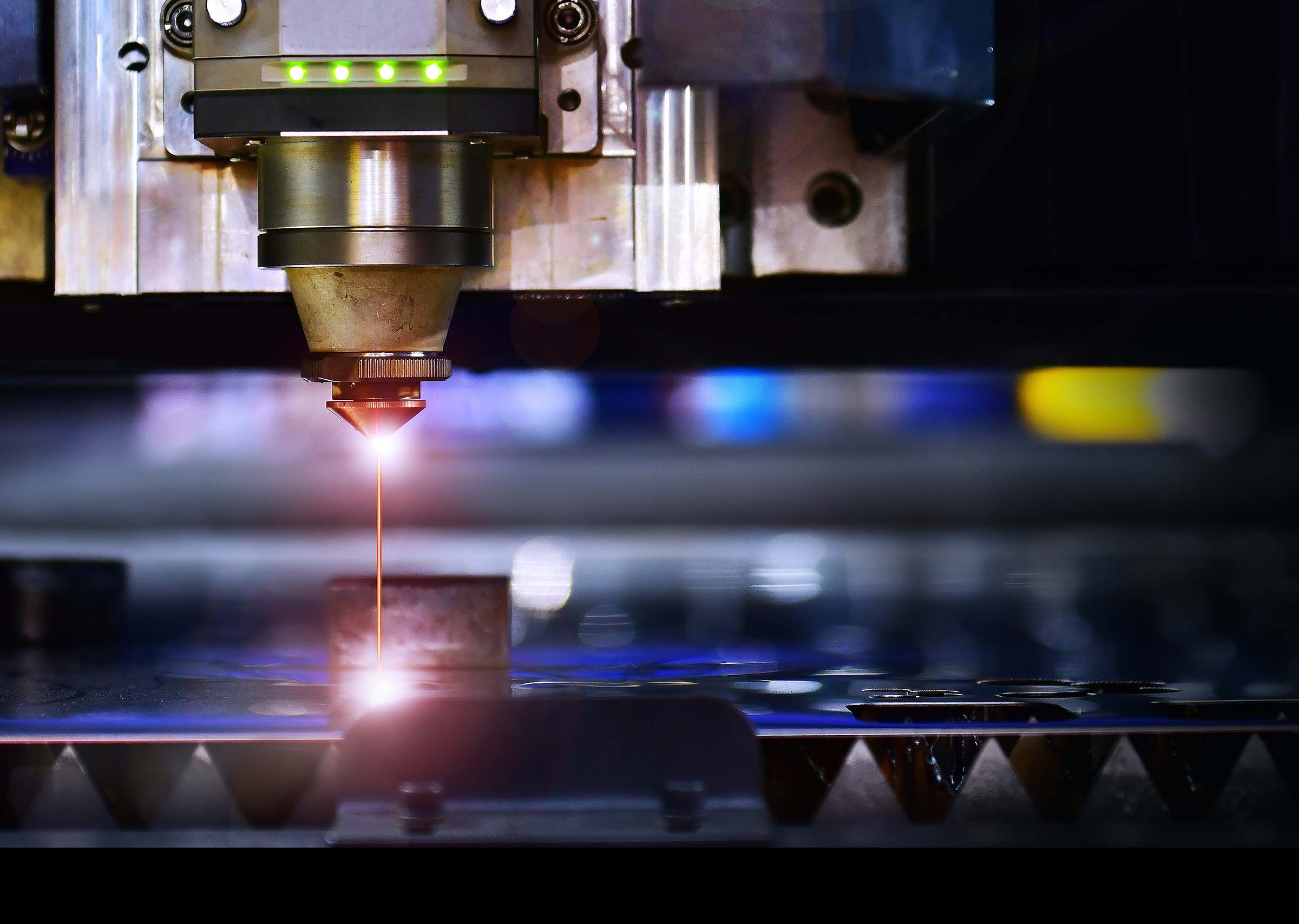
In manufacturing, laser technology is used predominantly for cutting metals. Lasers offer distinct advantages over more traditional thermal cutting methods like oxy-fuel and plasma. With any thermal cutting process, the metal is heated to its melting point and a high-velocity gas ejects the liquefied metal, leaving a void. In all cases, the cut path is left with a rough edge formed when the molten metal solidifies. The cut edge has a dark, oxidized crust commonly known as recast. It is probably no surprise that a recast edge usually is unacceptable.
This rough edge typically must be removed before further processing, which adds time and labor, so improving edge quality reduces processing time and improves productivity. Compared with other thermal processes like plasma, laser cutting is exceptionally clean and provides an almost burr-free edge. In many cases, no post-processing is required before using the laser-cut parts.All thermal processes create an area on the part where the heat has altered the mechanical and chemical properties of the metal. This is called the heat-affected zone. For critical applications, it is necessary to keep the HAZ as small as possible. Because lasers quickly and precisely can apply large amounts of energy to comparatively small areas, the HAZ on laser-cut parts is very small — again, often eliminating the need for further processing before use.
Welding is the second most common use of laser technology for manufacturing processes. Lasers benefit welding for the same reason that they benefit cutting processes. The laser energy is infinitely controllable and can be applied with extreme precision to infinitely small areas. Because of this, precision laser welding is the first choice for difficult applications.
Review the print ads from this magazine to continue
This quick advertiser review unlocks the rest of the article and keeps the full-screen reader focused on the ads instead of the page chrome.
Continue reading
June 2023
 MFGAxis Discussion
Be part of the shop-floor conversation
Like, save, or comment on this CTE story.
MFGAxis Discussion
Be part of the shop-floor conversation
Like, save, or comment on this CTE story.


MFGAxis Discussion