Liquid cool: Drilling Performance
Cutting fluids make it easier to keep your cool when workpieces are difficult to machine.
Whether they are extremely hard and brittle, resistant to heat or unusually gummy, some materials are more difficult to machine than others. When machining these stubborn metals, applying the proper cutting fluid becomes more important than ever. Many metalworking fluids are up to the task, including neat mineral oils, synthetic oils, a blend of the two (typically called semisynthetics), ester-based oils, water-based fluids and vegetable-oil fluids.
Their main purpose is to reduce heat, either by carrying it away from the tool/workpiece interface, reducing the friction inherent to the process, clearing heat-laden chips or some combination of the three. Two of the primary methods for applying fluid are via a high-pressure stream through the tool, essentially injecting the coolant directly into the cut while cooling the tool inside and out, or by flooding the entire workpiece to quench the heat through sheer liquid volume.
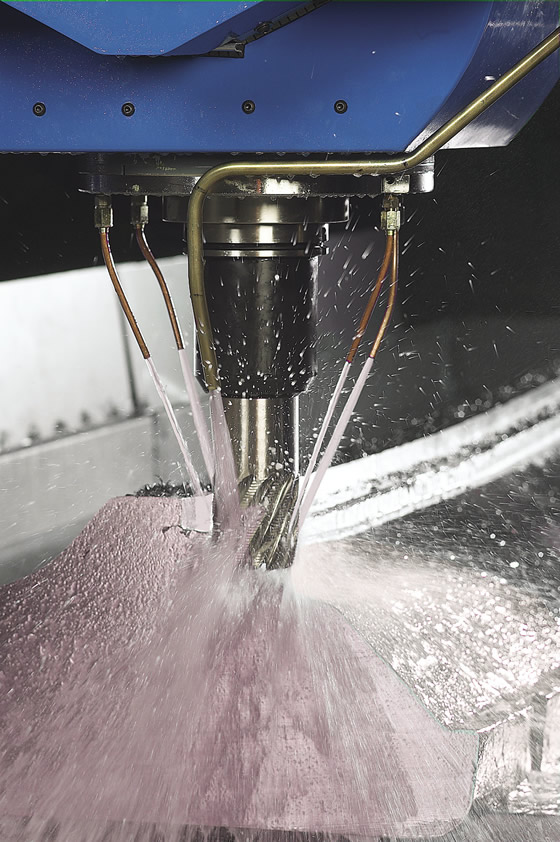
Courtesy of Cimcool Fluid Technology
Cimcool’s CIMTECH 320Z synthetic fluid is approved for aerospace applications and is shown being used on a titanium part.
One way to measure a material’s machining difficulty is in terms of resiliency, according to Scott Walker, president of machine tool builder Mitsui Seiki (U.S.A.) Inc., Franklin Lakes, N.J. “When machining aluminum, which is not a hard or highly resilient material, you literally shear it fast enough to melt the metal right at the cutting edge,” he explained. “That’s opposed to something like titanium, which has a very good modulus of elasticity, which means it will flex and bend a lot but will also always come back to its original shape.”
The melting temperature of resilient materials is typically significantly higher than the melting temperature of the tool’s cutting edge, he continued, meaning that if too much energy is used to cut it, enough heat will be generated to cause the cutting edge to fail.
If this occurs, production rates decrease while tooling costs go up, according to Kevin Tucker, product technology and marketing manager of Cincinnati- based coolant manufacturer Cimcool Fluid Technology LLC. “Sometimes the development of new materials outpaces the ability of the manufacturer to use the material effectively,” he said. “We’ve had shops ask for help because they just can’t make useful parts with the materials their customers expect them to use.”
The Harder They Fall
While there are different factors that can make a material difficult to machine, the hardest-to-cut ones are … well, the hardest—specifically those from 42 to 60 HRC, according to Brett Reynolds, senior applications engineer for Blaser Swisslube, Goshen, N.Y. Free machining metals, such as 1018 mild steel, or relatively soft ones, such as certain aluminum alloys, can typically be machined with most soluble oils or semisynthetic fluids without any additives. However, with very hard or resilient materials, such as martensitic or austenitic stainless steels, titanium or high-nickel alloys like Inconel 718, Reynolds continued, the best results are obtained by using an extreme-pressure (EP) additive package, regardless which type of fluid is chosen.
He explained that an EP additive package protects a cutting tool at temperatures up to 1,100° F (520° C) by forming a chemically reactive film between the cutting tool and metal chip interface, which reduces friction and aids in the cutting process (see “Know your additives” sidebar below).
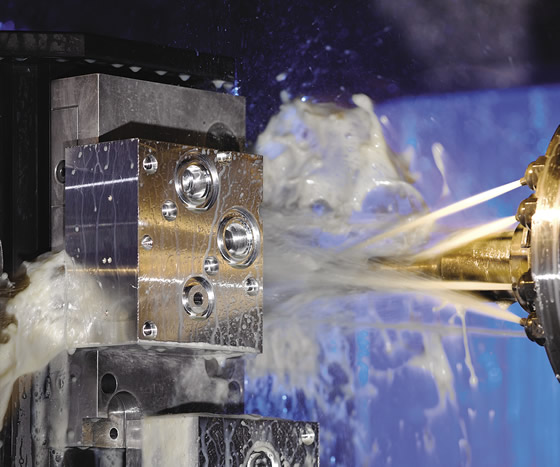
Courtesy of Chemetall
Semisynthetic fluids like Chemetall’s Tech Cool 35048BF combine cooling and lubricity.
Additive packages can vary from manufacturer to manufacturer; some of these additives function by introducing chemicals whose physical properties change as the temperature rises to create a protective layer between the tool and workpiece. The additive layer lowers the cutting force and improves the surface finish by reducing friction, and the EP additives create a precise area of controlled oxidation to render the material easier to machine, according to Hank Limper, market development manager for Houghton International Inc., Valley Forge, Pa.
When cutting steel with a chlorine-fortified coolant, he explained, the coolant transforms the iron into iron chloride at the precise point of the cut. And when machining aluminum with phosphorous present in the coolant, the result is aluminum phosfide. “Because this reaction is so controlled and localized, the workpiece itself is not grossly altered from a metallurgical viewpoint, but the metal right at the point of contact with the tool is transformed into something easier to machine,” Limper said.
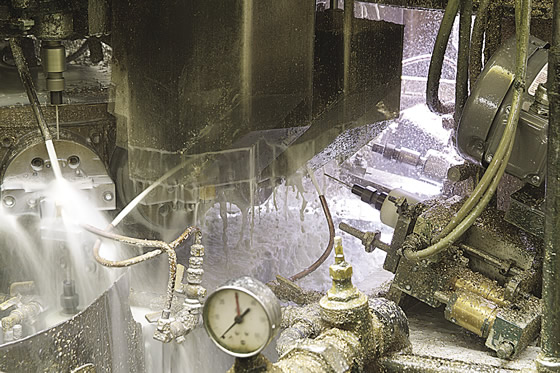
Courtesy of Houghton International
Flood coolant quenches the heat of machining operations by applying high volumes of fluid, such as this Hocut 795 series coolant from Houghton International.
“There are engineering guides that define machinability for metals,” he continued, “but, frankly, over years of experience you start to understand the characteristics of different alloys. Very soft metals are difficult because they can get ‘draggy’ and weld to the cutting edge; other alloys are difficult because the alloying components have been added specifically to make the material harder and tougher, to give them the metallurgical properties you would desire from the finished part. The flipside is those same properties often translate to very difficult machining, which means the cutting fluid is extremely important.”
Type Cast
While EP additives are beneficial, the fluid itself is obviously significant as well. Whether a synthetic, a soluble oil or a semisynthetic is utilized, the water used to dilute the product to operational concentration is the most effective component at lowering the temperature in the cutting zone; however, water does not provide the necessary lubrication to cut metal. The lubricity components, such as mineral oil, vegetable oil, polymers or other synthetic materials, serve to reduce friction and aid in obtaining the desired part finish.
Statistically, Houghton’s Limper believes synthetic coolants as a class of products to be more corrosive to painted sumps, seals and moving metal parts than oil-based fluids. On the other hand, neat cutting oils are extremely lubricious, but can make floors slippery and even catch fire when used during high-speed machining because they simply do not dissipate heat as well as a water-dilutable fluid.
David Enright, business manager for New Providence, N.J.-based coolant manufacturer Chemetall, generally finds that semisynthetics and soluble oils provide the best balance of cooling and lubrication. However, his company decides what specific fluid is best for the job by conducting a detailed audit of the job to be performed, including machine tool setup and cutting tools employed.
“The audit includes asking the tooling people how they determine that particular tools are the ones they want to use for the job, and what specific end result they want,” he said. “If a prospect is adamant about using a synthetic, there’s a variety that we can recommend, but, personally, I’m biased toward using semisynthetics with difficult materials, because you get the best of both worlds.”
Mitsui Seiki’s Walker prefers pure oil, regardless of the workpiece, but acknowledges the drawbacks.
“Oils don’t evaporate,” he explained, “and when you’re cutting resilient materials that generate a lot of heat, the water in some coolants will evaporate. But oils are flammable and they’re pretty bad for the environment, so a lot of people don’t want to use them.”
Under Pressure
How coolant is applied is another significant variable, but while flood is the standard approach to most machining jobs, high-pressure, through-tool coolant has become much more common and is frequently utilized in today’s manufacturing environments.
“It seems to me that everybody is running high pressure, especially since the cost has come down on these units in the last 10 years,” said Blaser Swisslube’s Reynolds. “Frankly, it’s pretty rare to see a machining center sold without a high-pressure coolant system.”
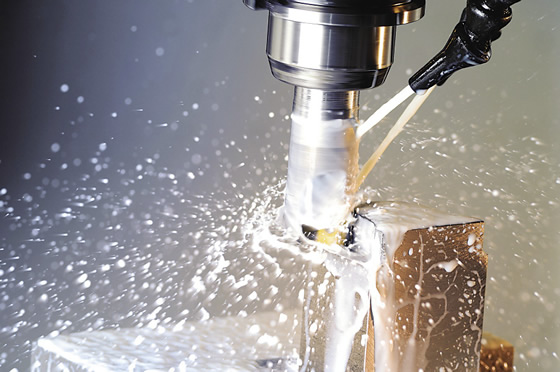
Courtesy of Chemetall
Chemetall’s Tech Cool 35052CF is a chlorine-free cutting fluid for resilient materials.
The idea behind high-pressure coolant, he continued, is that in addition to providing cooling and lubricity, the fluid creates a hydraulic wedge between the cutting tool and the chip, helping to break and separate the chip from the workpiece and blast it out of the way.
Review the print ads from this magazine to continue
This quick advertiser review unlocks the rest of the article and keeps the full-screen reader focused on the ads instead of the page chrome.
Advertisers included in this article experience
Print placements connected to this article
Iscarmetals
MAX AR
) B Ultimate Insert Clamping Guarantees Supreme Tool Life Jet Pressure with Free Unobstructed Unique Chipbreakers Chip Flow for Ultimate for Ultimate Insert Life Blade Life Parting and Parting and Parting and Parting and Parting and Parting and Parting and Grooving Grooving for Grooving for Grooving for Grooving for Grooving for Grooving for for Cr-Ni Alloys.
) MAX AR B Ultimate Insert Clamping Guarantees Supreme Tool Life Jet Pressure with Free Unobstructed Unique Chipbreakers Chip Flow for Ultimate for Ultimate Insert Life Blade Life Parting and Parting and Parting and Parting and Parting and Parting and Parting and Grooving Grooving for Grooving for Grooving for Grooving for Grooving for Grooving for for Cr-Ni Alloys, Hard Materials Hard Materials Hard Materials Soft Materials Soft Materials Stainless Steel Ductile Materials and
Visit Iscarmetals View this placement in the issue recordPrint ads from this magazine
) B Ultimate Insert Clamping Guarantees Supreme Tool Life Jet Pressure with Free Unobstructed Unique Chipbreakers Chip Flow for Ultimate for Ultimate Insert Life Blade Life Parting and Parting and Parting and Parting and Parting and Parting and Parting and Grooving Grooving for Grooving for Grooving for Grooving for Grooving for Grooving for for Cr-Ni Alloys.
) MAX AR B Ultimate Insert Clamping Guarantees Supreme Tool Life Jet Pressure with Free Unobstructed Unique Chipbreakers Chip Flow for Ultimate for Ultimate Insert Life Blade Life Parting and Parting and Parting and Parting and Parting and Parting and Parting and Grooving Grooving for Grooving for Grooving for Grooving for Grooving for Grooving for for Cr-Ni Alloys, Hard Materials Hard Materials Hard Materials Soft Materials Soft Materials Stainless Steel Ductile Materials and
Continue reading
May 2014
“We usually see through-tool coolant run at 1,000 to 1,500 psi,” he said, “but for really difficult materials, some companies are pushing the envelope as high as 2,000 psi, which is very demanding on the fluid.”
At a high enough pressure, the coolant can foam due to air entrainment—and air is a notoriously poor lubricant.
“Historically, lubricants that could perform at this level were often foamy due to their molecular structure,” said Cimcool’s Tucker. To address this issue, Cimcool and other coolant companies have developed low-foaming fluids that maintain lubricity. However, even the best formulations can run into trouble at extreme pressures.
“A lot of times we see machines turning over the sump every 2 to 3 minutes, where we recommend a minimum of 5 to 7 minutes rest interval time,” Reynolds said. This shortened interval dramatically decreases cutting performance because an aerated fluid recirculates. The high fluid turnover, he explained, is due to increasing customer demands for a more compact machine tool footprint, which in turn requires a smaller coolant sump.
“Increasing the sump capacity can greatly reduce the foaming potential of the fluid,” Reynolds said. “This is due in part to the fluid having more rest time in the coolant sump. Also, the greater the sump capacity, the greater the heat-dissipating ability the fluid will have. When a cutting fluid becomes warm, the potential for foam increases, so if the coolant volume is insufficient, a coolant chiller may be necessary.”
Mind Your Monitor
Whatever approach is chosen, metalworking fluid is an important tool when cutting difficult-to-machine materials. Monitoring and maintaining the concentration of the cutting fluid to know when to replenish it is the single most important thing a user can do to avoid trouble, according to Houghton’s Limper.
“In theory, the more difficult the machining operation, the greater the loss of the raw materials that are formulated into the coolant to provide lubricity and machinability,” Limper said, “so you might deplete that fluid sooner than you otherwise would in a very simple machining operation. However, our experience is that, more often than not, simply adding extra coolant right out of the drum and as needed to maintain proper concentration will suffice. Concentration is the most important indicator on your dashboard.”
Chemetall’s Enright added that the workpiece material makes no real difference in monitoring.
“There are certain parameters to look at in every machining operation,” he said, “and whether you’re machining a Hastelloy or some easy aluminum alloy, the factors that are monitored are basically the same. No matter what you’re machining, you want to make sure the fluid is being replenished.” CTE
Contributors
Blaser Swisslube Inc.
(845) 294-3200
www.blaser.com
Chemetall
(800) 526-4473
www.chemetallamericas.com
Cimcool Fluid Technology LLC
(888) 246-2665
www.cimcool.com
Houghton International Inc.
(800) 666-4684
www.houghtonintl.com
Mitsui Seiki (U.S.A.) Inc.
(201) 337-1300
www.mitsuiseiki.com
Unist Inc.
(800) 253-5462
www.unist.com
Know your additives
Different EP additives have unique properties, making them well-suited for different applications. Chemetall’s David Enright offered the following insight into the three most common extreme-pressure additives.
- Sulfur has the greatest ability to handle heat and pressure, but is the most corrosive, especially on nonferrous metals. It can also produce biological problems in the fluid. Activation temperature range is 1,100° F to 1,800° F (593° to 982° C).
- Chlorine also handles heat and pressure well and is much less corrosive than sulfur. Its lower activation temperature also makes it effective on nonferrous metals, specifically aluminum. Activation temperature range is 400° F to 1,100° F (204° to 593° C).
- Phosphorus is the least active of the three. It is noncorrosive but can cause biological problems and ecological difficulties if wastewater is not properly treated. Activation temperature range is below 400° F.
—E. Jones Thorne
Some insist on mist for difficult-to-machine materials
While flood and through-coolant are the most prevalent methods of delivering cutting fluid to a workpiece, another method exists—minimum quantity lubrication, or MQL, in which lubricant is measured in drops, not gallons.
“The aim of a coolant, essentially, is to use a high quantity of liquid to transfer the heat away from the tool and the workpiece,” said Tim Walker, senior vice president of MQL equipment and fluid manufacturer Unist Inc., Grand Rapids, Mich. “We simply try not to generate as much heat in the first place.”
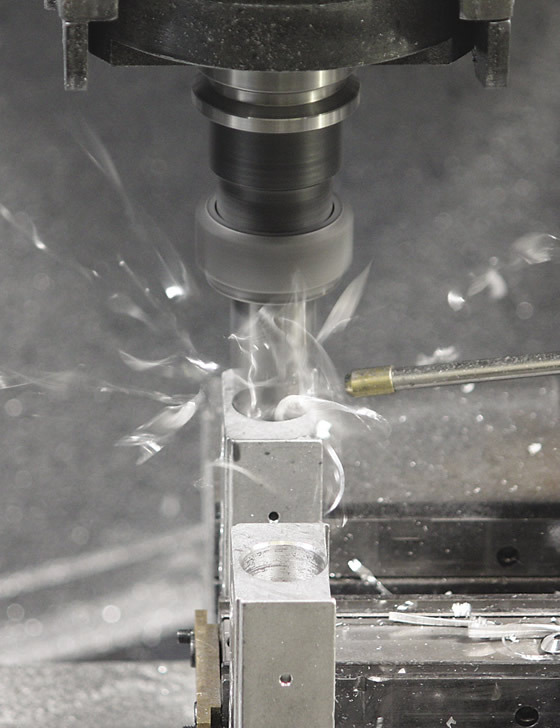
Courtesy of Unist
An aluminum drilling operation with a Unist MQL applicator shown on the right.
Unist’s system delivers a neat oil which is aerosolized directly onto the workpiece/cutting tool interface, typically used with a second nozzle using high-pressure air to clear chips, which carry much of the heat with them. Because there is no excess fluid, there’s no reservoir, sump, fluid recycling, rancidity issues or health hazards. The entire “waste disposal” process consists of dropping the empty jug in the shop’s recycling bin, Walker said.
Even on difficult machining jobs, MQL can be effective, especially when combined with multilayer coated tools—the specific coating will vary based on the materials and cutting parameters, he said, but TiA1N often works well. When cutting hard materials, the lubricant and the coating work together to create a lubricious layer between tool and workpiece, Walker explained, reducing heat by lowering friction, without the mess typically associated with large amounts of coolant. That same lubricious layer helps when machining gummy materials, he continued, because the barrier on the tool prevents built-up edge.
“Typically, if you’re going to apply MQL externally, you’ll want a relatively low air pressure, enough to aerosolize the oil and get it to the tool, but not too much, which would blast it really hard. The latter will create a mist of lubricant in your workshop and that’s unpleasant for everyone,” he explained. “However, in deeper drilling applications when the tool is buried inside the workpiece, you can actually go high-pressure, through-tool MQL. You’re putting in the same amount of oil, you’re using the high-pressure air to blast the chips back out, and you’re not worried about creating a mist of oil because the tip is inside the work.”
Unist has sold more than 63,000 MQL systems, according to Walker, with many of them being equipment retrofits. Some shops, however, decide to purchase machines specifically designed for MQL to get the most out of their machining processes.
“Some shops want the performance that comes with two-channel, through-spindle MQL and in this case a retrofit can be intrusive into the machine and, therefore, expensive,” he explained. “Instead, many shops choose to use a combination of external nozzles and single-channel, through-spindle MQL on their machines. This comes with some technical compromises in performance, but is often the best choice when looking at the performance-to-price ratio.”
—E. Jones Thorne
Glossary terms in this article
Related


Subscribers can use MFGAxis notes, saves and discussion tools with their InnoNet account.