Hybrid manufacturing essentials: Design & Engineering
There are cutting tool considerations when machining molds and other complex components using hybrid manufacturing technology.
Hybrid additive manufacturing is a process in which selective laser melting in a powder bed is combined with subtractive three-axis milling in a single hybrid machine tool. Although selective laser melting is the most frequently used AM technology, other appropriate technologies include laser metal deposition, direct metal deposition and metal powder application.
On one hand, hybrid AM achieves significantly higher part accuracies and surface qualities than are possible with conventional laser melting in a powder bed. On the other hand, zero-point definition through machine-integrated spindle coordinate systems makes it possible to generate precise reference and clamping surfaces for the downstream process chain. This capability minimizes the downstream process chain, especially with toolmaking, moldmaking, rapid prototyping and small series production, as well as providing new possibilities in terms of designs, structures and material properties.
One of the main advantages with hybrid AM is saving costs by reducing machining waste and scrap. Consider a block of 45-kg (100-lb.) steel placed in a CNC machine. If the finished part weighs only 11 kg (25 lbs.), this means that 34 kg (75 lbs.) of scrap is tossed in the chip bed. It is therefore prudent to consider hybrid AM.
Tool Trends
Cutting tools have evolved to support the subtractive part of the AM process and offer geometric shapes and coatings relative to the layering process with abrasive properties and toughness characteristics of the tool sintering procedure.
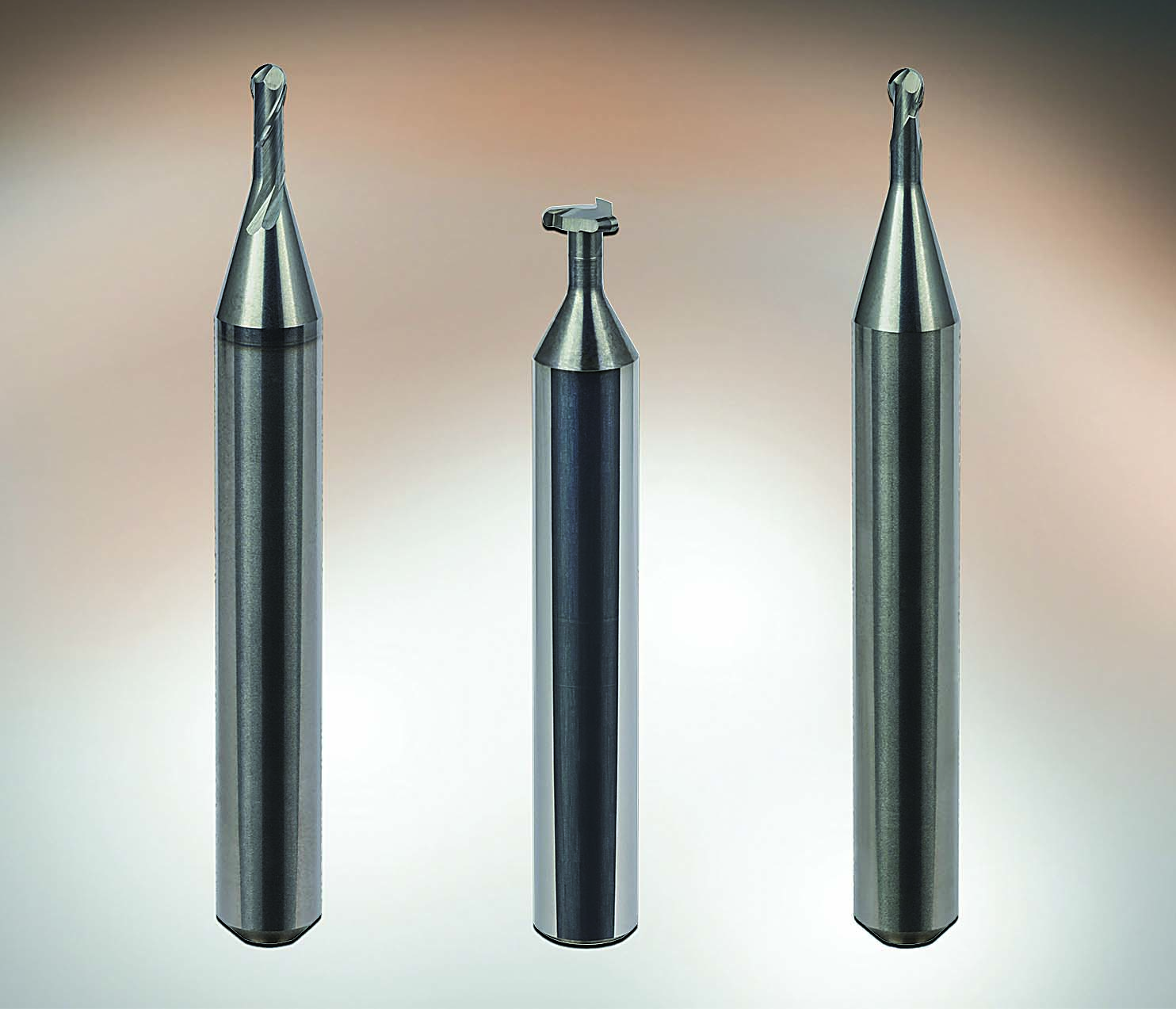
A selection of endmills is available from Emuge for hybrid manufacturing applications. Image courtesy of Emuge
For optimal results, select endmills specially designed with the right geometries, tool substrates and coatings for machining molds and other components that have been additively manufactured. The selection of workpiece materials includes titanium and aluminum alloys; nickel-chrome-iron; and tool, stainless and cobalt-chrome steel. For example, ballnose and radius endmills should have a special neck design optimized to minimize deflection and enhance stability. This design imparts a fine surface finish while extending tool life.
Review the print ads from this magazine to continue
This quick advertiser review unlocks the rest of the article and keeps the full-screen reader focused on the ads instead of the page chrome.
Advertisers included in this article experience
Print placements connected to this article
800.833.2239 www.amamcotool.com
READY TO SHIP:
composite routers Some of our most popular designs are now THE RIGHT in stock, ready to ship when you need them. TOOL… We’ve just launched the new F108 KC Router, with a serrated concept to cut RIGHT NOW! Kevlar, fiberglass, or CFRP composites. We can optimize it for roughing or finishing. To request a quote call or visit us online
READY TO SHIP: composite routers Some of our most popular designs are now THE RIGHT in stock, ready to ship when you need them. TOOL… We’ve just launched the new F108 KC Router, with a serrated concept to cut RIGHT NOW! Kevlar, fiberglass, or CFRP composites. We can optimize it for roughing or finishing. To request a quote call or visit us online. 800.833.2239 www.amamcotool.com
Visit 800.833.2239 www.amamcotool.com View this placement in the issue recordPrint ads from this magazine
composite routers Some of our most popular designs are now THE RIGHT in stock, ready to ship when you need them. TOOL… We’ve just launched the new F108 KC Router, with a serrated concept to cut RIGHT NOW! Kevlar, fiberglass, or CFRP composites. We can optimize it for roughing or finishing. To request a quote call or visit us online
READY TO SHIP: composite routers Some of our most popular designs are now THE RIGHT in stock, ready to ship when you need them. TOOL… We’ve just launched the new F108 KC Router, with a serrated concept to cut RIGHT NOW! Kevlar, fiberglass, or CFRP composites. We can optimize it for roughing or finishing. To request a quote call or visit us online. 800.833.2239 www.amamcotool.com
Continue reading
October 2020
In addition, a pre-milling ballnose endmill targets roughing and pre-finishing operations to produce a specific machining allowance on an additively manufactured part. The machining direction is from top (z+) to bottom (z-). For finishing operations in a part’s construction layers no longer subject to thermal stress, the finishing cutter, also with ballnose geometry, is recommended. The cutting area of the tool designed for that pull machining from bottom to top enables finishing the material layers that no longer are thermally stressed.
A solid-carbide “back taper” radius endmill, which is similar to a T-slot cutter with a radius, is for 2D machining component undercuts. The endmill specifications are aimed at pre-finishing and finishing on additively produced parts. This tool is suitable for point milling strategies and provides the ability to take deep undercuts.
Overcoming Abrasion
Tool coatings also play a significant role when machining additively manufactured components. For instance, Emuge Corp. in West Boylston, Massachusetts, offers the new ALCR coating, which is an AlCrN-based coating that provides high wear resistance even under severe thermal stress. Because machining must be performed without coolant application as a cutter removes material while partly in the powder bed, the cutting tool experiences a high level of abrasive wear.
Dry machining is necessary for these hybrid AM applications because an inert gas atmosphere and elevated temperatures prevail in the machine chamber. Therefore, the coating prevents adhesion of a built-up edge even when cutting difficult-to-machine materials at elevated temperatures, extending tool life while imparting fine surface finishes.
Some hybrid AM applications may need solid-carbide microendmills designed to meet the demanding requirements of micromachining applications. When this is the case, microendmills with special neck geometries enable these tools to effectively cut deep contours. A high radial bending strength allows the tools to withstand alternating radial stress on the cutting edge and thus on the relieved neck during machining.
Requirements for a cutting tool always depend on the application for which the tool is intended. But in general, the ultimate goal is to find a balance between flexibility and rigidity.