

Getting a grip: Drilling Performance
There are numerous advantages to rigidly holding a workpiece: feed rates can be increased and cutting times reduced, cutters last longer and impart finer surface finishes, and…
There are numerous advantages to rigidly holding a workpiece: feed rates can be increased and cutting times reduced, cutters last longer and impart finer surface finishes, and more-accurate parts are produced.
At trade shows where vendors offer demonstrations, you rarely see flimsy, difficult-to-hold parts being machined. In the real world, however, such parts are common. Holding parts for secondary operations, such as drilling holes on an edge, can also be challenging.

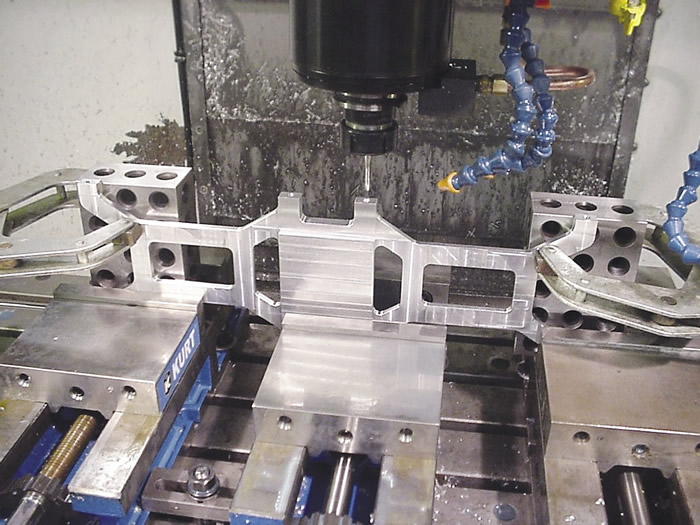
This part is held for edge drilling with the aid of 2-4-6 blocks. All images courtesy J. Harvey.
When presented with a part that is difficult to hold, your ingenuity will be put to the test. However, don’t spend time constructing complex fixtures when you don’t have to. When a standard vise won’t do the job, one option is conventional shop tooling, such as 1-2-3 blocks, 2-4-6 blocks, long parallels, grinding vises, angle plates and V-blocks. These items can effectively provide the added support you need.
Nonetheless, I’ve found that when I finally decide to build a custom fixture, I’m almost always glad I did. Often a fixture is needed to hold parts for perimeter cutting if the material is already at the correct thickness. In these cases, you can’t use excess stock to hold the part.
The following is a simple but effective trick for making fixtures you can bolt parts to. Suppose you are making a part that has no excess material to hold for cutting the perimeter, but has through-holes that can be used for clamping. When you are done drilling, manually tap the fixture through the holes in the part. After that, simply screw the part to the fixture. You are now ready to cut the perimeter. The beauty of this method is you never have to move the part.
Most fixtures can be constructed of aluminum. Our shop has a couple drawers full of simple fixtures that machinists have constructed for various jobs. One of our biggest problems with these fixtures is we don’t have enough room to store them, so they get scattered about, making them difficult to find.
Review the print ads from this magazine to continue
This quick advertiser review unlocks the rest of the article and keeps the full-screen reader focused on the ads instead of the page chrome.
Continue reading
April 2016
Related

 MFGAxis Discussion
Be part of the shop-floor conversation
Like, save, or comment on this CTE story.
MFGAxis Discussion
Be part of the shop-floor conversation
Like, save, or comment on this CTE story.


MFGAxis Discussion