

Drilling stack materials
The aircraft industry now has the means to precisely machine multilayer material combinations. These combinations, called stack materials, include several thin layers of different materials. Aircraft skin, for example, could consist of titanium, aluminum and composite layers, according to Lee Coleman, automation division manager for Suhner Manufacturing Inc., Rome, Ga.
The aircraft industry now has the means to precisely machine multilayer material combinations.
These combinations, called stack materials, include several thin layers of different materials. Aircraft skin, for example, could consist of titanium, aluminum and composite layers, according to Lee Coleman, automation division manager for Suhner Manufacturing Inc., Rome, Ga.
Such combinations may improve end products, but can cause headaches for aircraft manufacturers trying to drill through them, as each material in the stack requires its own parameters for optimal machining. If the materials are drilled with the wrong speed and feed rate, the process won’t produce clean holes, Coleman said.
That’s why the French firm Somex, a member of the Suhner group of companies, developed an alternative to the pneumatic drills commonly used in the aircraft industry. In addition to their considerable air consumption and noise emissions, these pneumatic drills have fixed spindle speeds and feed rates, so they can’t be adjusted to the different material conditions encountered while moving through stack materials.
By contrast, Coleman noted, Somex’s new L-MAX is a CNC drilling unit that can be programmed to run at different speeds and feeds for each material in a stack and drill holes that meet the aircraft industry’s stringent quality standards. The L-MAX “is your only option when you’re dealing with stack materials that need to be cleanly drilled,” he said.
The L-MAX features two servomotors that work in conjunction with each other, one that drives the spindle and another for the feed. The motors are connected to a control system that lets users regulate the speed and feed at any point during drilling operations.
Another key L-MAX feature is its “adaptive drilling” mode. In this mode, the drill automatically recognizes the transition from one material layer to another and matches the speed and feed to the new material conditions.

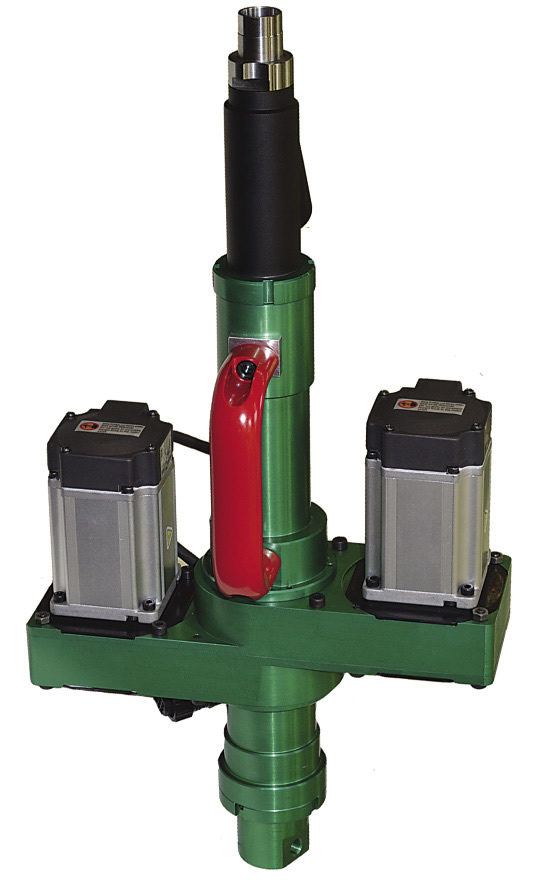
The portable L-MAX is designed to drill clean holes in stack materials. Image courtesy Somex.
Review the print ads from this magazine to continue
This quick advertiser review unlocks the rest of the article and keeps the full-screen reader focused on the ads instead of the page chrome.
Advertisers included in this article experience
Print placements connected to this article
Hainbuchamerica
We have all heard the phrase WORK SMARTER, NOT HARDER. Makes sense, right? In times
We have all heard the phrase WORK SMARTER, NOT HARDER. Makes sense, right? In times Contact Hainbuchamerica at 1.800.281.5734 or visit hainbuchamerica.com.
Visit Hainbuchamerica View this placement in the issue recordPrint ads from this magazine
We have all heard the phrase WORK SMARTER, NOT HARDER. Makes sense, right? In times Contact Hainbuchamerica at 1.800.281.5734 or visit hainbuchamerica.com.
Continue reading
June 2016
“We’re not only monitoring the position of the drill but also its torque feedback,” which changes based on the amount of power needed to drill through a particular material, Coleman explained. “When the position and torque feedback tell the drill that it’s going from one material to another, the settings quickly change and the unit continues to drill” at the optimal speed for the material.
For adaptive drilling to work, the L-MAX must be customized for each application. “We recommend that customers send us test pieces and let us do several test runs,” Coleman said, adding that his company works closely with toolmakers to determine the optimal feed rates for different applications.
During the customization process, the L-MAX can be programmed to allow it to drill through several different materials. One “recipe,” for example, might be suitable for drilling through layers consisting of three different materials, but another recipe would be needed to drill through the same materials in the same order but with different thicknesses.
At a user’s plant, the L-MAX unit is rolled to the drilling location, where the operator takes the drill by its two handles and locks it in place on a fixture, then returns to the control panel to operate the drill.
Coleman said the unit’s portability is a big advantage in an aircraft plant, where an assembly line can’t be set up for drilling holes. “They may only be doing 10 or 15 aircraft a month, and they might have 100 holes to drill in each aircraft in different locations.”
Another L-MAX advantage touted by Somex is quieter-than-normal drilling. The unit’s 65-dBA maximum noise level is significantly lower than that of pneumatic drills, the company claims.
On the other hand, the L-MAX costs more than conventional aircraft drilling options. Coleman provided an approximate price range of $30,000 to $45,000 for a complete L-MAX unit. Reasons for the hefty price tag include the customization required for each application, the use of servomotors rather than conventional AC motors and the unit’s special servocontrol station.
The L-MAX is “expensive,” he said. “But if the customer needs that precision, then it’s worth it.”
Glossary terms in this article
Related


 MFGAxis Discussion
Be part of the shop-floor conversation
Like, save, or comment on this CTE story.
MFGAxis Discussion
Be part of the shop-floor conversation
Like, save, or comment on this CTE story.


MFGAxis Discussion