

Diaphragm chucks offer high-end holding
Diaphragm chucks are ideal for thin-walled parts or parts made with delicate materials, according to the Workholding column in the August 2014 issue of Cutting Tool Engineering…
When I was working in a machine shop in 1981, Vern moved me from hand screws to NC lathes. My first task there was turning Inconel stator rings. “This’ll give you something to cut your teeth on,” he said, laughing.
Thin like a slice off a soup can, the rings required a 0.001″ tolerance on the bore and concentricity of half that for the chucking diameter. After 2 days and a box of scrap parts, I convinced Vern that collets and 3-jaw chucks weren’t going to cut the mustard and got him to spend $5,000 on an air chuck and a set of pie jaws. Boy, did he gripe about the price.
With the air chuck, the tolerances became manageable, but barely—triangulation remained a problem no matter how accurately I bored the jaws and the chuck would start to open around 2,000 rpm, so I never could achieve the spindle speeds I wanted. The good news is Vern gave me a nice raise.
In hindsight, a diaphragm chuck would have been a better solution. Lee Flick, vice president of workholding supplier Pioneer N.A., Elk Grove Village, Ill., said diaphragm chucks are ideal for parts like these. “The advantage is very accurate control of clamping pressure. You can grab thin-walled parts or delicate materials, such as glass or plastic, without damaging the workpiece,” he said.
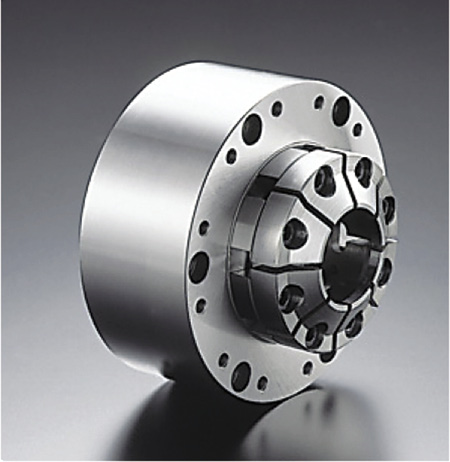
All images courtesy Pioneer N.A.
A diaphragm chuck from Pioneer N.A.
Flick explained that diaphragm chucks use an expanding gland. This means there are no sliding parts as in a conventional chuck. Imagine bolting a set of jaws to the face of a steel pie tin. When you push on the opposite side of the tin, right at the center, the jaws open. Load a part, release the pressure and the metal returns to its original shape, thus securing the workpiece (see diagram below).
Granted, the actual mechanism is more complex than our pie tin example, but the lesson is that diaphragm chucks are repeatable and accurate—runout of 0.00002 ” is typical. And because the business end of a diaphragm chuck is smooth, there are no nooks and crannies where bits of metal or grinding grit can hide, making them ideal for abrasive environments, such as grinding and hard turning.
They’re also capable of holding at high speeds. Where my 1981-vintage air chuck gave up the ghost at 2,000 rpm, diaphragm chucks today can easily achieve three times that speed with no loss in clamping force. Paul DeFeo, vice president and COO of workholding provider Northfield Precision Instrument Corp., Island Park, N.Y., said this is possible because diaphragm chucks are easy to counterbalance. “We’ll often place a counterweight on the backside of the diaphragm to counteract the hysteresis effect induced by the jaws. In some cases, we can go up to 15,000 rpm without losing pressure.”
However, a diaphragm chuck is roughly twice the price of that air chuck Vern was so reluctant to buy. They’re not effective at holding shafts and other long, skinny parts either, at least not without tailstock support or chuck modifications. In these cases, Pioneer offers a double-diaphragm chuck that contains two plates and corresponding jaw sets: one to grip the front of a long workpiece and the other to hold the back.
Diaphragm chucks can also be a challenge to set up. All of the suppliers interviewed for this article agreed that the lion’s share of top jaws used on diaphragm chucks are machined and ground by the chuck manufacturer. That’s not to say shops can’t make their own jaws; the process is similar to machining jaws for conventional chucks. But diaphragm chucks are ultraprecision workholding devices and making effective ones requires an expert touch.
Review the print ads from this magazine to continue
This quick advertiser review unlocks the rest of the article and keeps the full-screen reader focused on the ads instead of the page chrome.
Continue reading
August 2014
Related


 MFGAxis Discussion
Be part of the shop-floor conversation
Like, save, or comment on this CTE story.
MFGAxis Discussion
Be part of the shop-floor conversation
Like, save, or comment on this CTE story.


MFGAxis Discussion