Turning hardened materials presents challenges, opportunities
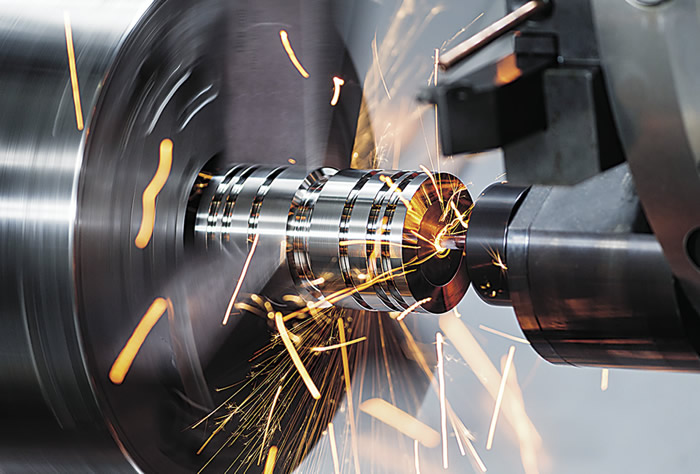
Opinions vary on the definition of hard turning. Some industry experts say it's the single-edge cutting of hardened steels from 58 to 68 HRC, while others suggest hard turning begins at 45 HRC and includes hardened irons and superalloys. All, however, agree it presents difficulties but is quite manageable provided the right cutting tools, machine and process parameters are used.
Hard turning is used to finish a variety of parts, such as bearing journals and races, brake drums and rotors, cylinder bore liners, gears, pinions and splines—or to semifinish those same components prior to grinding. Properly applied, it achieves an accuracy best measured in microns and, in many cases, is faster and more cost-effective than cylindrical grinding.
Opinions vary on the definition of hard turning. Some industry experts say it’s the single-edge cutting of hardened steels from 58 to 68 HRC, while others suggest hard turning begins at 45 HRC and includes hardened irons and superalloys. All, however, agree it presents difficulties but is quite manageable provided the right cutting tools, machine and process parameters are used.

Horn added to its Supermini line for boring workpieces as hard as 66 HRC without the use of PCBN. Image courtesy Horn USA Inc., Nico Sauermann.
Making Choices
Let’s start with cutting tools. Don Graham, manager of education and technical services for Seco Tools LLC, Troy, Mich., said that if the setup is fairly rigid and the correct cutting parameters can be achieved, indexable PCBN inserts are generally the best bet for hard turning.
“A cutting speed of 600 sfm is a good starting point for PCBN,” he said. “We recommend a double-sided round insert where possible, carefully rotating it as the tool wears. Depending on depth of cut, this might provide 10 to 20 uses per side. Some shops are scared off by the relatively high price of these inserts, however. In these cases, we’d likely suggest a PCBN-tipped insert —or even one of our new superhard carbide grades.”
Graham said the company’s TH carbide can successfully turn materials up to 65 HRC and, unlike PCBN, is available in a range of geometries and chipbreaker configurations. And carbide is less prone to breakage in some applications—a casehardened shaft, for example, where it’s possible that softer material might be encountered, which would quickly dissolve the cutting edge and spell near-certain doom for the PCBN insert.
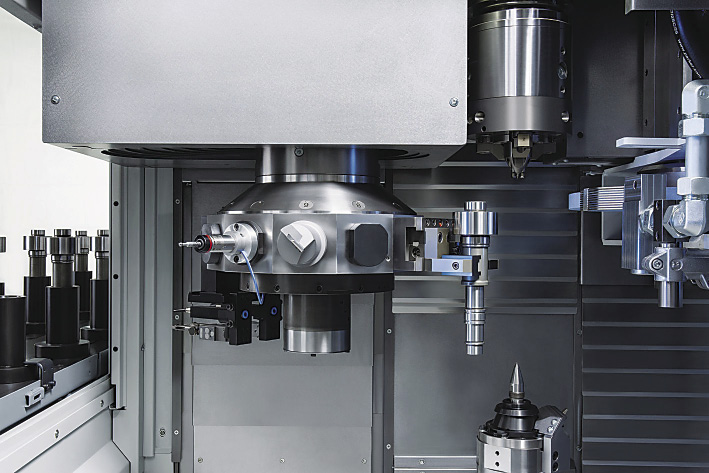
This vertical lathe combines turning and grinding in a single machine. Image courtesy EMAG.
Initially, carbide is also less expensive, although Graham pointed out that cost per edge favors PCBN. “PCBN might cost 10 to 25 times more than carbide, but you’re also going to get 50 to 100 times the tool life. Certainly, for high production, PCBN is the way to go.”
Indexable ceramics are another option. Jack Kohler, applications engineer for Greenleaf Corp., Saegertown, Pa., said the cost of ceramic cutting tools falls somewhere between PCBN and carbide, and offers equivalent or better performance in some applications. “Ceramic does quite well in the 50-HRC to 65-HRC range,” he said. “Cutting speeds would be comparable to PCBN. Figure around 700 sfm on a 55-HRC A-2 tool steel, for example, with only slightly lower tool life.”
Kohler said he’s seeing increased use of ceramic in high-temperature alloys, such as Inconel 718 and Hastelloy, although he warns shops to steer clear of titanium, as this presents a fire risk because titanium chips can burst into flames at the high cutting speeds common with ceramics. Regardless of the metal being cut, ceramic inserts usually come with a slight hone, land or combination of the two at the cutting edge to prevent chipping and increase strength.
Ceramics should be run dry in hardened materials, Kohler said. He recommends Greenleaf’s WG-600 silicon-nitride grade—a CVD-coated version of the company’s whisker-reinforced WG-300—as a good starting point for most hardened steels, as well as its new XSYTIN-1, a phase-toughened ceramic grade designed specifically for high-performance roughing and interrupted cuts.
In or Out?
Some might wonder about the difference between hard turning the inside of a part (boring) and its outside. Most agree that boring is generally more difficult than OD turning, regardless of material hardness. That’s because boring bars are less rigid than other turning tools, creating problems with chatter and tool deflection. Because quarters are often tight in a bored hole, chip evacuation can be a challenge, leading to coolant starvation and workpiece galling. In addition, achieving sufficient surface speeds becomes increasingly difficult for small part features, such as bores, and PCBN and ceramic inserts require high cutting speeds.
The solution, experts agree, is to apply the shortest tool possible relative to tool diameter, preferably no greater than a 4:1 length-to-diameter (L:D) ratio. Boring bars should be on center or, in some cases, a few tenths (0.0003″) above center to allow for deflection. And use a boring insert with a 0° lead angle whenever possible, so cutting forces are directed opposite the direction of cut.
“An often-overlooked component of ID work is accounting for the axial, radial and tangential cutting forces produced when turning,” said Mike Csizmar, regional sales manager at Horn USA Inc., Franklin, Tenn. “This is also true on external operations, but due to the increased L:D ratios associated with boring, these forces become more pronounced, affecting dimensional qualities. If you have a choice, axial (Z-axis) cutting force is preferred. A rule of thumb is that DOC should be equal to or greater than the tool nose radius, thus generating greater axial force. This provides the ability to control chatter, diameter and taper in a more efficient manner, and allows you to get the most out of your cutting tool.”
Enhanced Precision
Review the print ads from this magazine to continue
This quick advertiser review unlocks the rest of the article and keeps the full-screen reader focused on the ads instead of the page chrome.
Advertisers included in this article experience
Print placements connected to this article
Kyoceraprecisiontools
CA3-Series
CVD Coated Carbide for Cast Iron 3 Powerful New Grades & Chipbreakers Extending tool life beyond that of most cast iron turning grades currently on the market, the new CA3-Series with high coating adhesion provides stable machining. 3 unique grades and 3 new K-Series chipbreakers cover a variety of nodular and gray cast iron turning applications
CA3-Series CVD Coated Carbide for Cast Iron 3 Powerful New Grades & Chipbreakers Extending tool life beyond that of most cast iron turning grades currently on the market, the new CA3-Series with high coating adhesion provides stable machining. 3 unique grades and 3 new K-Series chipbreakers cover a variety of nodular and gray cast iron turning applications. Rake Face Condition After Withstanding 3,000 Impacts CA3-Series (CA315) Competitor
Visit Kyoceraprecisiontools View this placement in the issue recordPrint ads from this magazine
CVD Coated Carbide for Cast Iron 3 Powerful New Grades & Chipbreakers Extending tool life beyond that of most cast iron turning grades currently on the market, the new CA3-Series with high coating adhesion provides stable machining. 3 unique grades and 3 new K-Series chipbreakers cover a variety of nodular and gray cast iron turning applications
CA3-Series CVD Coated Carbide for Cast Iron 3 Powerful New Grades & Chipbreakers Extending tool life beyond that of most cast iron turning grades currently on the market, the new CA3-Series with high coating adhesion provides stable machining. 3 unique grades and 3 new K-Series chipbreakers cover a variety of nodular and gray cast iron turning applications. Rake Face Condition After Withstanding 3,000 Impacts CA3-Series (CA315) Competitor
Continue reading
December 2016
Tom Sheehy, applications engineering manager for Hardinge Inc., Elmira N.Y., said hard turning can be performed on virtually any lathe and provides many benefits.
“Hard turning offers lower machine investment, reduced setup and tool inventory, fewer operations, faster cycle times and greater process flexibility,” he said. “Unfortunately, many shops can use it only for semifinishing of parts prior to grinding, primarily because the majority of CNC lathes are unable to achieve the extreme tolerances and form accuracy produced by cylindrical grinding machines.”
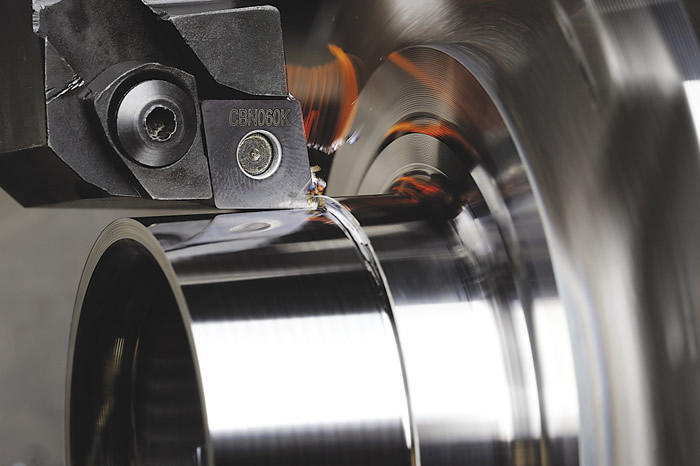
Turning a part with a Seco PCBN-tipped insert. Image courtesy Seco Tools.
CNC grinders are routinely called upon to produce part roundness of 1μm (0.00004″), maintain diametral tolerances of ±2.5μm (0.0001″) and impart surface finishes as fine as 8 rms or finer. Sheehy said the only way a CNC lathe can compete in this arena is if it is designed from the ground up for hard turning.
“Hardinge Super-Precision lathes offer 0.1μm programmable resolution,” he said. “Axial errors are mapped and compensated for electronically. All mating surfaces within the machine are hand-scraped, the linear guide ways and ballscrews are oversized, and the base of the machine is filled with composite polymer for vibration damping. Not only does this produce the accuracy and rigidity needed to replace many grinding operations, it also increases tool life during hard turning by up to 30 percent.”
Despite these capabilities, some parts are not suitable for hard turning. Bearing seals, for example, often call for ground surfaces, which eliminate the possibility of fluid escaping through what is essentially a microscopic thread-wide channel produced by single-point turning. And the “white zone” created when material softens and subsequently rehardens during turning (and grinding to a lesser extent) may cause premature component failure. Sheehy said both of these situations can be minimized with the right tooling and a few process adjustments.
Combining Technologies
Some machine builders, Hardinge included, offer turning and grinding machines, making them trusted advisers on which process is most suitable for a given part. Another is EMAG LLC USA, Farmington Hills, Mich., which also offers machines that grind and hard-turn. The company’s director of sales, Kirk Stewart, agreed that hard turning offers many opportunities for improvement in productivity and part quality, and proper machine design is critical to success.
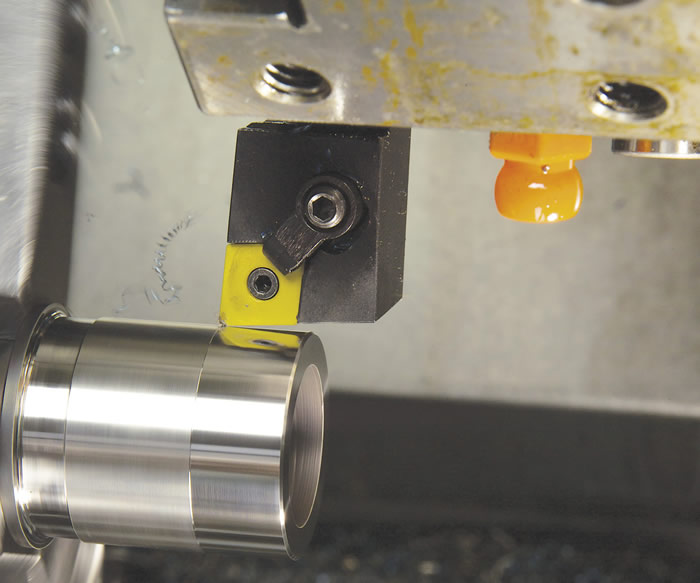
Turning with ceramic inserts is usually done dry. Here the toolholder is mounted face up, driving cutting forces down into the machine’s load-bearing surfaces. Image courtesy Greenleaf.
“A significant benefit of changing from grinding to hard turning is the reduction in capital investment,” Stewart said. “Grinding, however, does have its place and is, in some instances, a faster process when multiple features are ground simultaneously—a situation that is ideal for high-volume applications. Thus, in a high-volume environment, when there are only one or two features that require finishing, hard turning might be the better process for overall capital investment.
“Alternatively, when the machine architecture allows, a combined configuration of turning and grinding can become very attractive for mid-volume requirements, an architecture that EMAG machines inherently provide.”

Contributors
EMAG LLC USA
(248) 477-7440
www.emag.com
Greenleaf Corp.
(800) 458-1850
www.greenleafcorporation.com
Hardinge Inc.
(800) 843-8801
www.hardinge.com
Horn USA Inc.
(888) 818-HORN
www.hornusa.com
Seco Tools LLC
(248) 528-5200
www.secotools.com/us
Glossary terms in this article