Keep it clean and green
Chip handling systems provide "green" benefits to the profitability of a company and its environmental stewardship.n
Manufacturers of machined metal parts leave money on the table when leaving coolant on chips.
For example, if a manufacturer sends a typical scrap shipment of about 18,144 kg (40,000 lbs.) of coolant-laden chips to a recycler, about 20% of the weight is moisture, said Mike Hook, director of sales and marketing at Kalamazoo, Michigan-based Prab Inc., which makes equipment to move scrap metal chips and convert them to dry chips or compact briquettes. That equals about 3,629 kg (8,000 lbs.) of fluid, or roughly 3,785 L (1,000 gal.), because coolant weighs about 3.6 kg (8 lbs.) per gallon.
“That has to be disposed of by the recycler and hauled by the hauler,” he said. “And you lose all the value of that in terms of coolant that could be reused, so you have to buy 1,000 gal. of new coolant to replace it.”
Hook said scrap recyclers usually accept coolant-laden chips but back-charge a customer to handle and dispose of the fluid.
“Dry, reduced metal scrap is going to be the most valuable to the recycler,” he said.
Additionally, Hook said legislation makes a part manufacturer responsible for coolant from cradle to grave, so a hauler isn’t liable if coolant leaks or otherwise escapes from a container during transport.
Protecting the Planet
Not only is metalworking fluid a significant expense for part manufacturers and a rising one as the petroleum and other products needed to make it increase in cost, but the environmental protection regulations for scrap and fluid disposal continue to become stricter and pricier when violated, said Justin Viner, regional sales manager for Knoll America Inc. The Madison Heights, Michigan-based company, which is building a new headquarters in Dallas, North Carolina, also offers a wide range of equipment for central chip handling systems, including conveyors, pumps, coolant filtration, shredders, centrifuges and briquetters.
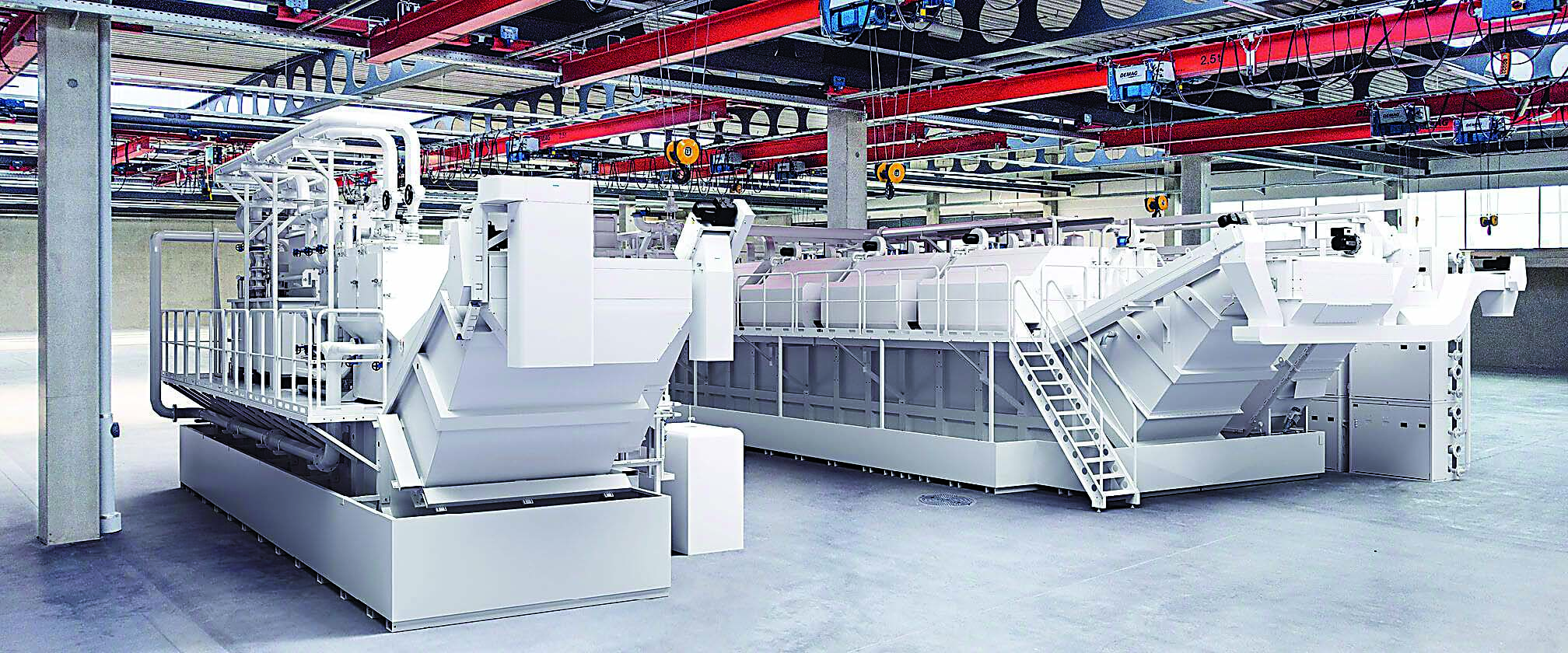
A system solution is required when chips and coolant are transported automatically to a central point and treated there. Image courtesy of Knoll America
“The cleaner the chips are, the better it is to get rid of them,” he said, either by recycling or disposing of them.
Viner said an automated central chip handling system enables chip processing to be performed outside a production area, enhancing worker safety.
Using conveyors and sensors, he said the system is automated until the stage at which chips are dumped into containers.
“You can have robots even at that point to reduce personnel costs and remove the chips into containers,” Viner said.
Nonetheless, he said it’s easier to integrate an automated central system when machining centers are installed before rather than after.
“Sometimes it is an afterthought for companies,” Viner said.
Hook explained that creating a central system traditionally involved setting machine tools along a trench into which chips and fluid are conveyed to a centrifuge to wring out the fluid or to a briquetter to squeeze out the fluid and turn the chips into pucks before sending filtered fluid back to the machines and the scrap to trailers.
“It’s very simple and effective,” he said.
In addition to mechanical conveyors, Hook said material can be conveyed pneumatically to more efficiently transport it longer distances, which is especially
beneficial for newer modular shop layouts where companies adjust production processes based on changing workflow.
“The flexible automation makes a lot of sense,” he said.
Hook said electronic automation also plays a role in chip handling systems, allowing end users to communicate with partner organizations. This capability enables a system, for example, to tell a scrap dealer that bins are full and need to be collected.
Working with sister company KMC Global Controls & Automation in Kalamazoo, he said Prab offers an Industrial Internet of Things option for chip handling systems that monitors parameters, such as run times and downtimes, and sends data to customers so they can use it in Industry 4.0 initiatives.
“Some of this technology gets into predictive maintenance,” Hook said, “where we have sensors that will sense precursors to failure to make sure the equipment is serviced prior to it breaking down.”
Drying Out
Fundamental to an automated central chip handling system is a wringer/centrifuge or briquetter. Prab reports that its centrifuges and briquetters reclaim up to 99% of metalcutting fluids while saving space.
“Our equipment has proved to reduce scrap volume up to 90%,” said Marketing Coordinator Jack Gould. “The oil savings is a big part of it as well, especially with a centrifugal wringer system.”
Review the print ads from this magazine to continue
This quick advertiser review unlocks the rest of the article and keeps the full-screen reader focused on the ads instead of the page chrome.