
Let Edming Use Sink In
Let Edming Use Sink In
Electrical discharge machining, or EDMing, is a form of machining wherein you use an electrode to channel enormous amounts of electricity into a workpiece.
Electrical discharge machining, or EDMing, is a form of machining wherein you use an electrode of some sort to channel enormous amounts of electricity into a workpiece to create your desired geometries. There are a few distinct types of electrical discharge machines (EDMs), such as small hole, wire and sinker. Their names imply the method by which the electrode delivers the electrical current.
A small hole EDM uses a small tube of brass to poke a small starter hole into your part, usually a starting hole for your wire EDM to feed its wire electrode through. Wire, as just stated, uses a tiny diameter wire (around 0.010", sometimes coated) to travel the designated cutting path to give you the desired part. Wire is great for making dies and punches, as most machines currently available have four-axis capability in that the two heads of the machine move independent of one another to allow for things like die draft angles.
You also have the option of a sinker EDM, of which I am focusing on here.
Sinker EDMing
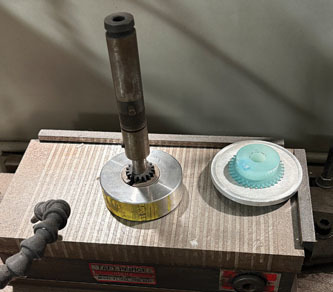
This method of EDMing uses a pre-determined shape of electrode (most made of high-density graphite or copper-tungsten). So long as you can machine the negative geometry of your desired feature and attach it to the toolholder for the machine, you are in business. (See figure 1 for a test part made before burning the shape into a mold body.)
Sinker EDMing is an easy decision for any shop that deals with hard machining or that needs to work with heat-treated parts. So long as the part can conduct electricity, the sinker EDM can do the job.
Sinker EDMing is also a standout option when you need to cut complex geometries or perfectly square-cornered pockets into your parts. See figure 2 for an example of a part my students and I made using our sinker EDM. It has a 7/16" hex straight through the part — for a mating locking lug.


A little back story…
Here at Lafayette College in Easton, Pennsylvania, we have a civil engineering curriculum that engages students in designing and building a scale model bridge of their choice with which to go head-to-head with our peer schools in a competition involving our design, costs, build speed, strength and deflection under load. A little over 15 years ago, a crack student came up with a simple steel connector set that kept our teams in contention for first place over the course of several years. It even won us the grand prize.
Well, the judges didn't seem too friendly to the idea that — year after year — our team could start with a proven design, tweak it, fine-tune it, and then walk away with the competition. They outlawed our secret setup and any derivatives thereof when the 2011 challenge came around.
This forced the crop of civil engineering seniors at the time to come up with a new plan. They designed a self-aligning and self-locking mechanism that used a rod of hex stock with a slot in it for a spring-loaded latch. The connector that they welded onto the bridge needed a slightly larger hex pocket cut into it, and, since we didn't have the time to wait for a hex broach nor the means to align it the same way every time (there were 50 of these connectors to make), we decided to buy hex-shaped high-density graphite. We chopped a few pieces off at an arbitrary length, turned the one end down to fit into our toolholders for the machine, and oriented them in the holder such that they could cut the same pocket every time. We were able to set the machine for depth (see figure 3) and continue roughing out more connectors to be burned. The electrode being a perfect hex also meant that the six corners were cut as sharp as possible, barring graphite degradation, meaning the stock could cleanly pass through the pocket. This would have been nigh impossible with most conventional machining methods as the corners would all be rounded.
Having only a few months to design and test their parts, not fine-tune what worked already, the students struggled to adapt to the new parts. The students ended up with accolades for their ingenuity in 2011, but took a proverbial beating in the time trials and deflection testing.
Modifying an existing part
Another great time to use sinker EDMing is when you need to modify an existing part. Another of Lafayette Engineering's bigger projects involves a Formula SAE car. We designed one to transmit power from the motor to the rear end (via the differential) with the use of "tripod joints," or a type of CV axle. The ends of the two arms employ tripod cups and rollers so that power can be reliably transmitted at any point in the rotation. In my early years working with the students, they would butcher a Volkswagen Rabbit for the rear end of its power train and chop off the splined and threaded ends of its tripod cups. Any round holes were modified to square holes so that they would hold our pre-loading tensioners that held together the entire wheel assembly on each side. (Sadly, I don't have any pictures of this example, as that method of power transmission has given way to a much simpler method of integrating the tripod cups.)
Sinker EDMing could be perfect for your shop if you do any work in heat-treated metals or tough-to-machine metals that need intricate features, a high-quality finish, straight walls and high precision — especially when you need those sharp square corners in the bottoms and sides of any pocket.