Grinding: A pictorial odyssey
An examination of the grinding process through the lens of an electron microscope.
An examination of the grinding process through the lens of an electron microscope.
A picture is worth a thousand words, and that maxim holds true for grinding. The interactions between the abrasive grit and the workpiece occur at a microscopic level and can be hard to visualize. When I give my “High Intensity Grinding Course,” I’ll explain a subject for 5 minutes and watch attendees eyes start to glaze over. But when I flash a photo on the screen—Boom!—I see the “aha” in their eyes as they instantly form a mental picture of what I’m talking about.
Over the years, I’ve taken and collected hundreds of electron-microscope photos of grinding wheels, swarf, workpieces, dressing tools and just about everything else related to grinding. I’ve selected 22 of the best and assembled them here, presented with descriptions of the photos and interesting facts or trivia about grinding.
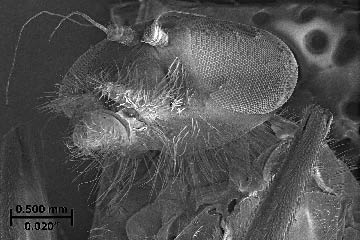
Courtesy of Niagara Cutter
Figure 1: The head of a housefly. The hairs on the fly’s legs are 3μm thick, about the same thickness as a chip produced when grinding hardened steel. The fly’s eyes are each 0.700mm in diameter, about the same size as a 24-mesh abrasive grit.
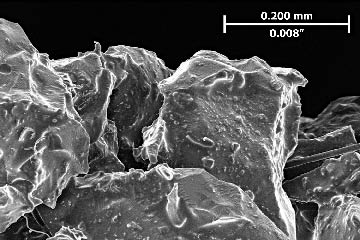
Courtesy of J. Badger
Figure 2: Sharp grits in a freshly dressed, 80-mesh, vitrified-bond aluminum-oxide grinding wheel. An 80-mesh, 16 “-dia., 2 “-wide, 2 “-bore wheel contains about one billion abrasive grits.
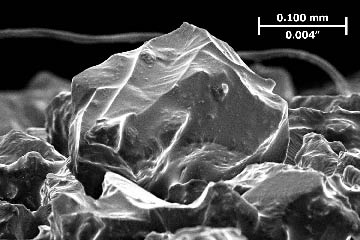
Courtesy of J. Badger
Figure 3: A single, 80-mesh Al2O3 grit in a freshly dressed vitrified-bond grinding wheel. A grit in a 16 ” wheel running at 3,000 rpm taking a 0.001 ” DOC is in contact with the workpiece 0.00008 seconds, or 0.08 milliseconds.
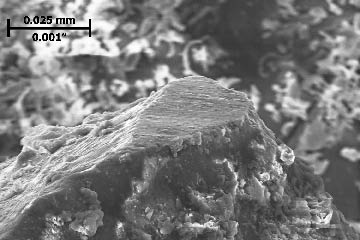
Courtesy of J. Badger
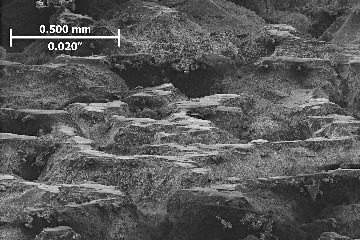
Figure 4: A dull grit in a worn, 46-mesh, vitrified-bond, N-grade, Al2O3 grinding wheel. Wheel dulling causes increased heat generation and grinding burn, increased normal forces and chatter and a finer surface finish.
Courtesy of J. Badger
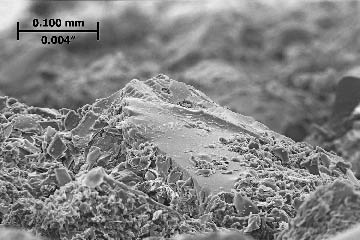
Figure 5: Dull grits in a worn, 46-mesh, vitrified-bond, N-grade, Al2O3 grinding wheel. This wheel was excessively dull, and the wear flats were visible to the naked eye. This N-grade wheel was “too hard,” meaning it had too much bond material and dull grits did not break out of the bond.
Courtesy of J. Badger
Figure 6: The tip of a microfracturing ceramic grit in a worn, 46-mesh, vitrified-bond, Al2O3 Norton-SG wheel after grinding hardened steel. This grit has done a lot of work, but it is not dull. Because it is a microfracturing grit, the tip of the grit remained sharp, enabling it to cut material efficiently.
Courtesy of J. Badger
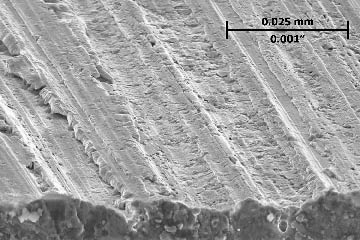
Figure 7: A ground and hardened steel surface. At the grit/workpiece interface there are three possible interactions: rubbing, side and front plowing and chip formation. Side plowing creates grinding scratches. This image shows plowing that caused the material to fold onto itself.
Courtesy of J. Badger
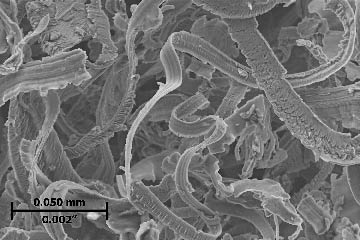
Figure 8: Swarf from grinding highly alloyed conventional HSS. Like turning and milling, grinding is a chip-formation process. However, the chips are thin and irregularly shaped. The swarf produced from grinding a standard ¼ “-dia., 4 “-long drill contains about 100 million individual chips.
Courtesy of J. Badger
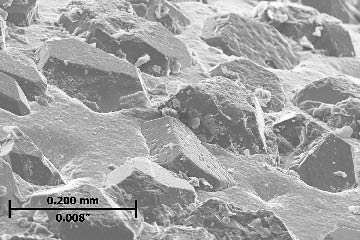
Figure 9: A worn electroplated diamond wheel for grinding tungsten-carbide dies. This wheel was at the end of its life, but not wheel dulling is visible. The wheel experienced a large amount of grit fracture and bond fracture, and the cutting-point density increased to such a degree that the grits no longer effectively penetrated the workpiece.
Courtesy of J. Badger
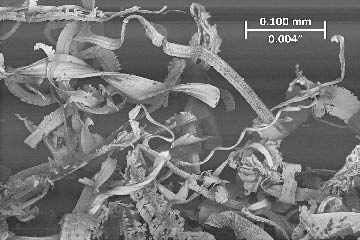
Figure 10: Swarf from grinding a tungsten-carbide workpiece with a resin-bond diamond wheel. Even grinding carbide, or “hard metal,” is a chip-formation process. However, because of carbide’s higher hardness and lower ductility compared to steel, the chips are shorter and blockier. Almost all grinding operations form chips. The exception is ceramic material, which has such low ductility that the material-removal mechanism isn’t chip formation but rather brittle fracture. Ceramic material is removed when cracks form below the surface followed by the “beating out” of chunks of hard ceramic material above the cracks.
Courtesy of J. Badger
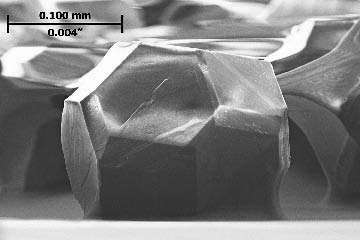
Figure 11: An 80/100-mesh diamond grit. Diamond and, in particular, cubic-boron-nitride abrasives can be manufactured in various geometries, from angular to blocky. This enables selection of geometries suited to particular grinding operations. The geometry shown is a truncated octahedron and is “blocky.” Therefore, it is suitable for grinding operations requiring high material-removal rates.
Review the print ads from this magazine to continue
This quick advertiser review unlocks the rest of the article and keeps the full-screen reader focused on the ads instead of the page chrome.
Advertisers included in this article experience
Print placements connected to this article
Taol
industry stats
■ November ’08 sales down $35.9 million U.S. cutting tool sales fell nearly $36 November sales figures, according to the 2007, they declined nearly $23 million million from October to November, a United States Cutting Tool Institute. during the same period. CTE decrease consistent—though larger— In 2006, total sales were down $17.6 For more information, contact USCTI.
industry stats ■ November ’08 sales down $35.9 million U.S. cutting tool sales fell nearly $36 November sales figures, according to the 2007, they declined nearly $23 million million from October to November, a United States Cutting Tool Institute. during the same period. CTE decrease consistent—though larger— In 2006, total sales were down $17.6 For more information, contact USCTI with the 2 previous years’ October to million from October to November; in at (216) 241-7333 or [email protected]. Total billings 2007 2008 $175M $154M $148.7M $148.4M $147.5M $149M $147.3M
Visit Taol View this placement in the issue recordPrint ads from this magazine
■ November ’08 sales down $35.9 million U.S. cutting tool sales fell nearly $36 November sales figures, according to the 2007, they declined nearly $23 million million from October to November, a United States Cutting Tool Institute. during the same period. CTE decrease consistent—though larger— In 2006, total sales were down $17.6 For more information, contact USCTI.
industry stats ■ November ’08 sales down $35.9 million U.S. cutting tool sales fell nearly $36 November sales figures, according to the 2007, they declined nearly $23 million million from October to November, a United States Cutting Tool Institute. during the same period. CTE decrease consistent—though larger— In 2006, total sales were down $17.6 For more information, contact USCTI with the 2 previous years’ October to million from October to November; in at (216) 241-7333 or [email protected]. Total billings 2007 2008 $175M $154M $148.7M $148.4M $147.5M $149M $147.3M
Continue reading
February 2009
Courtesy of Niagara Cutter
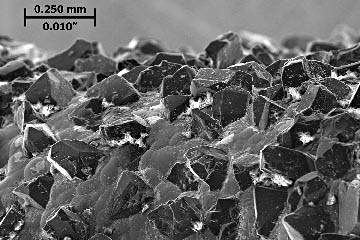
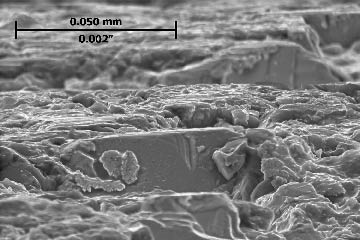
Figure 12: A worn electroplated CBN grinding wheel. Because electroplated wheels are not dressed, distribution of grit heights is random. This means that initially only the very highest grits are in contact with the workpiece, resulting in low grinding forces, low heat generation and a rough surface finish. As the wheel “closes down,” the surface finish becomes finer and grinding power and heat generation both increase.
Courtesy of J. Badger
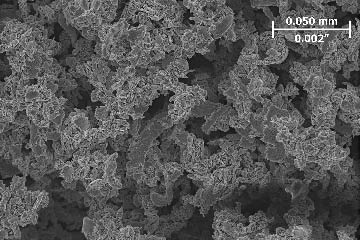
Figure 13: A worn, 140/170-mesh, resin-bond CBN wheel. Resin-bond wheels have little natural porosity. Here, only two grits can be seen poking above the bond material. “Sticking” the wheel clears some of the bond material, providing some porosity, but the wheel still has much less porosity than an electroplated or vitrified-bond wheel. As a result, cooling is more of a challenge and the wheels are more prone to mechanical loading.
Courtesy of J. Badger
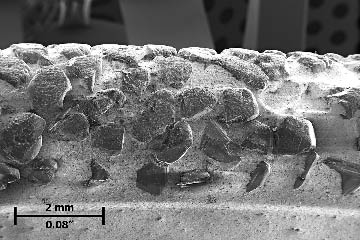
Figure 14: Swarf from using an Al2O3 wheel to continuous-dress grind a nickel-base alloy for making a turbine blade. Nickel-base alloys are very ductile, making the chips long and stringy.
Courtesy of J. Badger
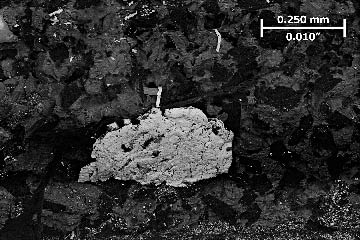
Figure 15: Diamonds in a worn rotary diamond disc. Some of the individual diamonds, about 1mm in diameter, have broken out of the binder material, which leads to dressing tool failure.
Courtesy of J. Badger
Figure 16: Mechanical loading in a resin-bond CBN wheel after grinding hardened steel. (CBN grits are black, the bond material is gray and loaded steel is white.) CBN wheels are more prone to loading because of their slow rate of wear. With Al2O3, the wheel wears and/or is dressed away before loading can accumulate to levels where it inhibits the cutting action. With CBN, wear and dressing rates are low, so loading has time to accumulate. In addition, resin-bond wheels are prone to loading because they have little porosity.
Courtesy of J. Badger
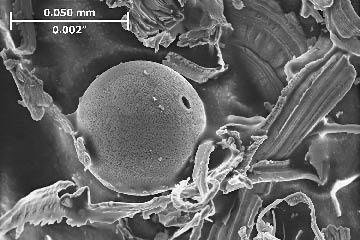
Figure 17: A melted globule of hardened steel amongst grinding chips. The melting point of iron is 2,800° F (1,540° C). This temperature is rarely if ever reached in grinding. However, as chips fly off the grinding wheel, they oxidize in the atmosphere. This is an exothermic reaction, meaning it gives off heat. This is what causes grinding sparks and, in this case, melting of the steel into a globule. No sparks or melted globules result during grinding tests performed in an inert nitrogen atmosphere.
Courtesy of J. Badger
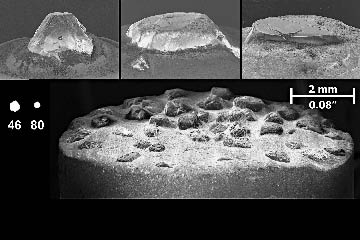
Figure 18: Clockwise from top left is a new single-point diamond, a worn single-point diamond, a very dull single-point diamond and a worn diamond cluster. Single-point diamonds are versatile. However, if they are not rotated they become dull, leading to a dull wheel. The sizes of 46-mesh and 80-mesh grits are shown on the same scale, giving an indication of how a dull diamond will dull an abrasive grit. One solution is to switch to a diamond cluster, which provides a more consistent result. However, because it is wider, the diamond traverse speed must be increased by at least a factor of four. Also, clusters are not as suitable for intricate geometries and small radii as single-point diamonds.
Courtesy of J. Badger
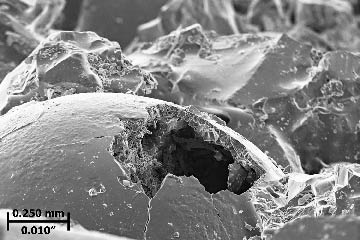
Figure 19: A broken hollow sphere in a worn, 30-mesh, vitrified-bond, induced-porosity Al2O3 grinding wheel. These “bubble alumina” hollow spheres give a wheel “ping-pong-ball porosity.” However, these spheres must be broken by the grinding or dressing operation and do not give the wheel “contiguous” porosity where coolant can flow from pore to pore. Therefore, ping-pong-ball porosity is not very effective.
Courtesy of J. Badger
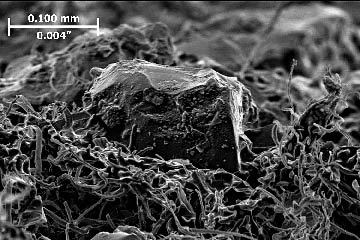
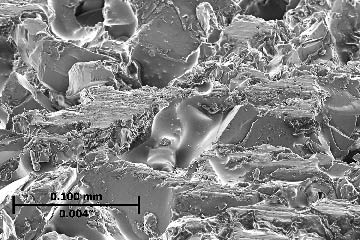
Figure 20: Mechanical loading in a vitrified-bond Al2O3 wheel. Loading can be divided into two types: mechanical and chemical. Mechanical loading is when the chips become embedded in the porosity of the wheel. Chemical loading is when the workpiece chemically reacts with the abrasive grits and adheres to them.
One way to significantly reduce mechanical loading is to fill the pores of the wheel with high-velocity coolant.
Courtesy of J. Badger
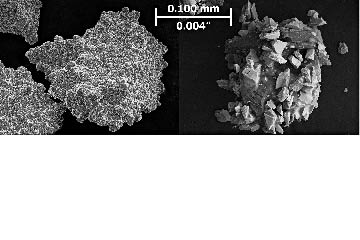
Figure 21: Chemical loading in a 120-mesh, vitrified-bond Al2O3 wheel. Many strange chemical reactions occur between the grit and the workpiece. In this case, Al2O3 reacts with the thin layer of iron-oxide that forms immediately on the workpiece surface. It also reacts vigorously with the chromium-oxides that form in steels with chromium. What’s more, Al2O3 adheres to the virgin steel in the workpiece.
Courtesy of Winterthur
Figure 22: Coated superabrasive grits. Diamond and CBN grits don’t adhere well to a resin or metal bond. Therefore, a coating is used. The grit adheres to the coating, the coating adheres to the bond and therefore coated grits are held more firmly in the wheel. CTE
About the Author: Dr. Jeffrey Badger is an independent grinding consultant. His Web site is www.TheGrindingDoc.com.
Glossary terms in this article
Related


Subscribers can use MFGAxis notes, saves and discussion tools with their InnoNet account.