Give sawing its due: General Industry Coverage
Although arguably less interesting than some newer technologies, sawing is still a vital machining operation at modern machine shops.
An old toolmaker once told me that the lathe is the foundation of a machine shop. He said operating a shop without a lathe would be impossible because it was used for more jobs than any other machine. I was very green at the time, so I took his words as the truth. But after many years of machining, including starting three machine shops from scratch, I have discovered he may have been exaggerating a little. If I could go back and have the conversation again, I would argue that sawing operations are the foundation of a machine shop.
Most workpieces come from shapes like angle iron or larger bulk materials, such as round bar, flat bar, sheet and plate, and sawing is by far the most efficient method for separating workpieces from bulk materials.
Some may argue that shearing is better than sawing because it is faster. However, plate shears are good only for shearing flat materials. Angle iron, channel and round bar can be sheared with machines like ironworkers and bar shears, but these machines cut a limited number of shapes and sizes. Tubes also may be sheared but strictly with specialized machines that can be justified by very large production quantities.
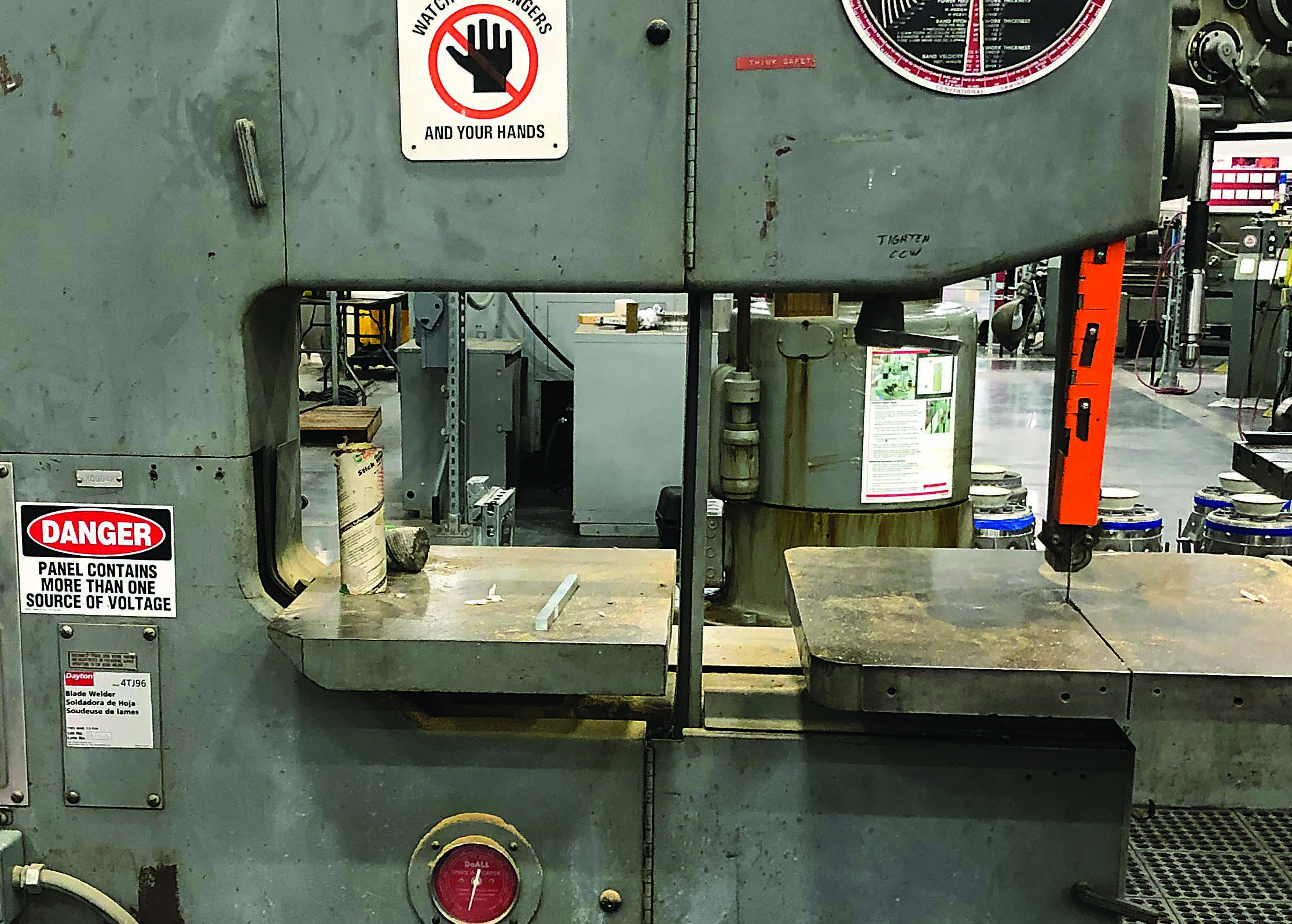
Vertical bandsaws are ideal for rough-cutting features before going to a mill. CNC vertical bandsaws called plate saws are common at steel warehouses. Image courtesy of C. Tate
Shearing always causes some amount of edge deformation. As the diameter or thickness of a material increases, so does the amount of deformation. Edge deformation can result in extra machining, increased handwork or a poor fit during fabrication.
Benefits of Sawing
A saw can cut many sizes of bar and is limited only by the size of stock that will fit physically into a machine. Saws also are capable of cutting an infinite number of shapes as long as a piece may be clamped. In addition, saws can be tooled up to cut odd shapes, whereas ironworkers and shears are dedicated to specific shapes. Saws do not cause edge deformation, and a good saw delivers very clean cuts and square ends. Shearing machines are definitely faster, but a saw is more flexible and provides a better cut.
Review the print ads from this magazine to continue
This quick advertiser review unlocks the rest of the article and keeps the full-screen reader focused on the ads instead of the page chrome.
Advertisers included in this article experience
Print placements connected to this article
Tel: 508-987-0121
High Precision Universal and Centerless Grinders Centerless Grinding Machines Universal OD / ID Grinders Internal Grinding Machines Comprehensive Technical Sales, Service and Support Full series of high precision surface grinders and rotary grinders Rotary table machines in both vertical and horizontal spindle configurations.
Tel: 508-987-0121 eMail: [email protected] High precision, long term reliability, worldwide support and affordable maintenance www. gmsigroup.com High Precision Universal and Centerless Grinders Centerless Grinding Machines Universal OD / ID Grinders Internal Grinding Machines Comprehensive Technical Sales, Service and Support Full series of high precision surface grinders and rotary grinders Rotary table machines in both vertical and horizontal spindle configurations
Visit Facebook View this placement in the issue recordPrint ads from this magazine
High Precision Universal and Centerless Grinders Centerless Grinding Machines Universal OD / ID Grinders Internal Grinding Machines Comprehensive Technical Sales, Service and Support Full series of high precision surface grinders and rotary grinders Rotary table machines in both vertical and horizontal spindle configurations.
Tel: 508-987-0121 eMail: [email protected] High precision, long term reliability, worldwide support and affordable maintenance www. gmsigroup.com High Precision Universal and Centerless Grinders Centerless Grinding Machines Universal OD / ID Grinders Internal Grinding Machines Comprehensive Technical Sales, Service and Support Full series of high precision surface grinders and rotary grinders Rotary table machines in both vertical and horizontal spindle configurations
Continue reading
January 2021
Bandsaws, cold saws (aka circular saws) and abrasive saws are common types of saws, and each has many different combinations of blade materials, styles and sizes to choose from. Of course, there are numerous kinds of blades for cutting metals, plastics and wood, but blades also are made specifically for cutting materials like fiberglass, rubber and ceramics. There are saws and blades for every application. All these variations give an endless combination of possibilities, making sawing a universal operation.
With the proliferation of multitasking machines and lathes with live tools, sawing operations easily can be carried out on other types of machines. Combining a sawing operation with a bar feeder or bar puller gives the ability to run lathes unattended. Thin-walled or delicate parts can be damaged by a parting tool. Replacing the parting tool with a saw may mitigate the risk of damage to delicate parts. Sawing can be faster than parting because a constant surface speed is maintained and a saw has more active cutting edges.
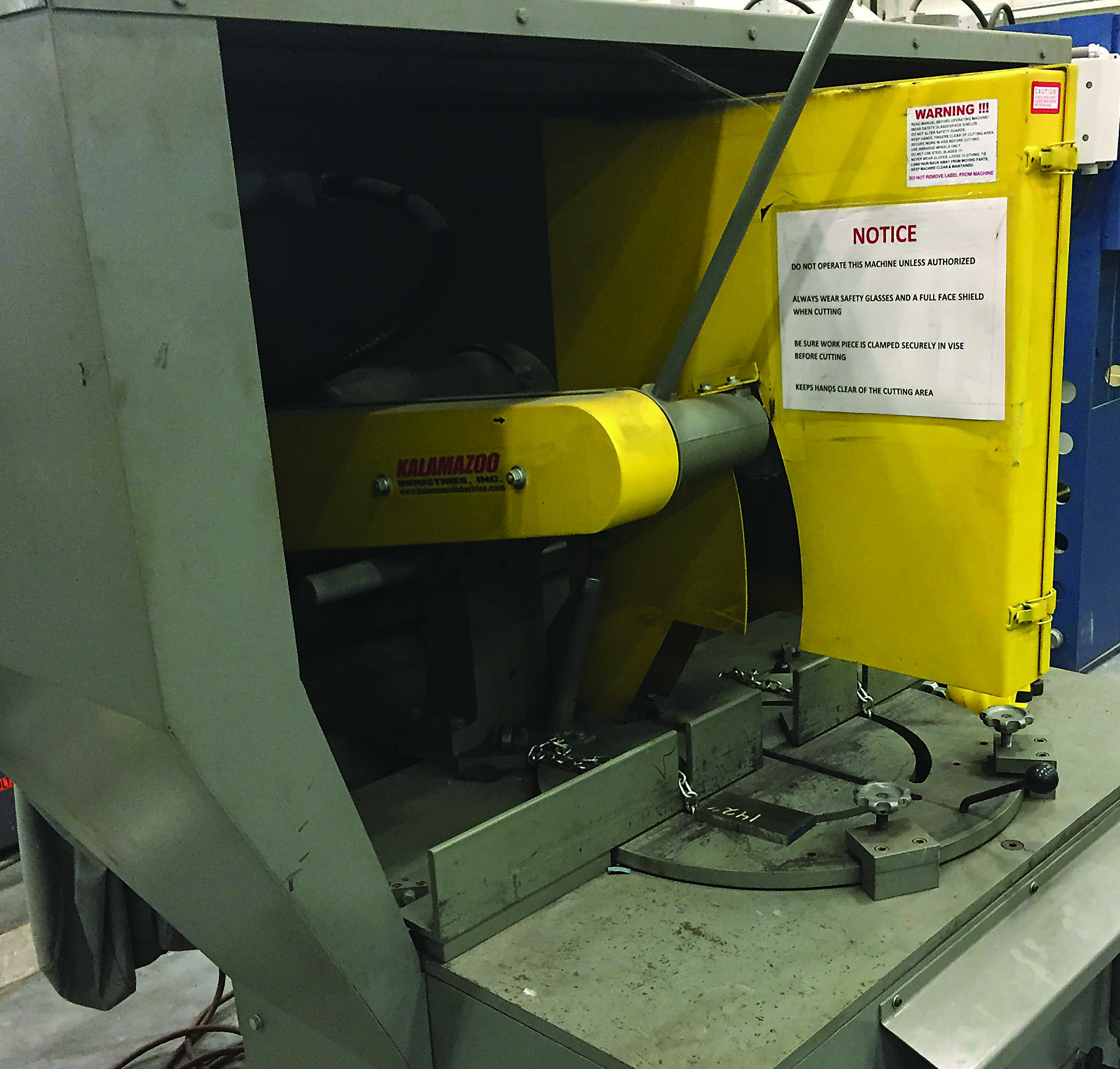
Abrasive saws are fast and easy to use. They are as accurate as other types of saws but dirty. Image courtesy of C. Tate
Operational costs for a saw are low, and sawing operations are usually economical. Consumable items like saw blades are rather inexpensive and have a long life compared with other cutting tools, such as endmills and drills. Maintenance intervals are infrequent, and spare parts are priced reasonably relative to other types of machines. Adding the options necessary to make a saw automatic is often inexpensive and allows the saw to run unattended, further improving low operating costs.
Sawing is also a very efficient way to prepare workpieces for other machining operations and reduce machining costs. It is common practice at a toolroom to lay out a workpiece on a surface plate and use a bandsaw to remove large pieces before going to a mill. Making a few cuts on the bandsaw can significantly reduce milling time and tooling costs. Hole saws are a great substitute for drills when making large-diameter holes in thin materials as drills tend to damage the stock, and slitting saws are a much better choice than endmills for milling deep, narrow grooves.
Sawing may be the most common manufacturing process at machine shops. It is versatile, simple and reliable. Many young engineers and machinists I meet are very familiar with laser and waterjet cutting but have no knowledge of sawing. Although arguably less interesting than some newer technologies, sawing is still a vital machining operation at modern machine shops.
Glossary terms in this article
Related

Subscribers can use MFGAxis notes, saves and discussion tools with their InnoNet account.