Effectively Reaming Nickel-Base Alloys
Nickel-base alloys reward a slow, stable reaming process with close control of stock allowance, speed, feed, and coolant. This guide covers the main setup priorities.
Quick take: Nickel-base alloys punish aggressive reaming with heat, deflection, and poor hole quality. This guide works best when it is used with feeds-and-speeds math and material-behavior references rather than as a stand-alone rule sheet.
Related references: Cutting Speed and Feed Rate Guide, Understanding Hardness in Metalworking, and Coefficient of Linear Thermal Expansion: Machining Guide.
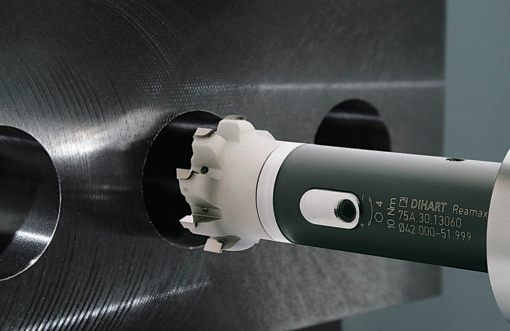
Courtesy of KOMET of America
The Dihart Reamax TS carbide-tipped reamer is available from KOMET of America.
Effectively reaming nickel-base alloys requires a slow and steady approach.
When a metal part must offer low weight, corrosion and oxidation resistance and high strength at high temperatures, part designers often turn to nickel-base alloys. These materials, along with iron- and cobalt-based materials, are considered heat-resistant superalloys.
However, the properties that make nickel alloys desirable for extreme environments, such as those found in pressurized-water reactors at nuclear power plants and in aerospace turbocharger rotors, make the metals a challenge to machine. That’s because the high pressure the cutting tool exerts on the workpiece during machining produces a stressed and deformed surface layer, explained Adrian von Rohr, Dihart product manager for KOMET of America Inc., Schaumburg, Ill. This deformation causes the workpiece surface to harden, slowing the machining process.
“Even under the best conditions, stresses may be produced that distort the work,” von Rohr said. “For maximum dimensional stability, it is best to rough the part almost to size, stress-relieve it and then finish it to size.”
Particularly difficult-to-machine nickel alloys include Incoloy 901, Nimonic 80 and 105, and Inconel 625 and 718. The latter is a precipitation-hardenable nickel-chromium alloy with excellent creep-rupture strength at temperatures up to 1,300° F. It is used in gas turbines, pumps and rocket motors, according to ESPI Metals, Ashland, Ore., a supplier of high-purity metals and metal compounds for research purposes. The nominal composition of Inconel 718 includes, among other elements, 52.50 percent nickel, 19.00 percent chromium, 17.00 percent iron, 3.05 percent molybdenum and even a bit of titanium, at 0.90 percent.
Because these extreme-environment parts often require high-quality holes—with an H7 international size tolerance grade or better—part manufacturers commonly employ reaming to meet surface finish, size and concentricity requirements. For example, an H7 tolerance for an 18mm-dia. hole is 0 “/+0.0007 “.
“As the hole gets bigger, the tolerance range gets larger,” said Jacob Miller, product manager for Allied Machine & Engineering Corp., Dover, Ohio. The cutting tool manufacturer recently added replaceable-head reamers from S.C.A.M.I. to complement Allied’s monoblock and ring-style reamer offerings from the same Italian manufacturer.
Although high-performance drills can produce high-quality holes, reaming is required for a tighter diameter tolerance. Indexable-insert drills typically achieve a tolerance as tight as 0.008 ” and solid-carbide drills achieve a 0.002 ” tolerance, von Rohr noted, but solid-carbide, carbide-tipped and indexable-inserts reamers attain a tolerance of 0.0004 “. KOMET makes solid-carbide, carbide-tipped and indexable-insert reamers.
Take it Slow
Similar to other machining processes, reaming nickel alloys requires a significantly slower cutting speed compared to most other materials, Miller noted. “Usually it’s between 60 and 80 sfm for coated carbide,” he said.
Because nickel alloys tend to workharden, a slower speed reduces friction and heat generation, von Rohr added. Just as a drilled hole guides a reamer, drilling speed can direct reaming speed. A rule of thumb is to ream at about two thirds the drilling speed, he noted.
Others interviewed concurred that reaming nickel alloys is a slow process but some offered slightly different recommendations. Tom Edler recommends reaming Inconel at 80 to 100 sfm. He’s the national deep-hole drilling, reaming, thread milling, ITS bore and oil field thread chasers products manager for Iscar Metals Inc., Arlington, Texas. Iscar’s BAYO T reaming system is suitable for nickel-alloy applications. While the speed is slow, the feed can be a different matter. “The design of the tool allows for aggressive feed rates, typically 20 to 30 times faster than conventional reamers,” Edler said.
Compared to reaming steel at a cutting speed of about 650 sfm, 200 sfm is appropriate for Inconel 718 when applying BTA Heller Inc.’s float reaming, or skive, tool, noted Mark Sollich, president and CEO of the Troy, Mich., company. BTA Heller states that the tool body holds a floating cutter magazine with two cartridges and two indexable inserts that oppose one another and have diametrical adjustment of 0.080 ” to 0.118 “, depending on the tool diameter. Each insert has four cutting edges.
“A float reaming tool is designed to follow the existing hole and give uniform size, finish and wall thickness from start to finish, producing a true round bore,” Sollich explained. “When you start into the bore, you introduce hydraulics to the tool, expanding the floating magazine, or cutters, to whatever size you require and skiving through the part with high-volume coolant running on the tool OD, which flushes chips away from the cutting edges. When you get to the end of the bore, you turn off the hydraulics, collapsing the cutters, and pull the tool back without leaving any scratches or marks inside the bore.”
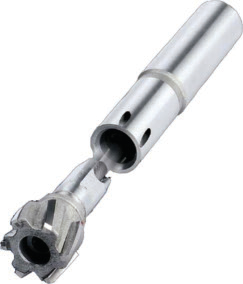
Courtesy of Allied Machine & Engineering
The new S.C.A.M.I. replaceable-head reamers complement Allied’s monoblock and ring-style reamer offerings.
The float reaming tools, which can open existing bores up to 1⁄8 ” on diameter, are applied only in a deep-hole drilling machine and can ream holes 100 diameters deep or more, according to the company.
Sollich added that the tool’s double-effective cutting configuration allows users to substantially increase the feed rate versus a single-cutter reamer. For Inconel 718, he recommends a feed of 0.040 to 0.060 ipr.
According to von Rohr, too low a feed rate results in glazing, or workhardening, of the workpiece and excessive tool wear, while an excessive feed reduces the accuracy of hole dimensions and surface finish quality. He recommends a feed from 0.0015 ” to 0.004 ” per flute per revolution when reaming nickel alloys.
Gary Schmidt, applications engineering for M.A. Ford Manufacturing Co. Inc., Davenport, Iowa, recommends basing reaming parameters on those for holemaking with carbide drills, cutting the reaming speed in half and doubling the feed. The increased feed will load the reamer and prevent it from rubbing and wearing prematurely, he noted. M.A. Ford produces standard solid-carbide reamers from 0.013 ” to 5⁄8 ” and specials up to 1¼ “.
Geometries at Work
In addition to running at the correct feed, applying reamers—which cut only on the bevel and taper leads and not on the lands—with up-sharp cutting edges and positive rake angles will shear nickel alloys rather than push the material. “The biggest concern is making sure you have a sharp tool geometry to minimize the amount of heat you produce,” said Allied’s Miller.
To support those sharp edges, the relief angles must be slightly less steep than on reamers for less demanding materials, according to M.A. Ford’s Schmidt. Reamers typically have 3° to 5° relief angles, whereas 1° to 3° is more appropriate on tools for nickel alloys.
“What we’re seeing on some of the newer reamers is just a bit of a cylindrical margin, so, if you have chipping, the cutting edges are backed up,” Schmidt added. With that design on a reamer with a smaller relief angle, toolmakers place more support on the back of the cutting edge, making the edge stronger.
The BAYO T reaming system from Iscar Metals is suitable for nickel-alloy applications.
Because chip control can be problematic when reaming nickel alloys, chipbreaker geometry is beneficial, according to Sollich. He noted BTA Heller’s float reamers have a manual chipbreaker held with an insert clamp. “The chipbreaker width can be adjusted based on the workpiece material,” he said. “If you’re reaming a material that tends to be tough as far as chip control, you tighten the chipbreaker to a smaller width, maybe 0.040 “.”
On conventional reamers, a chipbreaker is effective for controlling chips but it reduces tool life compared to a reamer without one, according to KOMET’s von Rohr. A chipbreaker may not even be required to control nickel alloy chips. That’s because, as the material workhardens, it becomes more brittle and tends to break from the parent material before becoming long and stringy, he added. “The nickel itself almost acts like a chipbreaker.”
A reamer’s geometric configuration also helps minimize chatter—especially unwanted in a finishing operation. Reamers frequently have asymmetrical flute spacing to disrupt the natural-harmonic-frequency generation that causes chatter during machining, von Rohr noted. He added that the flute design can aid machinability when interrupted cutting, such as when reaming cross-holes. “Dihart always uses asymmetrical-flute spacing for our high-performance reamers,” he said.
Iscar’s Edler indicated that BAYO T reamers have uneven flute spacing, with two flutes directly across from each other and the remaining ones varied. “It’s definitely to avoid harmonics,” he said.
When controlling chips, a reamer’s lead angle also plays a critical role. In addition to possibly a 45° lead angle, a reamer might have a double, or compound, angle, with a 20° lead as well, to reduce the cutting force and enhance chip control by generating smaller chips, Edler explained. “The compound angle can be anything we need it to be to solve the chip control issue.”
He added that the lead angle varies, depending on whether the hole being reamed is a through- or blind-hole. When reaming a through-hole, a 45° lead angle rolls the chips forward—ahead of the tool and out the hole. In a blind-hole, a 20° lead directs the chips back up the flutes and out the hole.
Not all influential reamer geometries can be readily seen. Coolant channels facilitate metalworking fluid flow to effectively evacuate chips and can also vary in design depending on what type of hole is being reamed. When it’s a blind-hole, Schmidt pointed out that M.A. Ford engineers the though-coolant design so it directs the flow backward, whether through one central channel or two holes, and helps bring chips out the top of the hole instead of sending them to the bottom.
Cool Cutting
Because nickel-base alloys withstand high temperatures, not much heat enters the material and the heat that does enter is carried away when chips are made. Therefore, coolant is needed to keep cutting edges from overheating and causing premature tool failure while helping to clear chips.
While some recommend applying a sulfurized or chlorinated mineral oil to improve both lubricity and antiweld properties when reaming nickel alloys, others emphasize having the proper coolant mixture. “When you get into high-temperature alloys, the concentration of water-based coolants is important,” M.A. Ford’s Schmidt said. “We like to see 8 to 11 percent. With the normal 4 to 6 percent concentration, you have much less lubricity.”
Review the print ads from this magazine to continue
This quick advertiser review unlocks the rest of the article and keeps the full-screen reader focused on the ads instead of the page chrome.
Advertisers included in this article experience
Print placements connected to this article
Mmus
Best in Class, Technology-Driven Solutions.
A LEADER IN MANUFACTURING PROCESS TECHNOLOGIES The Mitsubishi Materials name is tantamount to quality, technological leadership, and diversity in product offerings. We partner with industries such as medical, automotive, oil & gas, aerospace, and die & mold. Our three diamond logo represents what demanding customers can expect from our materials, products.
Best in Class, Technology-Driven Solutions. A LEADER IN MANUFACTURING PROCESS TECHNOLOGIES The Mitsubishi Materials name is tantamount to quality, technological leadership, and diversity in product offerings. We partner with industries such as medical, automotive, oil & gas, aerospace, and die & mold. Our three diamond logo represents what demanding customers can expect from our materials, products, services, and our outstanding employees. Mitsubishi Materials manufacturing plants are world-class operations, committed to environmentally sound practices. For additional information on Mitsubishi products, please telephone 800-523-0800
Visit Mmus View this placement in the issue recordPrint ads from this magazine
A LEADER IN MANUFACTURING PROCESS TECHNOLOGIES The Mitsubishi Materials name is tantamount to quality, technological leadership, and diversity in product offerings. We partner with industries such as medical, automotive, oil & gas, aerospace, and die & mold. Our three diamond logo represents what demanding customers can expect from our materials, products.
Best in Class, Technology-Driven Solutions. A LEADER IN MANUFACTURING PROCESS TECHNOLOGIES The Mitsubishi Materials name is tantamount to quality, technological leadership, and diversity in product offerings. We partner with industries such as medical, automotive, oil & gas, aerospace, and die & mold. Our three diamond logo represents what demanding customers can expect from our materials, products, services, and our outstanding employees. Mitsubishi Materials manufacturing plants are world-class operations, committed to environmentally sound practices. For additional information on Mitsubishi products, please telephone 800-523-0800
Continue reading
October 2012
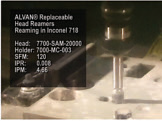
Courtesy of Allied Machine & Engineering
Click the image above for a video demonstrating an ALVAN replaceable-head reamer from Allied reaming an Inconel 718 workpiece.
Iscar’s Edler agreed. “As long as you have a good concentration of water-based coolant, say 10 to 12 percent, everything will be fine.”
In addition to coolant concentration, applying it at high pressure is essential when reaming nickel alloys, Edler said. “The higher the pressure, the better the coolant penetration to get beyond that zone where the heat is being generated and to cool down the cutting edge, as well as the material.”
When using BTA Heller’s float reaming system, coolant volume is more important than pressure, with 25 gpm per inch in tool diameter being the rule of thumb, according to Sollich. He recommends applying sulfur- or chlorine-based cutting oil and maintaining the oil temperature at 80° to 85° F with a chiller unit to extend cutting tool life 15 to 30 percent.
Although sulfur has its benefits, workpiece staining can result if the oil and workpiece temperatures rise too high during reaming, KOMET’s von Rohr explained. Prior to heat treatment, users can remove the stain with a cleaning solution of sodium cyanide or chromic-sulfuric acid. “To avoid intergranular corrosion,” he cautioned, “the parts should be immersed in the cleaning solution only long enough to remove the stain.”
Cover Up
Coatings are also needed to protect reamers, as well as reduce friction, when cutting nickel alloys. “A coating makes the difference between an application working and not working,” said KOMET’s von Rohr. “You produce less heat and less stress, and it’s just easier for the chip to get out of the way with a coating.”
He noted TiAlN is the most common coating for nickel-alloy applications, but AlCrN is also suitable.
To maintain a sharp cutting edge, the coating can’t be too thick. “A thick coating does not necessarily mean you have a better tool,” von Rohr said. “It’s actually the opposite; a thick coating may crack easier.”
Schmidt noted the coatings on M.A. Ford reamers are from 0.0001″ to 0.0002″ thick and are applied by outside coating companies via flash coat to reduce coating cycle time, and, therefore, coating thickness and the amount of heat entering the tools. The coatings for nickel-alloy reaming applications are primarily silicon-based, he added, noting TiAlN and AlCrN, which are not silicon-based, are also effective.
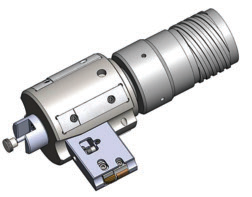
Courtesy of BTA Heller
BTA Heller’s float reaming, or skive, tool’s body holds a floating cutter magazine with two cartridges and two indexable inserts that oppose one another and have diametrical adjustment of 0.080″ to 0.118″, depending on the tool diameter.
“Silicon-based coatings were originally designed more for high-speed machining and hardened dies,” Schmidt said, “but they found their way into [the machining of] some of these nickel materials as well.”
Compared to reamers with brazed carbide tips, indexable-insert reamers offer more coating options, according to von Rohr. That’s because the carbide tip must be coated after brazing and the temperature used to apply the coating cannot be higher than what the brazed connection allows, meaning too high a temperature would cause the braze to fail.
“Because inserts are not brazed onto the body, high-performance coatings can be considered,” he said, noting indexable inserts repeat within 0.0001 “.
Miller pointed out that Allied offers coated and uncoated carbide and cermet reamers, and Allied generally recommends uncoated cermet tools for high-speed reaming. “There’s not a dramatic benefit to putting a coating on cermet as far as tool life,” he said, noting that cermet withstands tool wear from nickel alloy’s abrasiveness better than carbide.
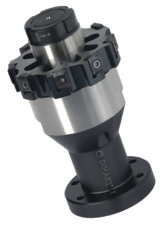
Courtesy of KOMET of America
KOMET of America offers the Dihart Duomax indexable-insert reamer.
Stock Out
When reaming nickel alloys, the tool must remove sufficient stock so material that isn’t workhardened is removed, according to von Rohr. The starting point recommendations are 0.010 ” for a ¼ ” hole, 0.015 ” for a ½ ” hole and up to 0.025 ” for a 1½ ” hole.
Instead of removing 0.005 ” to 0.008 ” of material for holes under ½ ” in diameter and 0.008 ” to 0.012 ” of material for holes ½ ” and larger when reaming non-nickel-alloy materials, Iscar’s Edler recommends 0.004 ” of stock removal for all nickel-alloy holes. An exception is when the drilled hole is egg-shaped, or out of round, more than 0.004 “. “You’re going to have an area that is not going to clean up,” he said. “You would then need to leave more material to have a completely finished hole.”
Nickel-base alloys and other heat-resistant materials certainly qualify as being difficult to machine, but effectively reaming them to improve hole cylindricity and surface finish is possible if users select the appropriate tools and make proper provisions. “If you want to run extreme, you have to take precautions,” Edler said. And when that’s the case, “high-temp alloys are basically the same as any other type of material.” CTE
About the Author: Alan Richter is editor of CTE. He joined the publication in 2000. Contact him at (847) 714-0175 or alanr@jwr.com.
Dissimilar materials double the trouble
Reaming nickel-base alloys can be challenging enough, but add a dissimilar material into the workpiece, such as a composite in stacked arrangement, and the demands increase exponentially.
“The way I usually explain it to customers is it is very similar to reaming a casehardened material,” said Gary Schmidt of M.A. Ford Manufacturing Co. Inc. “You have the outer crust that’s very hard and you have a softer center. Metal-matrix composite materials are that way too.”
He added that balancing tool geometries for both materials rather than optimizing them for one can prove effective.
However, optimizing the speeds and feeds for each material can also prove effective. Allied Machine & Engineering Corp.’s Jacob Miller emphasized this when reaming bimetal workpieces, such a thin Inconel explosion-bonded cladding on A 516 70 steel or 316 stainless. That might require starting at a slow surface speed and then increasing it once the tool passes the cladding.
“Your CNC will allow you to run at two different parameters as you’re going through the workpiece,” Miller said.
—A. Richter
Contributors
Allied Machine & Engineering Corp.
(800) 321-5537
www.alliedmachine.com
BTA Heller Inc.
(248) 597-0346
www.btahellerinc.com
ESPI Metals
(800) 638-2581
www.espimetals.com
M.A. Ford Manufacturing Co. Inc.
(800) 553-8024
www.maford.com
Iscar Metals Inc.
(877) BY-ISCAR
www.iscarmetals.com
KOMET of America Inc.
(800) 656-6381
www.komet.com
Glossary terms in this article