

Choosing the best in advance condition monitoring
Learn the main differences between continuous remote monitoring and wireless route-based monitoring to help you choose the right type for your business.
Without question, the industrial internet of things has changed the way we look at condition monitoring and diagnostics. Many now consider checking analog gages and jotting down measurements on a clipboard obsolete. Manufacturers use advanced condition monitoring solutions to do the following:
- Identify issues early.
- Reduce downtime.
- Decrease maintenance costs.
- Avoid dangerous situations.
- Make more informed decisions.
- Improve labor efficiency.
All these benefits have opened the door to predictive maintenance.
Which wireless solution is best for your business? The question today is not whether you need an advanced condition monitoring solution but which type. This article explains the main differences between continuous remote monitoring and wireless route-based monitoring.
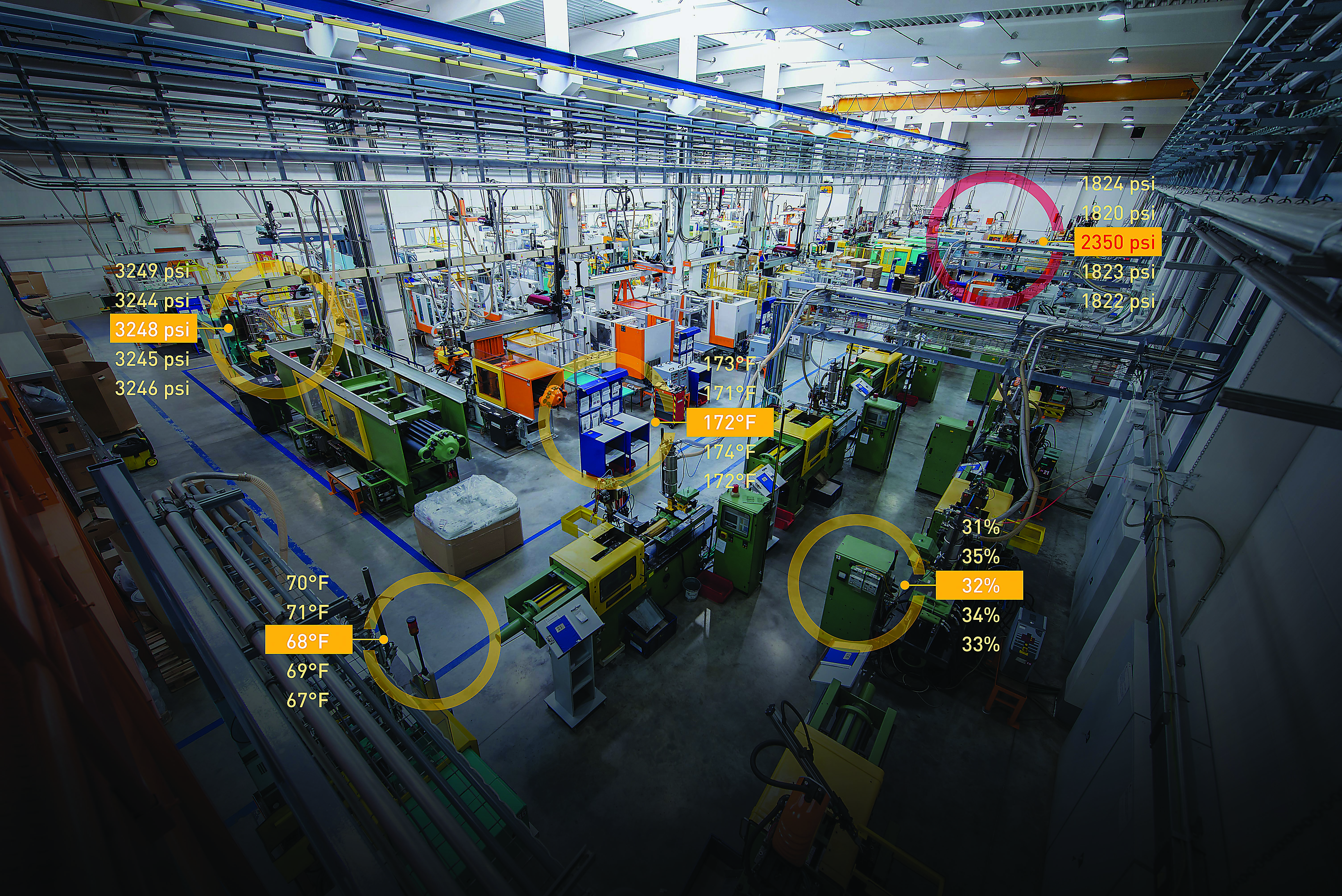
The floor of a plant has much to monitor. Image courtesy of Parker Hannifin
Wireless route-based condition monitoring. If you need a solution for short-term, on-site monitoring or diagnostics, a wireless route-based condition monitoring solution will likely give the best return on investment. The “route” refers to the asset manager’s maintenance routine, whether walking a plant floor and inspecting each machine or running diagnostics on a specific piece of equipment. Wireless sensors are installed at key points on the machines to monitor vital conditions—for example, temperature, pressure and humidity—and wirelessly transmit that information to a mobile device by using the required software or mobile app.
Wireless route-based condition monitoring alleviates these common issues:
Time. Technicians in range can wirelessly retrieve information from sensors installed on an asset. Without the wires and cables required by a traditional monitoring solution, technicians can monitor and record each measurement simultaneously, then move to the next piece of equipment. This method helps cut the time it takes to complete routes, thus potentially increasing the frequency of those routes. More daily measurements mean a more robust archive. There is also a better chance of catching the sudden spikes or drops in condition levels that often go unnoticed and lead to decreased asset performance or outright failure.
Accuracy. With one mobile device, such as a smartphone, technicians can easily and quickly monitor the digital readout and automatically record a measurement with the click of a button. Now the buildup of grease, dirt and grime on an analog gage—making it more difficult to read—is no longer an issue. Neither is the technician’s handwriting.
Record-keeping. Maintaining a digital record that can be exported and uploaded to a computer ensures that recorded measurements are no longer subject to being lost, misfiled, torn or stained by a random spill from a coffee cup. It’s also easier to analyze digital files to identify trends compared with hard copy records.
Downtime. The biggest benefit is that wireless monitoring solutions don’t require shutting down the piece of equipment to take measurements. Leaving job-critical assets online while running diagnostics means companies can investigate issues without halting production. This allows workers to:
- easily take accurate measurements from individual machines;
- wirelessly diagnose machine issues to reduce downtime and costs;
- easily monitor assets/machines on-site;
- export recorded measurements; and
- avoid potentially unsafe working conditions.
Route-based condition monitoring is suitable for companies that need an immediate, short-term diagnostic solution that is more accurate than traditional gages.
Continuous monitoring for remote measurements. Continuous remote monitoring gives users a broader view of their assets by providing a steady stream of information, so they never miss a beat. Unlike wireless route-based monitoring, which requires a technician to be within the range of a sensor to get the measurement, users can take measurements with a continuous remote monitoring system anywhere they have an internet connection. While conceptually similar, continuous remote monitoring solutions have a few differences compared with route-based monitoring solutions:
Long-term versus short-term monitoring. Route-based monitoring begins and ends when the end user is actively using the system. Continuous remote monitoring solutions are for long-term monitoring to give users immediate access to the health of their machines. Continuous monitoring solutions are always “watching” machines and systems for any issues that could lead to reduced performance or downtime. Therefore, at any time of day, users can access critical information without interrupting production.
Big picture versus snapshot. While route-based monitoring helps users take measurements and run diagnostics on individual assets, a continuous monitoring solution gives users the bigger picture of how things are running. Users can gather trend data from all assets at all locations and analyze that information to find ways to optimize machine performance and keep production running smoothly.
Remote versus on-site monitoring. When users have access from anywhere with an internet connection, they can monitor and collect the data of multiple assets from multiple locations simultaneously. Cloud-based remote monitoring lets users access everything from their desktop, so plant managers can analyze trends for all assets whether managers are on-site or miles away.
Employing a continuous monitoring strategy allows companies to do the following:
- Access data anywhere, anytime.
- Receive alert notifications of potential issues.
- Visualize data in a way that makes the most sense.
- Customize alerts, trend charts and dashboards.
- View measurement anomalies.
- Support continuous improvement efforts with trend data.
- Export data for analyzing later.
Continuous remote monitoring is perfect for large-scale operations with multiple assets or production/assembly lines.
Related




Subscribers can use MFGAxis notes, saves and discussion tools with their innoNET account.


