
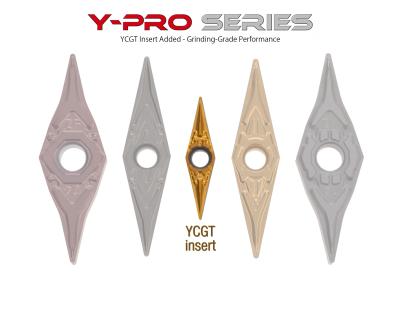
Tungaloy Corporation expanded its Y-Pro Series of inserts with the addition of precision-ground YCGT inserts featuring a 25° corner angle for enhanced profiling and undercutting performance.
In the field of small parts machining, where high-precision taper machining, profiling, and undercutting are required, improved machining accuracy and consistent surface quality are essential.
According to the company, this is especially true for applications such as fitting components on automatic lathes, medical implants, and shafts, where there is a growing demand for high-precision inserts with a 25° corner angle. However, suitable ground inserts optimized for this field have been limited, posing challenges in ensuring machining stability and quality under the current Challenges and Market Conditions.
The Y-Pro Series is an ideal tool line for complex turning operations such as profiling, undercutting, and V-groove machining. Its unique 25° corner angle design enables high-precision machining while avoiding interference. It is also compatible with multi-tasking machines and automatic lathes.
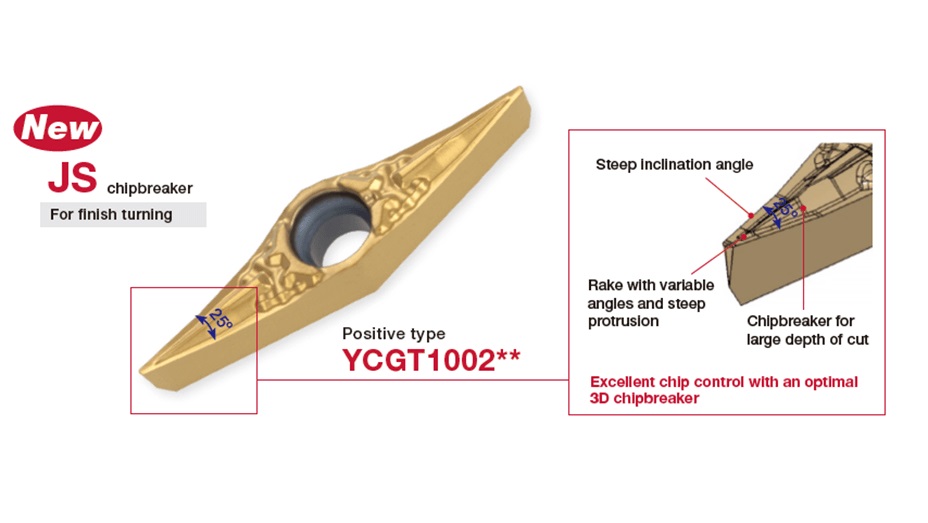
Benefits and features
- Feature 1: Ground Insert Ideal for High-Precision Machining – YCGT inserts deliver dimensional accuracy and edge quality comparable to grinding processes – The 25° corner angle design enables precise machining of intricate shapes and small components – Ensures stable machining with minimal dimensional variation in high-precision finishing operations
- Feature 2: Excellent Chip Control with JS Breaker – Unique 3D breaker geometry optimizes chip breaking and evacuation – Performs effectively across a wide range of applications, from finishing to deep cutting – Reduces chip entanglement and interference with the workpiece, enhancing productivity and safety
- Feature 3: Stable Machining and Superior Surface Finish with SH7025 Grade – SH7025 grade offers an ideal balance of wear resistance and toughness – Ensures consistent tool life even during extended continuous machining – Produces excellent surface gloss and smoothness, minimizing the need for secondary operations.
Contact Details

Related Glossary Terms
- grinding
grinding
Machining operation in which material is removed from the workpiece by a powered abrasive wheel, stone, belt, paste, sheet, compound, slurry, etc. Takes various forms: surface grinding (creates flat and/or squared surfaces); cylindrical grinding (for external cylindrical and tapered shapes, fillets, undercuts, etc.); centerless grinding; chamfering; thread and form grinding; tool and cutter grinding; offhand grinding; lapping and polishing (grinding with extremely fine grits to create ultrasmooth surfaces); honing; and disc grinding.
- profiling
profiling
Machining vertical edges of workpieces having irregular contours; normally performed with an endmill in a vertical spindle on a milling machine or with a profiler, following a pattern. See mill, milling machine.
- turning
turning
Workpiece is held in a chuck, mounted on a face plate or secured between centers and rotated while a cutting tool, normally a single-point tool, is fed into it along its periphery or across its end or face. Takes the form of straight turning (cutting along the periphery of the workpiece); taper turning (creating a taper); step turning (turning different-size diameters on the same work); chamfering (beveling an edge or shoulder); facing (cutting on an end); turning threads (usually external but can be internal); roughing (high-volume metal removal); and finishing (final light cuts). Performed on lathes, turning centers, chucking machines, automatic screw machines and similar machines.
- wear resistance
wear resistance
Ability of the tool to withstand stresses that cause it to wear during cutting; an attribute linked to alloy composition, base material, thermal conditions, type of tooling and operation and other variables.
