

Development of kilogram and second
Originally called a grave, meaning heavy, learn more about the history of the kilogram.
King of France Louis XVI commissioned a group of scientists, including the prominent Antoine Lavoisier (1743-1794), to create a unit of mass. It originally was called grave, meaning heavy. This name was changed to kilogram in 1795.
On Sept. 28, 1889, the first meeting of the General Conference on Weights and Measures, also known as CGPM, determined that the international and national prototypes of the kilogram would be made of the alloy of platinum with 10% iridium, accurate to within 0.0001%. The difference between the national and international kilogram is within 1 mg (0.00004 oz.).
The prototype of the kilogram is a right-circular bar, in which the height equals the diameter, of 39.17 mm (1.54″). This bar is kept at the International Bureau of Weights and Measures and known as Le Grand K.
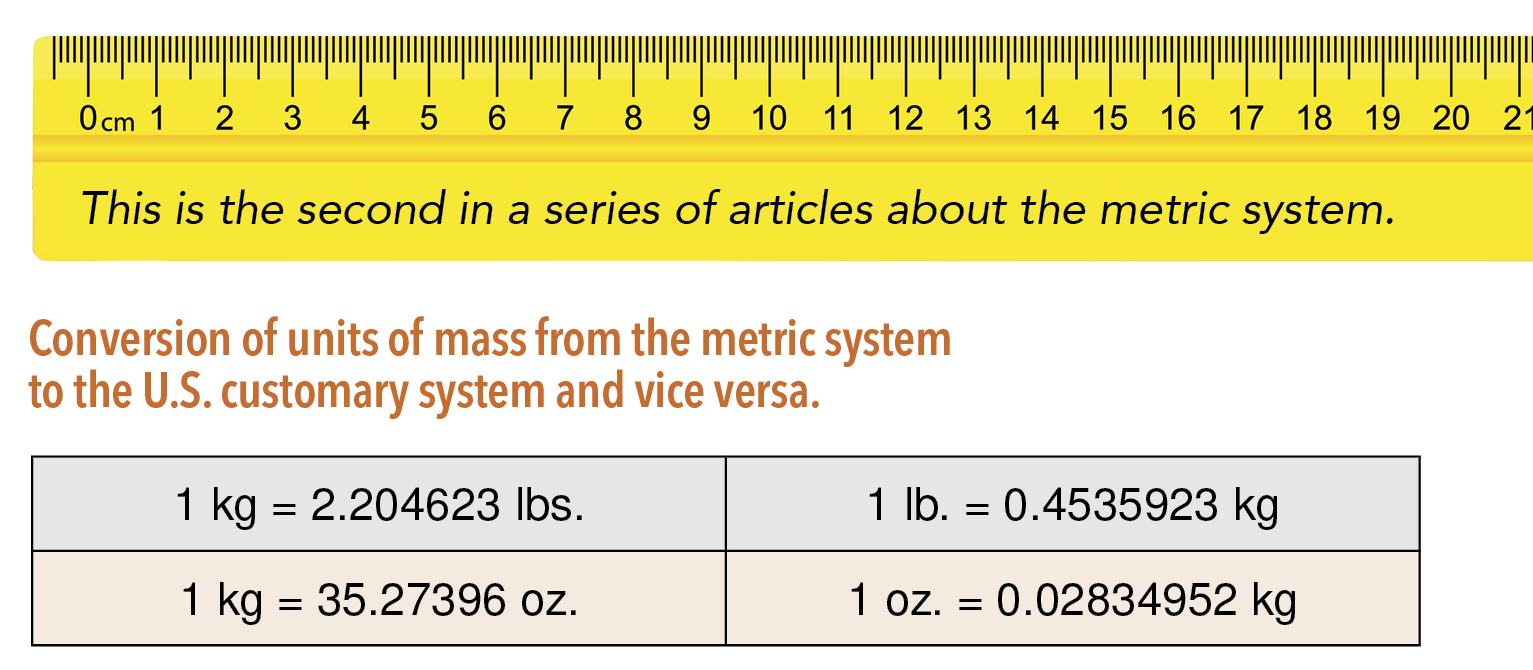
The most accurate measurements revealed that the mass of the international prototype was a bit greater than the mass of 1 dm3 of water (about 0.028 g, or 0.001 oz.). Since it was decided to leave the international prototype unchanged, the holding capacity of 1 L (33.8 fluid oz.), which is equal to the volume of 1 kg (2.2 lbs.) of water at 4° C (39.2° F), became a little greater than 1 dm3 (61.02 cu. in.), where 1 L equals 1.000028 dm3.
On Oct. 13, 1964, the 12th CGPM meeting authorized the equality: 1 L equals exactly 1 dm3.
Review the print ads from this magazine to continue
This quick advertiser review unlocks the rest of the article and keeps the full-screen reader focused on the ads instead of the page chrome.
Continue reading
March 2020
 MFGAxis Discussion
Be part of the shop-floor conversation
Like, save, or comment on this CTE story.
MFGAxis Discussion
Be part of the shop-floor conversation
Like, save, or comment on this CTE story.


MFGAxis Discussion