
Cost cutting: Drilling Performance
Indexable insert tools and techniques reduce costs while maintaining process reliability.
Indexable insert tools enable manufacturers to machine parts with carbide and other hard materials without having to purchase a solid cutting tool made of the same material as the cutting edges — a progressively expensive proposition as tool diameter increases.
Tools and techniques, however, are available to further reduce production costs and the cost per cutting edge when using indexable inserts. This article covers double-sided inserts and high-feed indexable insert milling tools.
On the Double
Double-sided inserts have a long history in metalcutting of reducing the cost per cutting edge, but cutting tool manufacturers continue to refine them and introduce offerings. Vernon Hills, Illinois-based YG-1 Tool (USA) Co., for example, announced that its new ENMX09 double-sided inserts have a total of four cutting edges and are suitable for high-feed milling.
“What makes them unique is the thickness, which addresses one of the major issues you have with double-sided, high-feed inserts,” said Jan Andersson, director of product management for indexable inserts. “The nature of the application is that you will always have flank wear on the bottom of the insert.”
He said the ENMX09 is 6.2 mm (0.244″) thick, which compares with insert thicknesses of 4.6 mm (0.181″) and 4.8 mm (0.189″) for two popular competing products.
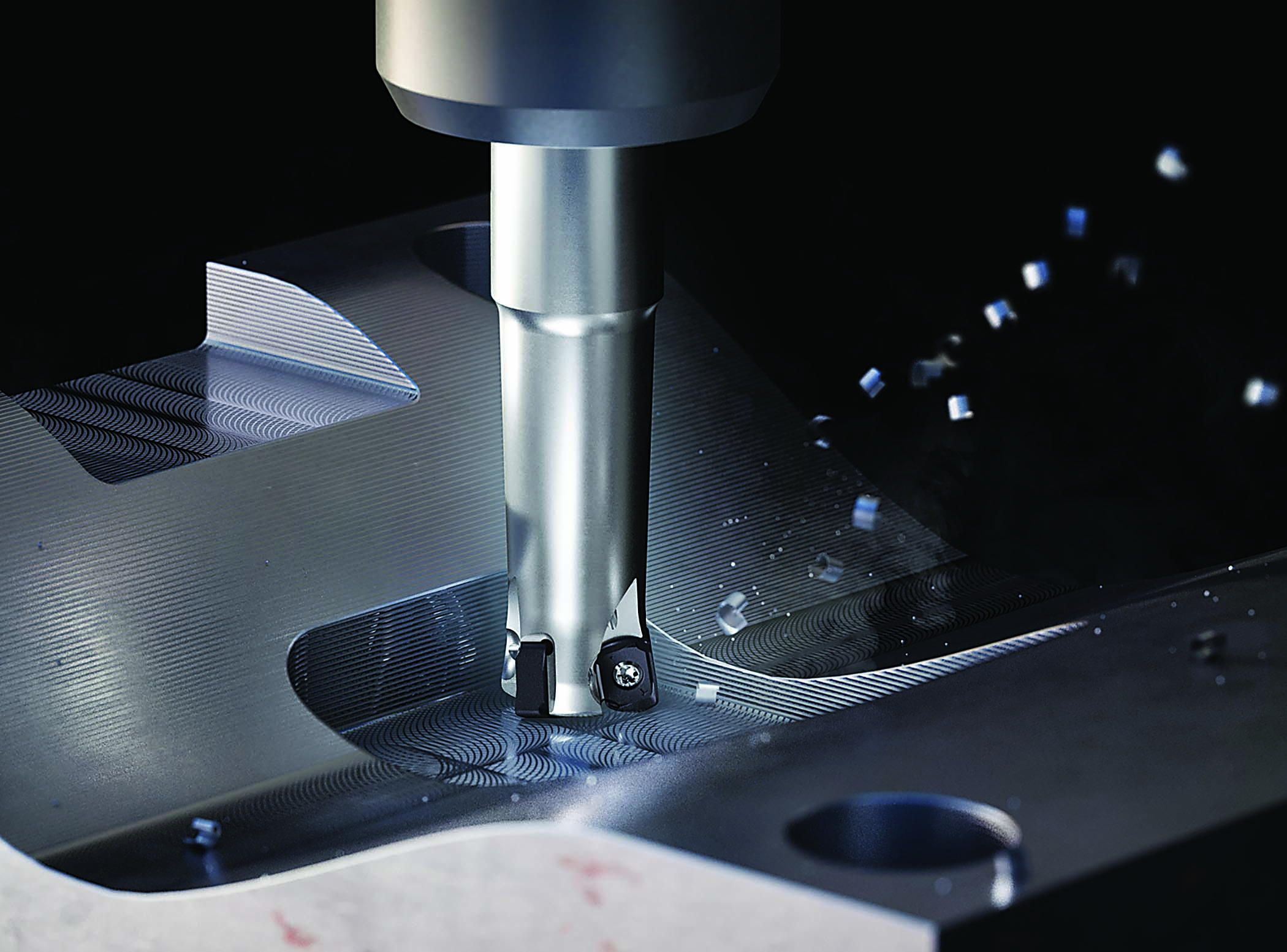
FFX4 ED endmills carry small, double-sided, “bone-shaped” inserts with four cutting edges for fast feed milling. Image courtesy of Iscar USA” data-entity-type=”file” data-entity-uuid=”58aebfb0-0bed-4ddd-943a-eabbc181fa9d” height=”399″ src=”/wp-content/uploads/legacy/inline-images/FFX4%20ED16_XNMU%2004%20-%20FeedMill%20small%20diameter%20%281%29%20%281%29.jpg” width=”576″ />Studies by YG-1 Tool (USA) showed that end users either used only one side of a double-sided, high-feed insert or accepted that they would obtain only 60% to 80% of the tool life for the second side compared with the first side when they used both sides, Andersson said.”Making a thicker insert allowed us to accept that flank wear but without having the encroachment issue,” he said. “This means four true cutting edges.”Developments in production technology have enabled tool manufacturers to increase the capability of double-sided inserts. Arlington, Texas-based Iscar USA, for instance, employs pressing technology with multiple stamping heads to increase the complexity of its double-sided inserts, said Keith Carlile, national product specialist for milling, who’s based in Centralia, Washington.”We can now make an insert that we could only dream about in the past,” he said.Carlile said one benefit is an increase in the cross-sectional thickness of the insert to permit more aggressive cutting than past products and provide adequate space for including Iscar’s signature dovetail clamping configuration on the top of the insert. The dovetail traps the insert rigidly in the pocket and takes pressure off the screw, he said.”It completely eliminates that micro back lift we have on the opposite side of the business end,” he said.In addition, Carlile said the dovetail design enables the toolmaker to manipulate how the insert sits in the pocket.”For instance,” he said, “we can lay an insert negatively in the pocket with an additional dovetail to make a very strong, robust mount but still have enough carbide so that we can bring the cutting edge positive and have a positive clearance underneath.”Robert Bokram, product manager for cutting tools at Ceratizit USA Inc. in Warren, Michigan, said toolmakers can offer double-sided milling inserts that have negative clearance geometries and high-positive rake angles.”The ‘pos/neg’ pocket orientation allows for insert designs that double the number of cutting edges per insert, utilizing higher rake angle chipbreaker geometries to compensate for the negative pocket orientation,” he said. “These more robust designs have proven to be very soft cutting, demonstrating similar spindle torque values to the conventional ‘pos/pos’ milling cutter designs.”Bokram said the more robust geometry permits the double-sided inserts to have an expanded range of applications beyond finishing, including medium and roughing operations, as well as machining heat-resistant superalloys and titanium.”They can handle heavier depths of cut and higher feed rates than conventional positive designs due to better support in the pocket,” he said.An Abundance of EdgesDavid Romlin, corporate product manager for indexable milling tools at Seco Tools AB in Fagersta, Sweden, said a time-tested double-sided insert is the Double Octomill, which has eight cutting edges per side for facemilling operations. (Seco Tools LLC is in Troy, Michigan.) A more recent development is the Double Turbo square shoulder mills that accept inserts with four cutting edges, which have an 11-degree positive helix angle to reduce power consumption.ENMX09 double-sided inserts are suitable for high-feed milling. Image courtesy of YG-1 Tool (USA)
“That provides good economy to the customer with the double-sided technology,” he said.
In addition to square inserts with eight cutting edges and octagon inserts with 16 edges, Carlile said Iscar offers the H606 double-sided round insert with six total edges. The insert gives adequate room for a helix angle on the outer diameter to supply a shearing rather than a pounding cutting action. He said an undercut feature on the bottom of the insert bisects a chip and reduces the amount of force it takes to remove the chip.
“We couldn’t do that with a single-sided insert,” he said. “We would have to have a very thick insert.”
However, limitations exist for inserts with edges on both sides. For example, Romlin said there’s a trade-off in productivity for double-sided inserts because the number of teeth in the cutter is slightly lower than for single-sided inserts.
“The double-sided insert requires a thicker core,” he said, “and hence (you) need more seat space in the cutter design.”
Andersson concurred that a double-sided insert has disadvantages.
“It’s detrimental from a technical perspective,” he said. “The one thing about double-sided inserts is you risk damaging the noncutting edge. If you don’t have chip control, the chip can wrap around and damage the bottom side of that insert.”
Bokram said double-sided inserts are restricted to the operations they can perform.
“Unlike pos/pos single-sided insert designs, they cannot perform ramping, plunging or contouring,” he said. “But they are well suited for face and shoulder milling, depending on the approach angle of the cutter.”
Feeding Frenzy
One surefire way to reduce production costs is by boosting part throughput.
“When it comes to cost per part, it all comes down to productivity because in reality the cost of the insert is very little in the scope of things,” Andersson said, adding that the cost of cutting tools represents on average 3% to 5% of total production costs. “You drive down production cost through productivity.”
Increasing the feed rate achieves this objective. Having wiper geometry on each cutting edge to improve surface finish enables end users to have the option of increasing the feed while maintaining the same surface finish as a conventional geometry, Bokram said. All Ceratizit USA positive/negative double-sided inserts have its Masterfinish wiper geometry on each edge.
“The exception is when the depth of cut exceeds the standard value and engages the adjacent edge, including the wiper on that edge,” he said. “Then, lower surface quality can be expected. This can be addressed with the addition of a wiper insert into one of the pockets.”
High-feed indexable insert milling tools are also widely available to up throughput. Andersson said this started several decades ago with round inserts, which have a continuously variable lead angle, depending on the DOC in relation to the radius.
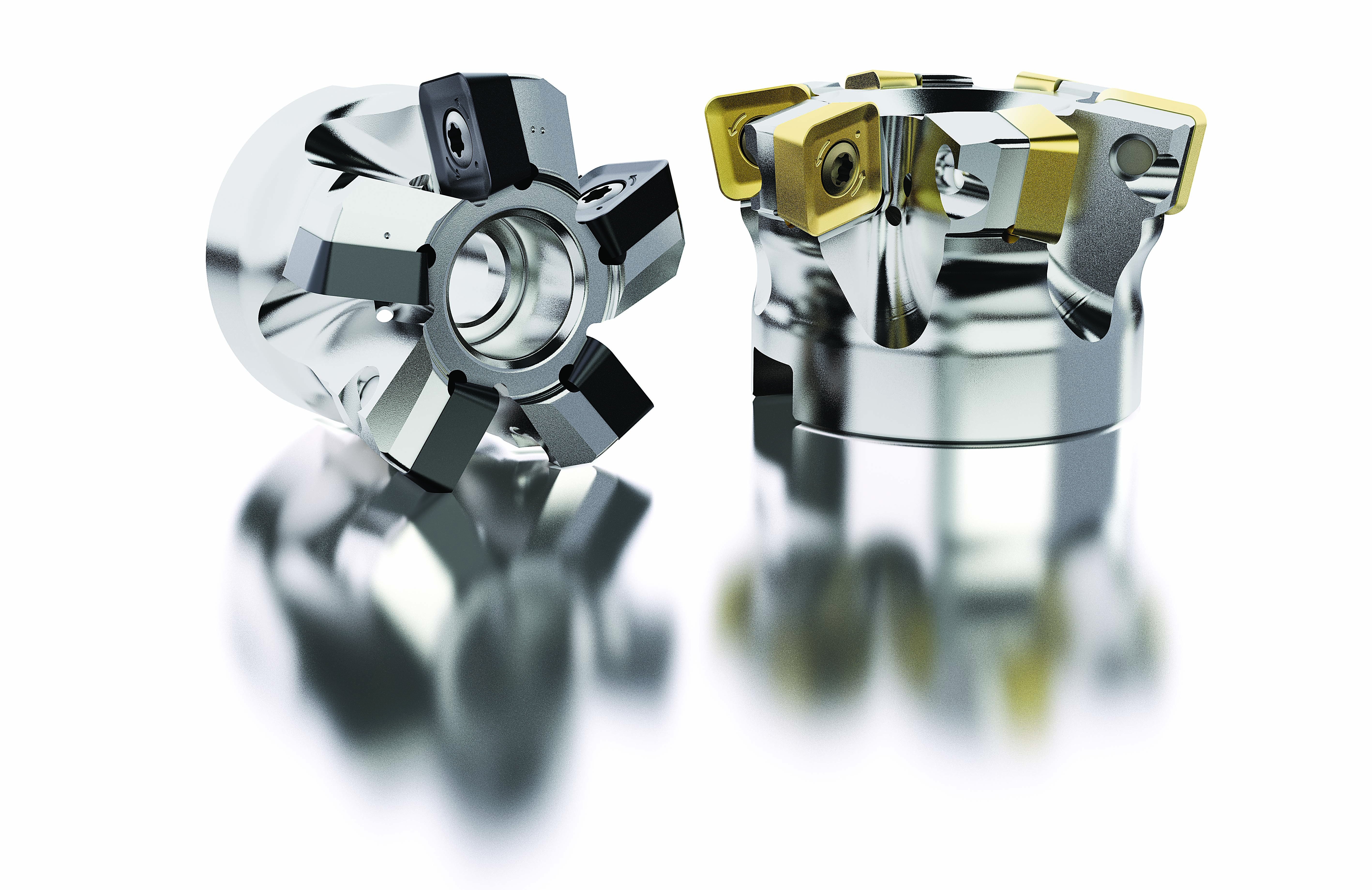
High Feed Square Cut milling cutters pair a shallow DOC with a high feed per tooth to achieve high metal removal rates. Image courtesy of Seco Tools
“The challenge with a round insert is you basically have a small contact point,” he said.
Carlile said cutting with a round insert generally generates chips that are too thin to absorb enough heat, with the remainder going into the part and tool.
“The problem with that is it would take a giant round insert to be able to take a reasonable depth of cut,” he said.
In addition, Romlin said rough milling with a round insert limits the ability of the tool to machine a shoulder, leaving a large scallop to be removed in a subsequent operation. He said the strategy for roughing with round inserts often involved starting with a large cutter and following with maybe two smaller inserts to rough a part.
The movement away from rough milling with round inserts to high-feed milling reduced the required size and number of cutters, as well as the size of the remaining corner scallop, he said.
“It was a big improvement in process reliability, productivity and stability because the force being applied is less as you start to use the high-feed concept,” Romlin said. “This is one of our fastest-growing product areas, supporting the need for productivity improvements in the manufacturing industry. The high-feed concept is now an established machining method.”
For example, Seco Tools introduced the High Feed Square Cut size 14 milling system late last year. The toolmaker reports that the single-sided, straight-edge insert geometries of the system are suitable for high-feed ramping, pocketing, plunging, facemilling and copy
milling.
A Shallow Approach
Bokram said high-feed milling tools use a simple design feature to fundamentally change machining parameters, often resulting in significantly higher total metal removal rates than conventional 45- and 90-degree designs. By reducing the approach angle of the cutter to 15 to 20 degrees, the resultant average chip thickness is reduced, which commonly is known as chip thinning.
“In order to increase the chip thickness to the ‘normal’ range for the insert edge geometry, the feed rate (ipm) must be increased,” he said. “The result is higher cutting speeds and ultimately higher metal removal rates.”
Review the print ads from this magazine to continue
This quick advertiser review unlocks the rest of the article and keeps the full-screen reader focused on the ads instead of the page chrome.
Continue reading
April 2022