Automated payback
Collaborative robots can provide a quick return on investment when the application is appropriate.
When automating a manufacturing process at a job shop, some feel that every application is collaborative robot-compatible based on their perceptions about what cobots can achieve.
“The marketplace is thinking cobots are the end-all, be-all solution, but in reality this is not always the case,” said John Tuohy, executive director of global accounts for Fanuc America Corp. in Rochester Hills, Michigan.
The company manufactures a variety of industrial robots and factory automation systems, including conventional robots that can handle payloads up to 2,300 kg (7,055 lbs.) and the CR and CRX series of cobots with payloads from 4 to 35 kg (8.8 to 77.2 lbs.).
Greg Buell, staff engineer of QSSR and machine tending applications for the general industry and automotive segment, concurred with his colleague.
“Collaborative robots may not be a good fit for all applications,” he said. “There are some cases where the integration and use of a collaborative robot could be more expensive than a standard robot.”
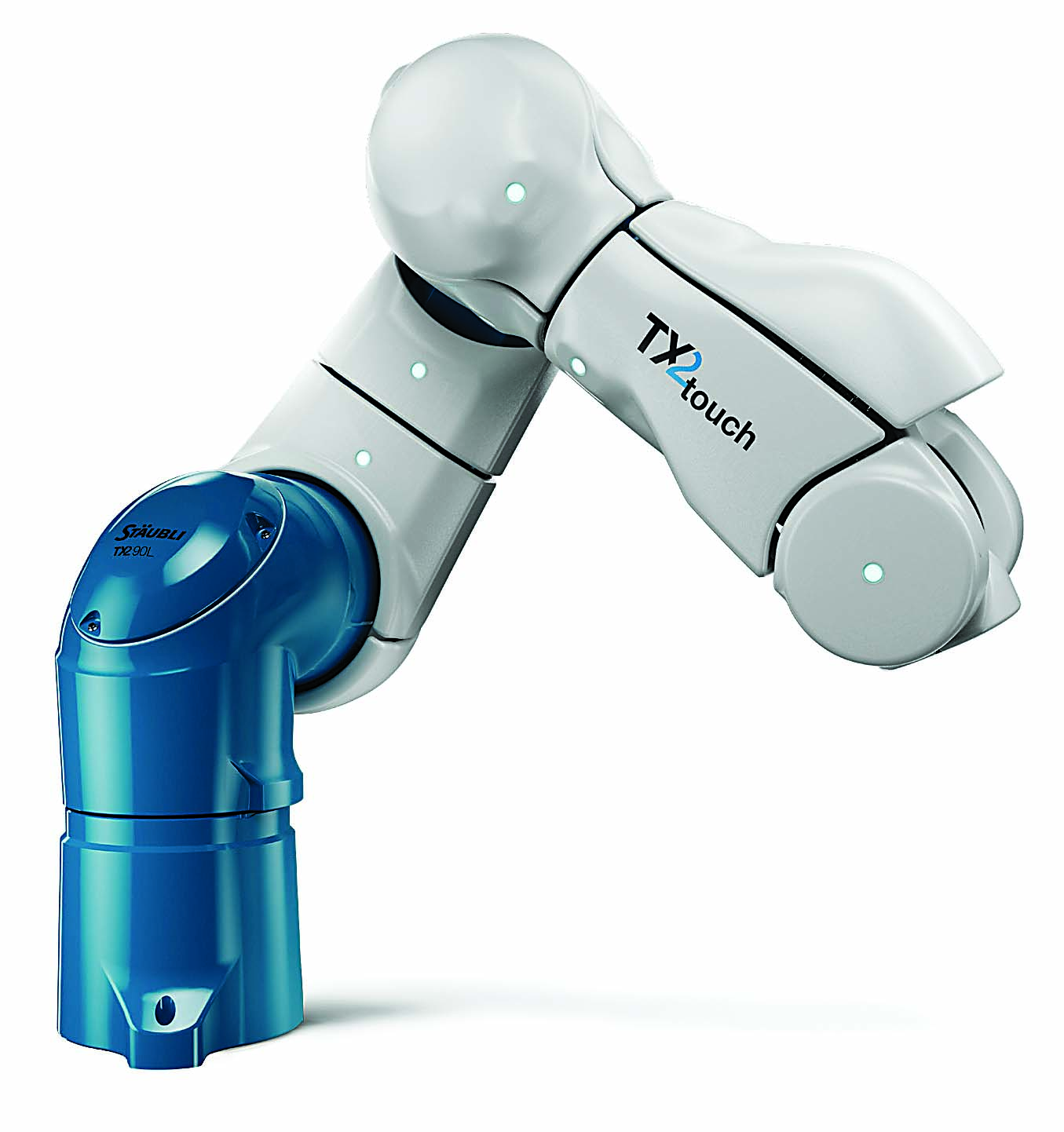
Stäubli reports that its TX2touch-90L cobot offers safe operation thanks to its advanced skin technology, quick reaction times and embedded modular safety functions. Image courtesy of Stäubli
For example, if a shop requires a specific throughput rate to achieve a return on investment within a required timeframe, a cobot might not do the trick because it moves slower than a conventional industrial robot, Tuohy added.
Nonetheless, when implementing a cobot into a high-mix, low-volume production environment makes sense, the ROI can be fairly quick.
“A year is becoming very common,” said Joe Campbell about a cobot’s payback.
He is senior manager of strategic marketing for cobot manufacturer Universal Robots USA Inc. in Ann Arbor, Michigan.
Campbell said manufacturers achieve a fast ROI in two different ways: by controlling the expense of getting the cobot up and running and by leveraging it to increase utilization. Installing a cobot for tending a machine tool might cost $75,000 to $80,000.
“That’s the cobot, the gripper, the mounting — everything,” he said. “The cost is pretty close to what you would pay a manufacturing operator over the course of the year with a little bit of overtime and benefits.”
And because a job shop or contract manufacturer doesn’t necessarily have a steady stream of similar parts that a hard-mounted traditional robot can feed into a machine, Campbell noted that high-mix, low-volume manufacturers can use a cobot like a tool and move it from machine to machine as needed.
End users often envision a cobot being repurposed and used in a variety of locations throughout a facility, but they frequently find that it works so well in one application that it remains there and additional cobots are purchased instead, according to Buell.
Incremental Investment
Toolcraft Inc. in Monroe, Washington, is a provider of CNC machining services that realized an ROI in 12 months after purchasing a UR5e cobot from Universal Robots USA, Campbell said.
“Twelve months is common, and the fastest we have on record is 34 days,” he said. “I believe those calculations included additional business that they would not have secured with the additional capacity from the cobot.”
Since then, Toolcraft has purchased a second UR5e, said Brian Laulainen, automation engineer for the company. One performs a variety of smaller jobs in a machine in which Toolcraft swaps between different part numbers and different machining operations.
“All the programs are saved,” he said, “and all the positions are saved, so we can pretty much just set the parts up in the same position in the machine and on our in-feeders.”
Laulainen said the other cobot is for a high-production job in which the part is machined on a five-axis trunnion before being moved to a fixture for a second operation.
“From there we pull the parts out, clean them and set them on a completed tray,” he said.
Laulainen added that Toolcraft might require custom end effectors, or end-of-arm tooling, for the different cobot setups that the company has, and it uses its Formlabs 3D printer to quickly produce the needed design.
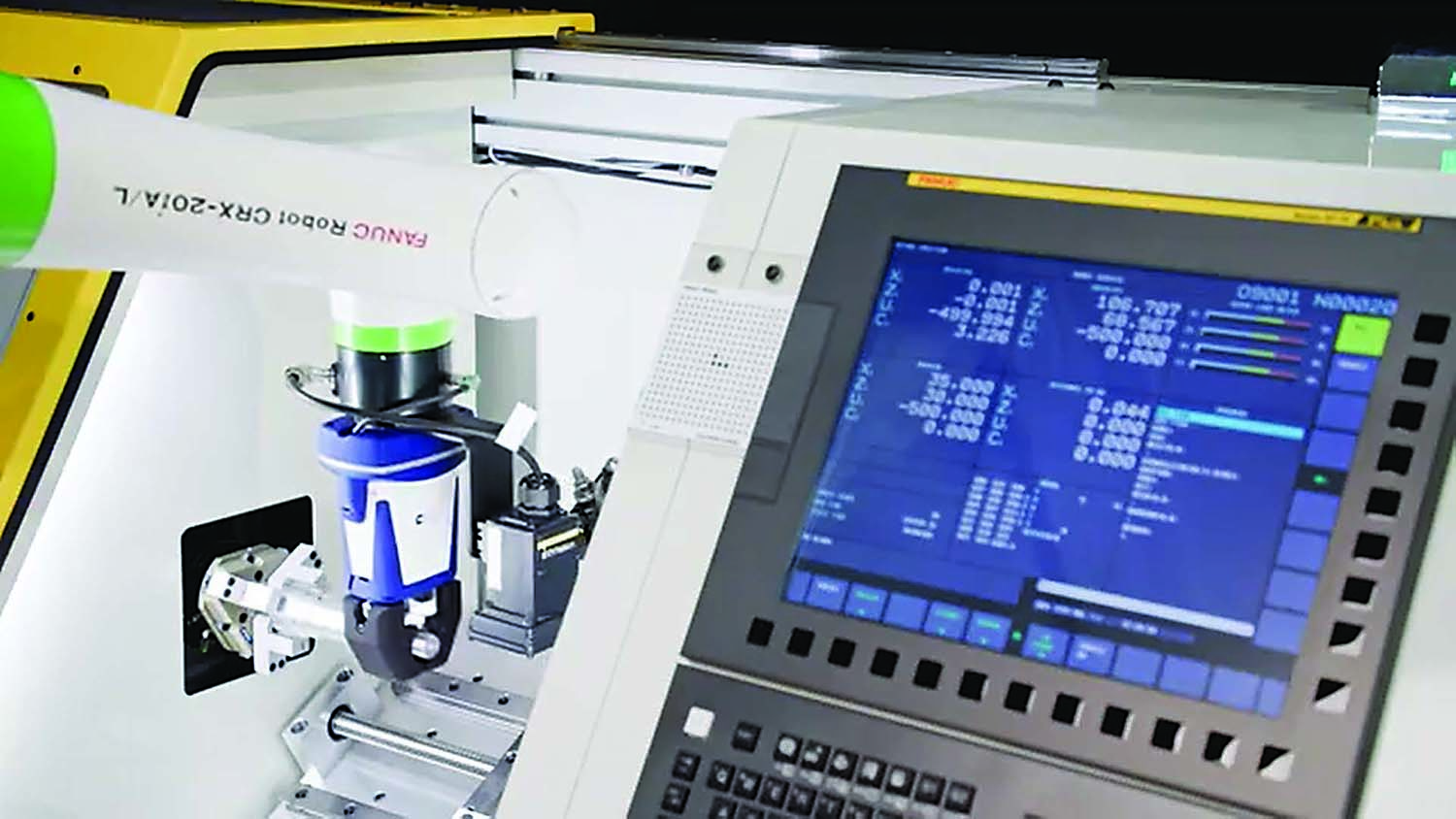
A CRX cobot is connected to a machine with Fanuc controls, and software simplifies robot integration and startup. Image courtesy of Fanuc America
“Within a few hours,” he said, “we have a new end effector.”
Campbell said not only is printing end-of-arm tools a quick way to produce them, but making them does not tie up the machine shop.
“The faster you can get any investment up and running,” he said, “the faster you start generating returns.”
In addition to gaining jobs that the shop might not have landed otherwise, Laulainen said the cobots enable Toolcraft to run lights-out machining and maximize payback. And the company’s incremental investment in automation equipment isn’t complete.
“Once the right parts come in and we see we have the ability or the place to add another cobot, we would do it,” he said.
Adding cobots continues to become quicker and easier as cobot manufacturers continue to make improvements, such as making it easier to program them for machine tending, Laulainen noted.
Programming Ease
End users are looking for more ease in programming, agreed Gilles Le Quilleuc, head of general industry for North America at Stäubli Corp. in Duncan, South Carolina. It’s important to get a cobot up and running quickly and achieve a fast ROI because job shops don’t typically have an engineering team and it’s becoming more difficult to find and hire application engineers.
Stäubli offers a host of robotic equipment, including industrial robots, mobile robots, automated guided vehicle platforms and cobots. According to the company, its TX2touch Power cobots offer safe operation around workers thanks to advanced skin technology, quick reaction times and embedded modular safety functions.
Review the print ads from this magazine to continue
This quick advertiser review unlocks the rest of the article and keeps the full-screen reader focused on the ads instead of the page chrome.
Continue reading
May 2023
QR codes and videos from this issue
Print QR codes, video callouts, and in-magazine links for this article now point to the CTE video hub in the HTML version.