
Turning center with built-in motor spindle

Published Date
December 05, 2025
The QTE-200 MSY CNC Turning Center from Mazak

The QTE-200 MSY CNC Turning Center from Mazak was built for speed, precision, and reliability, the company says. The QTE-200MSY’s integral 20 hp (15 kW) turning spindle reaches a maximum speed of 5,000 rpm, and the machine processes part diameters up to 13.39" (340 mm) and has a bar diameter capacity of 2.56" (65 mm).
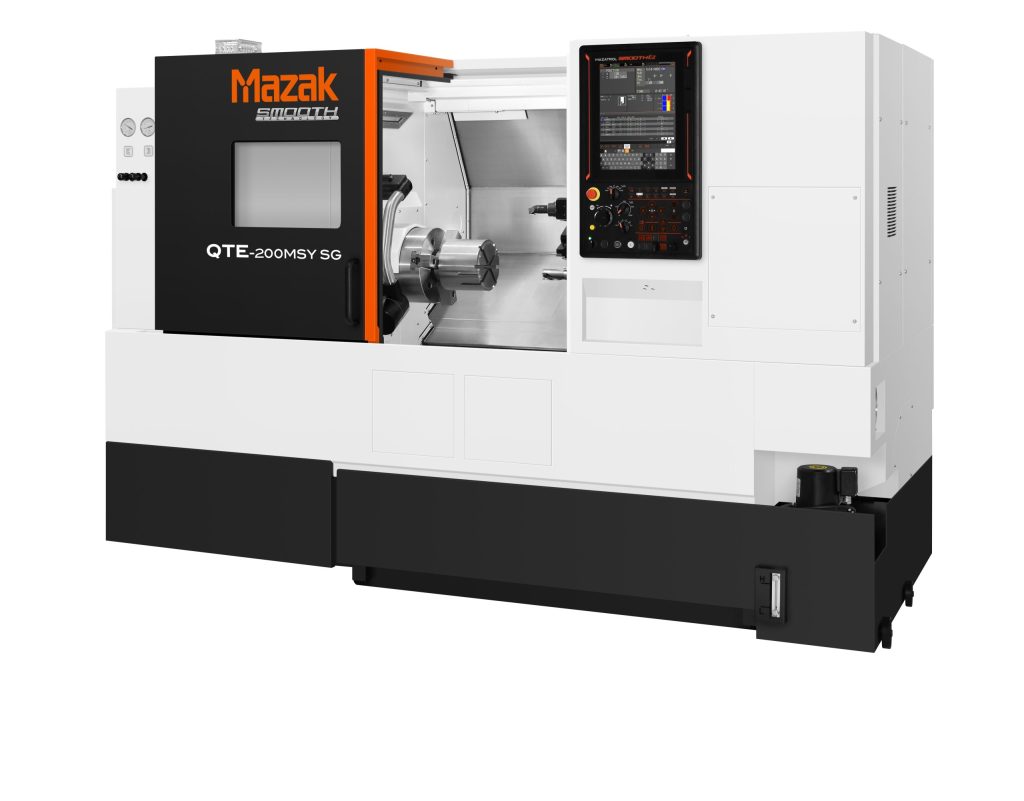
The machine accommodates workpieces up to 22.6" (574 mm) in length. Feed axes measure 8.46" (215 mm) in X, 3.94" (100 mm) in Y, and 23.8" (605 mm) in Z, with LM guides on all axes for superior long-term accuracy and repeatability. The rotary tool turret spindle provides 7.38 hp (5.5 kW) milling with a maximum speed of 4,500 rpm and 12-tool capacity.

The QTE-200MSY has a 10 hp (7.5 kW) second spindle capable of 6,000 rpm with a 6" chuck to allow for a Done-in-One process. For reduced maintenance and higher part quality, the headstock design of the QTE-200MSY eliminates belts and pulleys, while the overall machine construction minimizes vibration to produce high-accuracy machining with exceptional surface finishes.

The QTE-200MSY includes the Mazatrol SmoothEz CNC with Mazatrol conversational programming and G-code programming capabilities. For built-in automatic tool presetting, operators simply bring the tool tip in contact with the machine's Automatic Tool Eye, which automatically records the offset of the tool nose position, tool measurement and data registration to ensure accuracy and reduce setup time.

Related Glossary Terms

  • G-code programming

    G-code programming

    Programs written to operate NC machines with control systems that comply with the ANSI/EIA RS-274-D-1980 Standard. A program consists of a series of data blocks, each of which is treated as a unit by the controller and contains enough information for a complete command to be carried out by the machine.

  • chuck

    chuck

    Workholding device that affixes to a mill, lathe or drill-press spindle. It holds a tool or workpiece by one end, allowing it to be rotated. May also be fitted to the machine table to hold a workpiece. Two or more adjustable jaws actually hold the tool or part. May be actuated manually, pneumatically, hydraulically or electrically. See collet.

  • computer numerical control ( CNC)

    computer numerical control ( CNC)

    Microprocessor-based controller dedicated to a machine tool that permits the creation or modification of parts. Programmed numerical control activates the machine’s servos and spindle drives and controls the various machining operations. See DNC, direct numerical control; NC, numerical control.

  • conversational programming

    conversational programming

    Method for using plain English to produce G-code file without knowing G-code in order to program CNC machines.

  • feed

    feed

    Rate of change of position of the tool as a whole, relative to the workpiece while cutting.

  • gang cutting ( milling)

    gang cutting ( milling)

    Machining with several cutters mounted on a single arbor, generally for simultaneous cutting.

  • milling

    milling

    Machining operation in which metal or other material is removed by applying power to a rotating cutter. In vertical milling, the cutting tool is mounted vertically on the spindle. In horizontal milling, the cutting tool is mounted horizontally, either directly on the spindle or on an arbor. Horizontal milling is further broken down into conventional milling, where the cutter rotates opposite the direction of feed, or “up” into the workpiece; and climb milling, where the cutter rotates in the direction of feed, or “down” into the workpiece. Milling operations include plane or surface milling, endmilling, facemilling, angle milling, form milling and profiling.

  • turning

    turning

    Workpiece is held in a chuck, mounted on a face plate or secured between centers and rotated while a cutting tool, normally a single-point tool, is fed into it along its periphery or across its end or face. Takes the form of straight turning (cutting along the periphery of the workpiece); taper turning (creating a taper); step turning (turning different-size diameters on the same work); chamfering (beveling an edge or shoulder); facing (cutting on an end); turning threads (usually external but can be internal); roughing (high-volume metal removal); and finishing (final light cuts). Performed on lathes, turning centers, chucking machines, automatic screw machines and similar machines.