
Kyocera says its MA90 milling series features 4-edge tangentially mounted inserts, ensuring ultimate body rigidity, superior chip evacuation, enhanced tool life, and impeccable surface finishes. Available in a variety of inch and metric end mill, face mill, and modular head sizes, the MA90 mills are designed with rigidity and ease-of-use in mind.
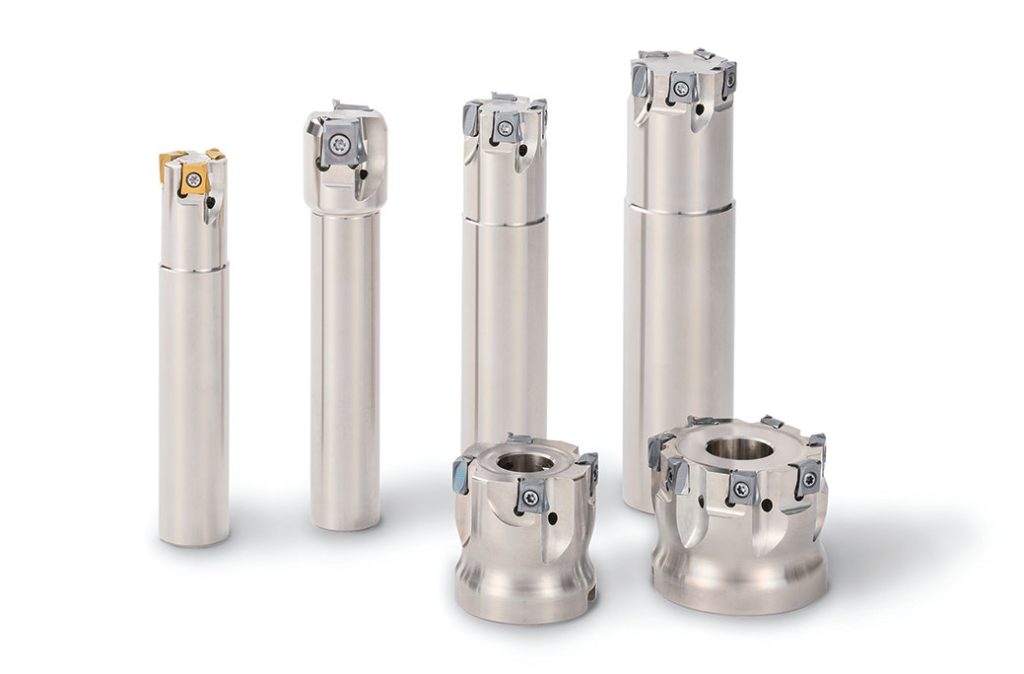
Due to its design with tangentially mounted inserts where the insert screws are on the side, cutting forces are directed into the insert pocket corner. On conventional mills where the screw is on the front, cutting forces directed over the edge of the insert can build tension on the screw. The tangential design also allows for more teeth per diameter, better chip evacuation, and larger web thickness, giving a significant amount of rigidity to the body.
When paired with the latest PR18 Series inserts, the MA90 demonstrates its capability to tackle various materials. PR18 Series insert grades incorporate proprietary MEGACOAT NANO EX coating technology, setting a new standard for wear resistance and durability, the company says. By using a unique double lamination technique with special nano multi-layers for abrasion, wear, and heat resistance, this coating surpasses conventional grades, delivering superior performance and extending the lifespan of the tools.
Contact Details
Related Glossary Terms
- gang cutting ( milling)
gang cutting ( milling)
Machining with several cutters mounted on a single arbor, generally for simultaneous cutting.
- milling
milling
Machining operation in which metal or other material is removed by applying power to a rotating cutter. In vertical milling, the cutting tool is mounted vertically on the spindle. In horizontal milling, the cutting tool is mounted horizontally, either directly on the spindle or on an arbor. Horizontal milling is further broken down into conventional milling, where the cutter rotates opposite the direction of feed, or “up” into the workpiece; and climb milling, where the cutter rotates in the direction of feed, or “down” into the workpiece. Milling operations include plane or surface milling, endmilling, facemilling, angle milling, form milling and profiling.
- milling machine ( mill)
milling machine ( mill)
Runs endmills and arbor-mounted milling cutters. Features include a head with a spindle that drives the cutters; a column, knee and table that provide motion in the three Cartesian axes; and a base that supports the components and houses the cutting-fluid pump and reservoir. The work is mounted on the table and fed into the rotating cutter or endmill to accomplish the milling steps; vertical milling machines also feed endmills into the work by means of a spindle-mounted quill. Models range from small manual machines to big bed-type and duplex mills. All take one of three basic forms: vertical, horizontal or convertible horizontal/vertical. Vertical machines may be knee-type (the table is mounted on a knee that can be elevated) or bed-type (the table is securely supported and only moves horizontally). In general, horizontal machines are bigger and more powerful, while vertical machines are lighter but more versatile and easier to set up and operate.
- wear resistance
wear resistance
Ability of the tool to withstand stresses that cause it to wear during cutting; an attribute linked to alloy composition, base material, thermal conditions, type of tooling and operation and other variables.
- web
web
On a rotating tool, the portion of the tool body that joins the lands. Web is thicker at the shank end, relative to the point end, providing maximum torsional strength.