Mazak’s Swiss style CNC for small, precise parts
Mazak’s Swiss style CNC for small, precise parts
The Syncrex 38/8 Swiss-style CNC machine handles bar stock up to 1.5" (38 mm), allowing shops to run full bar capacity with no special bar end preparation. The 8-axis configuration is standard with 10 hp (7.5 kW) main and second spindles, four cross working live tools on the main spindle, as well as up to six live tools and a Y-axis for the counter spindle.
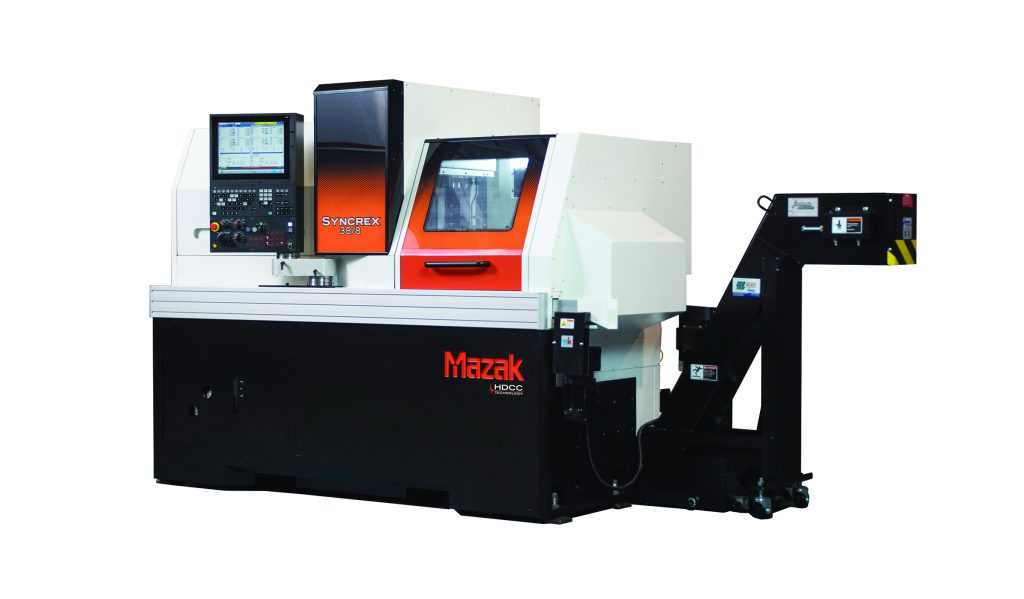
For high-volume production of small, precise motorsports parts, the Syncrex 38/8 Swiss-style machine is built on Mazak's High Damping Composite Casting (HDCC). The company says the high-rigidity base provides greater vibration-damping characteristics, less thermal growth, longer tool life, and greater part surface capabilities than cast iron.
The Syncrex 38/8 handles bar stock up to 1.5" (38 mm), allowing shops to run full bar capacity with no special bar end preparation. The 8-axis configuration is standard, featuring a 10 hp (7.5 kW) main spindle and a second spindle, as well as four cross-working live tools on the main spindle. Additionally, it includes up to six live tools and a Y-axis for the counter spindle.
The unit features 36 tool positions, and the removable guide bushing adapter enables operators to preset the guide bushing outside the machine. The machine is also considered "convertible" and can quickly and easily be changed over to run in chucker/non-guide brushing mode, to efficiently run shorter non-traditional parts that would normally run in a fixed headstock lathe, which improves shop output.
The Syncrex 38/8 includes the new Mazatrol SmoothSt control with a full mechanical keyboard. The optional Mazak Swiss Setup Assist (MSSA) provides fast and easy job setup capabilities, while the optional Mazak Dynamic Chip Control (MDCC) functionality increases chip-management performance.