
Flipping heavy plate parts
Flipping heavy plate parts
The patented EasyFlipper from Teqram turns sheet-metal parts within seconds without the need to use a crane and slings, belts or clamps to turn heavy workpieces. This is a less dangerous alternative, the company said, and helps keep the part from being scratched during material handling.
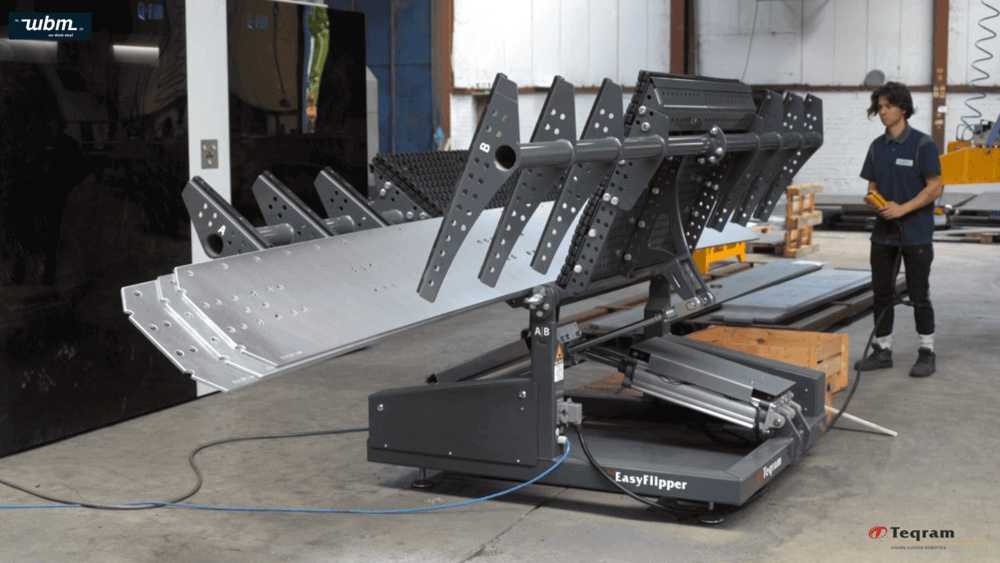
The patented EasyFlipper from Teqram turns sheet-metal parts within seconds without the need to use a crane and slings, belts or clamps to turn heavy workpieces. This is a less dangerous alternative, the company said, and helps keep the part from being scratched during material handling.
Teqram's Hydraulic EasyFlipper 5 Tons is designed to turn steel plates up to 5000 kg/11000 lbs smoothly and efficiently, the company says.
The EasyFlipper plate turner is often used as a workstation for deslagging and sanding as well as a plate flipper for steel plates or sheet metal blanks. Its use as a universal turning device is particularly popular for applications where speed and safety are important.
In one application, the EasyFlipper, which is mobile and can be moved with a forklift, was initially deployed at the plasma cutting station, the press brake, and the deburring machine as it was needed.
Typical applications:
- Safe and fast turning of heavy sheet metal components
- Turning of flame-cut parts, turning of plasma parts
- Turning heavy components in front of a machining center for processing the opposite side
- Turning laser-cut sheets next to a folding machine
- For visual inspection of the top and bottom sides in QA
- Turning of sheet metal packages - e.g. tear plates
- Turning heavy blanks to fulfill packing instructions