


Tips for Getting the Most Out of Wire EDM
Wire EDM depends on more than machine settings alone. This guide reviews the setup, maintenance, and process controls that most affect wire-EDM performance.
Quick take: Wire EDM performs best when shops treat setup, wire condition, flushing, and machine discipline as one system instead of chasing only parameter tweaks. This page is most useful when it is read with copper-EDM and EDM-surface references.
Related references: EDM Conquers Copper: Settings and Electrode Guide, Understanding EDMed Surfaces, and Shop math: Practice makes perfect.
Wire EDMing requires a range of equipment and complex operations, which can lead to a variety of problems. But the capability and flexibility of the electrical adaptive control technologies that monitor the EDM process—such as flushing, wire tension, automatic wire threading, wire consumption levels, geometry control, surface quality, water resistivity level and water chiller/thermal stability—have greatly improved over the past 10 years.
Adaptive control enables the EDM to adapt to changing conditions by adjusting its internal parameters. Adaptive control can also help prevent wire breakage and automatically fine-tune the process for maximum speed and efficiency.
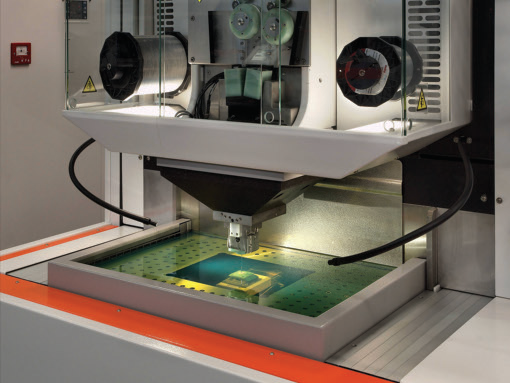
Courtesy of GF AgieCharmilles
Wire EDMs that use an oil-based dielectric machine carbide workpieces without cobalt depletion. This GF AgieCharmilles machine also features an automatic wire changer.
“The wire EDM process is [inherently] unstable,” said Brian Pfluger, EDM team leader for Mason, Ohio-headquartered Makino Inc., who is based in Auburn Hills, Mich. “So the electrical adaptive control tries to continuously self-optimize. If it detects a problem, such as a change in material thickness or a step-down, it will back off a little from the settings or use more aggressive settings to create a stable burn condition to maintain the best efficiency and accuracy.
“The control is always trying to cut as fast as it can while maintaining a stable machining condition,” Pfluger continued. “Even if you tell it to cut faster, the control will use settings that are stable. You can change your target parameters, but you want overall consistency. There is a productive limit to how hard you can push the EDM. If you push too hard, your wire breaks. Adaptive control is there to prevent that.”
The continued development of adaptive control has allowed previous accuracy and surface finish problems to become mostly a thing of the past. The control allows much better regulation and focus of the discharge spark to get repeatable results. This helps improve part quality and metallurgical integrity.
Of particular concern are recast layer and the heat-affected zone. Because EDM- ing is a thermal process, recast layer and HAZ will always be a reality, but newer adaptive controls have virtually eliminated these layers and concerns.
“The adaptive control allows the operator to fine-tune the wire EDM process to prevent recast,” said Pete Intihar, vice president of AccuteX EDM, Mason, Ohio. “The recast layer used to be from 0.001 ” to 0.005 ” deep, but with the new technology, it is only 0.0002 ” deep or less, depending on the material,” he noted. “You can’t get away from it 100 percent, but it is practically eliminated.”
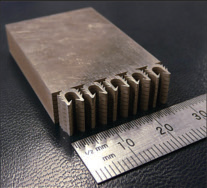
Courtesy of Makino
This Ti6Al4V medical part was machined on Makino’s DUO43 wire EDM in 5 minutes, 30 seconds (3 hours, 40 minutes for 40 parts). It took four passes to produce a 30 µin. Ra surface finish with 0.004 “-dia. brass wire.
One of the most important adaptive control features for wire EDMing is the ability to “tune” it for specific materials, such as titanium and Inconel. However, the machines are not capable of knowing which type of steel is being machined, according to Dave Kari, wire EDM director of Top Tool Co., Minneapolis. “All the EDMs are set up for D-2 tool steel, so for a piece of A-2 tool steel, for example, the settings require some changing,” he said. “A-2 requires 20 percent less power and more off time and somewhat higher voltages to help with the flushing and burning characteristics of the steel. Not everyone knows this.” Top Tool is a metal stamping manufacturer. The company is trending toward making microtooling but manufactures large parts as well.
Another surface finish problem is rust on steel parts. Most new wire EDMs have an anti-electrolysis system as part of the adaptive control that protects the cutting zone.
Another method to help prevent or control rust is to add chemical rust inhibitors to the water dielectric. While the chemical inhibitors are effective, they do require some maintenance and monitoring.
“The inhibitors can shorten the life of the resin system, which affects the water conductivity level,” Makino’s Pfluger said. (Resin is added to dielectric to maintain conductivity). “As you replenish water to make sure that rust preventative is effective, you have to closely monitor its concentration level.” Pfluger noted chemical rust inhibitors are not necessary when using Makino’s system.
The rust problem increases when using burn time, according to Kari. “With a bigger part, you still get a certain amount of rust. We had a part that took 115 hours, and we had to use rust inhibitor,” he said.
Benefits of Oil
Wire EDMs that use an oil-based dielectric instead of water “are really starting to come into play,” said Ken Baeszler, a product manager at GF AgieCharmilles, Lincolnshire, Ill. “Because water is inherently corrosive, it will corrode carbide and other materials susceptible to cobalt depletion if they are left in the work tank too long. With oil, carbide is not subject to that level of cobalt depletion, so we can put long campaigns, say, 100 hours’ worth of carbide work, in the tank and not worry about [corroding the cobalt]. This is great for unattended production.”
In addition to carbide tooling, such as stamping dies, oil-based dielectric EDMs work well with wire 0.003 ” in diameter and below and for smaller parts.
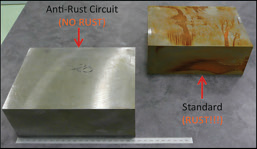
Courtesy of Makino
These pieces of 8.0 “×6.0 “×2.0 ” P-20 tool steel were tested on Makino’s DUO64 wire EDM. Both samples were submerged in water at a 15 microsiemens per centimeter conductivity level for a consecutive 24-hour period. The block on the right was tested without the rust prevention circuit being active, and the block on the left was tested with the rust prevention circuit being active. The left sample demonstrates the effectiveness of the anti-rust circuit, which prevents rust formation using a special cathode plate that electrically protects the entire machine working area, including the cutting zone.
“The oil contains the spark, making it less aggressive,” said Dave Thomas, president of Sodick Inc., Schaumburg, Ill. “The conductivity of water is much higher than oil so in water dielectric each spark is more violent. EDMing in oil can also, in some cases, allow the use of larger diameter wire because of the smaller spark gap compared to water dielectric.”
Until recently, it was commonly accepted that the disadvantage of using oil dielectric was cutting speed. “Precision tools could be machined without carbide depletion but cutting times could be 30 percent slower,” Thomas said. “Sodick’s Eco-cut technology reverses this speed comparison with water dielectric and now offers faster machining times.”
Another benefit is that, because oil maintains a specific conductivity, it doesn’t require deionizing. “So you don’t need a resin with an oil-based system,” Baeszler said. “A lot of people don’t realize that.”
Prevent Wire Breakage
One of the easiest ways to increase cutting speeds is to use coated wire instead of plain brass. However, this requires balancing cost vs. results because the coated wire costs about twice as much.
“Most shops run with brass wire based on its economy,” said Makino’s Pfluger. “Running coated wire can make the EDM run 30 percent faster, but it’s double the price.”
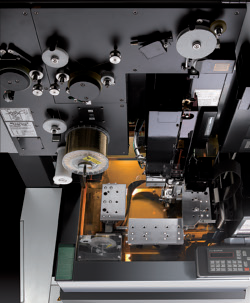
Courtesy of Sodick
EDMs that use an oil-based dielectric instead of water work well with fine wire and carbide workpieces.
AccuteX’s Intihar said among the soft brass, regular brass, zinc-coated and stratified wire available for EDMing, he recommends zinc-coated as a happy medium. “Zinc-coated wire is only a fraction over the cost of brass but still allows 15 to 20 percent faster cutting,” he said. “The coating makes the wire a little stiffer and you can put more energy into the wire, allowing faster cutting speeds.”
In certain “difficult-to-flush situations,” fewer wire breaks occur with a coated wire than plain brass. The purpose of coated wire is to aid the flushing, according to Baeszler. “If you push a wire too fast on an EDM, it breaks,” he said. “One of the reasons it breaks is the debris inside the spark gap overwhelms the wire. It causes the wire to short out, act like a fuse and break. Coated wire acts as a buffer between the wire and the workpiece, and the coating becomes sacrificial.”
Larger diameter wire also tends to break less frequently than smaller diameters. But larger wire can’t be used in all applications, such as for creating an inside radius that is tight and sharp.
Another disadvantage of using larger diameter wire is the larger the diameter, the less wire is on the spool. “Just by going from 0.0010 ” to 0.008 ” in diameter, you get 20 percent more wire,” Baeszler said. “And that 0.008 ” wire creates a 20 percent smaller kerf. This means less debris, so you use fewer filters as well.”
But Baeszler added that there is a need for larger-diameter wires. “It becomes, in a way, an ROI analysis. If I use this larger wire that is more expensive but cuts 2 hours faster, it is worth buying. If it doesn’t cut it X amount faster, then I am wasting my money.”
Pick a Guide
Both round and V-shaped wire guides are used in EDMs. Sodick’s Thomas typically recommends V-shaped guides for wire 0.001 ” in diameter or finer and round guides for anything larger.
There are disadvantages with the V-shaped guides, especially in the higher-speed wire EDMs, according to Thomas. “When the round wire sits in a V-shaped guide, the support area between the wire and the guide itself is only a 2-point contact. In the case of round guides, the support area is 360°, which is critical for achieving cutting precision.” Not everyone agrees with Thomas, however, that V-shaped guides are less accurate.
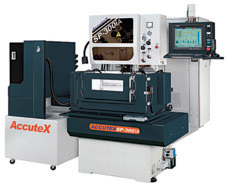
Courtesy of AccuteX EDM
AccuteX’s SP-300iA 5-axis wire EDM features its latest Microsparking technology for providing a low recast and fine finishes.
To switch wire size, the wire and guides are typically changed manually. However, some EDMs have automatic wire changers. When one wire spool is exhausted or the wire size needs to be changed, the machine automatically switches to another spool.
GF AgieCharmilles offers an automatic wire changer. “For example, say I have a carbide punch that needs a 0.004 “-dia. wire because it has small inside radii,” Baeszler said.”Cutting a 2 ” punch with 0.004 ” wire takes forever. I can go in and rough with 0.008 ” wire and then finish with 0.004 ” wire. And the EDM uses V-shaped guides so I don’t have to change the guides out to use a different size wire. On a standard machine, the operator would probably just stick with the 0.004 ” wire rather than manually change the wire and guides.”
Top Tool is one shop that takes advantage of an automatic wire changer. “Right now, we have 0.006 ” wire on one spool and 0.002 ” on the other spool,” Kari said. “The EDM cuts the outside features with the bigger wire and then switches to the smaller wire, threads it and cuts the inside with the smaller corner radius. It is a huge benefit because you maintain the integrity of your accuracy by not changing anything out and open up your efficiency by cutting with the larger diameter wire.”
Consumables and Maintenance
In addition to wire, EDM consumables include water filters and resin, and power contacts that deliver the power to the wire.
Wire EDM maintenance should be proactive and preventive, according to Makino’s Pfluger. “You don’t want to run the EDM until you have a problem,” he said. “You want to do it at prescribed intervals so you don’t have any surprises—like having the machine stop when you are running overnight. With the wire EDM process, the name of the game is maximizing unattended machining time.” Most new machines notify the operator when maintenance must be performed.
With wire EDM filtration systems, filters must be replaced at prescribed intervals—typically after 200 to 300 hours of operation. It can vary based on the filtration system capacity, machine operations being performed and material being machined.
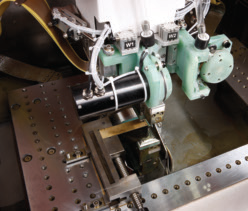
Courtesy of GF AgieCharmilles and Scenic Tool
GF AgieCharmilles offers EDMs with automatic wire changers. When one wire spool is exhausted or the wire size needs to be changed, the machine automatically switches to another spool.
A new type of filter is available made from poly fleece, a soft, two-sided pile material made from polyester. “Most filters have a paper-type element,” Pfluger said. “When you put a new set of paper filters in the machine, you have a precoat time. Say I have a new 5µm-particle-removal filter. It could be up to 10 machining hours before I am filtering my water dielectric out to a 5µm level. With the new poly fleece filters, there is a zero precoat time. You are at the defined micron rating immediately.”
Resin life depends on filter efficiency, materials being machined and quality of water that is added to the machine reservoir. “People tend to stretch their resin life by letting it run longer than it should,” Baeszler said. “But the water becomes more conductive and they don’t get the results they want.”
The two power contacts, one in the upper head and one in the lower, must be indexed occasionally and eventually replaced. Indexing intervals can vary, depending on the machine manufacturer and machining processing being performed.
“Depending on how aggressive the settings are and the wire diameter, the contacts should be indexed after 60 to 80 machining hours on average, taking into account the differences in operations and wire sizes,” Pfluger said. “If those items are not maintained, the EDM will not work at all.”
Water cleanliness is also important. The water has to be at the right pH level—from 6.8 to 7.2. “But if sensors on the wire EDM for the water are not cleaned with alcohol every 150 hours, you are going to have a bad resistivity reading,” Top Tool’s Kari said. “Also, it is important to change the water at least once a year.”
The EDM itself must also be kept clean, including the rollers that help tension the wire. Over time, dirt and debris accumulate on those rollers, which can cause slippage.
“Cleaning is critical for any EDM,” AccuteX’s Intihar said. “We recommend taking 15 minutes every Monday to clean. Remove the wire guides, power contacts and other removable parts and clean them with EDM cleaner along with the upper and lower heads. Put it all back together and you are good for another week.” CTE
About the Author: Susan Woods is a contributing editor for CTE. Contact her at (224) 225-6120 or susanw@jwr.com.
Contributors
AccuteX EDM
(513) 701-5550
www.accutexedm.com
GF AgieCharmilles
(800) 282-1336
us.gfac.com
Makino Inc.
(800) 552-3288
www.makino.com
Sodick Inc.
(888) 639-2325
www.sodick.com
Top Tool Co.
(763) 786-0030
www.toptool.com
Glossary terms in this article
Related



Subscribers can use MFGAxis notes, saves and discussion tools with their innoNET account.