

Deep and steady: Drilling Performance
A long boring tool can cause vibration, so deep holes can be deep trouble. But several strategies can minimize vibration.
Courtesy of Anderson Dahlen
Anderson Dahlen was able to use a 27 “-long quill to bore a 23 “-deep hole because the spindle had a smaller diameter than the hole.
A long boring tool can cause vibration, so deep holes can be deep trouble. But several strategies can minimize vibration.
Two job shops had different deep holes to bore, but they had the same concern: controlling vibration.
In Rogers, Minn., Tavis Metal and Fabrication was boring a blind-hole 6 ” deep and 0.976 ” in diameter in a structural steel. The hole consisted of a 1 “-deep segment, followed by a 1 “-deep cross-bore gap—which was followed by a 4 “-deep segment.
Complicating the matter, the drill that created the hole hadn’t tracked true, so the hole was “wavy,” according to Jeremy Evans, Tavis Metal’s machine shop manager.
Anderson Dahlen Inc., Ramsey, Minn., didn’t have to worry about waviness. Inside a stainless steel housing, the 7.23 ” through-hole was straight and 23 ” deep.
Both shops had to avoid the bane of deep-hole boring: vibration.
Antivibration Strategies
Thankfully, there are ways to minimize vibration when deep-hole boring. Jack Burley, vice president of sales and engineering for BIG Kaiser Precision Tooling Inc., Hoffman Estates, Ill., cited these key strategies:
1. apply the maximum-diameter boring bar,
2. select an appropriate boring-bar material,
3. reduce cutting speed,
4. maximize stock removal before boring,
5. select inserts that reduce vibration, and
6. when needed, use a special tool.
“The largest tool-shank diameter gives the highest rigidity,” said Roland Fleischer, product manager with toolmaker Mapal Inc., Port Huron, Mich., about the first strategy. High rigidity dampens vibration or, at least, keeps the vibration’s amplitude low.
However, the bar design can’t hinder chip evacuation. Tavis Metal ran into that problem with its initial boring bar, which was 0.845 ” in diameter. Everything worked fine in the hole’s first segment, and chips were effectively evacuated.
Unfortunately, some chips fell through the cross-bore into the blind segment and wrapped around the boring head, damaging the finish.
Tavis Metal solved the problem by switching to a 0.845 “-dia. boring head from toolmaker Seco Tools Inc., Troy, Mich., which enables chips to evacuate the hole.
Anderson Dahlen didn’t have to use a boring bar for its 23 “-deep hole.
Corey Bond, an Anderson Dahlen process engineer, picked a Seco 5 “-long, indexable, radial, fine-boring head. The head’s 3.75 ” diameter and bolt-on inserted wing with a 1.641 ” overhang left plenty of room for chip evacuation. The boring head was attached to a 50-taper toolholder and mounted to the horizontal boring mill’s 5 “-dia. spindle. The workpiece was then brought up to the spindle.
Bond then used the mill’s W-axis quill, which can extend the spindle 27 “, to bore the hole. “We were able to use the rigidity of the machine,” Bond said.
Boring-Bar Material
In a deep hole, a boring tool’s resistance to vibration is also affected by the boring bar’s material.
A boring bar is usually made from tool steel, heavy metal or carbide. Each type’s vibration resistance depends on its modulus of elasticity. The greater the modulus of elasticity, the greater the cutting force needed to bend, or deflect, the material. The less susceptible a material is to deflection, the less it is to vibration.
Courtesy of Kyocera
Besides its material’s natural rigidity, a boring bar may be devised with other features for avoiding chatter, like an antivibration mechanism.
BIG Kaiser’s Burley recalled the approximate modulus of elasticity for the three materials: 30 million psi for alloy steel; 50 million psi for heavy metal, a free-machining tungsten alloy; and 90 million psi for carbide. “Steel and heavy metal would tend to bend with less extension,” said Ken King, COO of Kaiser Tool Co. Inc./THINBIT, Fort Wayne, Ind.
However, tool prices significantly escalate from steel to heavy metal to carbide, Burley noted.
He added that heavy metal has a vibration-dampening property and can sometimes work as well as carbide, such as when boring a hole with at least a 6:1 depth-to-diameter ratio.
Sometimes, however, none of the three types is suitable for deep-hole boring.
Courtesy of Seco Tools
In horizontal machine tools, a long boring tool’s weight can be problematic, but may be avoidable by using a boring head and extensions made of a lightweight material, such as aluminum, with their connections made of steel. Some rigidity would be lost, but the loss may be partly offset by making the new bar with a larger diameter than the one it replaced. That solution, though, means losing a bit of clearance.
Burley said each material’s weight can become prohibitive when a boring bar’s diameter exceeds 2 ” and its length exceeds 16 “.
Take a 5 “-dia. hole requiring a 25 “-long boring bar. “There’s no way you could put a solid piece of carbide or steel out that far and still expect it to go through a toolchanger,” Burley said, because it would fall out of the toolchanger’s arm and would exceed the maximum weight limit for the spindle itself.
So, a shop may have to use a multiple-material boring bar, with one material being lightweight. One such combination is steel and aluminum. Burley said those materials can be combined so the boring bar dampens vibration and reduces weight simultaneously.
Reduced Cutting Speed
If a shop encounters vibration, another strategy to reduce it is to reduce cutting speed. Anderson Dahlen had to scale back its insert’s speed from its 425-sfm maximum potential. “I ran it at about 200 to 225 sfm,” Bond said, adding that the spindle speed had to be varied in the cut if the shop sensed vibration starting.
The advantage of lower speeds is obvious: It reduces the cutting force, which helps reduce vibration.
On the other hand, a cutting speed that’s too low can also produce vibration. “I’ve had situations where I kept lowering it, and it got worse,” said Mike Smith, product manager–milling for Seco Tools. “After I increased it a little bit toward where I was before, it hit the correct frequency and worked better.”
“You need a certain cutting pressure to have a stable condition in the cut,” Fleischer said.
The disadvantage of lower cutting speeds, however, is longer cycle time. And, like the cutting speed, the feed rate can be changed, though within its recommended range. If the feed rate is reduced too much, there will be cutting problems, which may cause vibration.
Courtesy of THINBIT
Review the print ads from this magazine to continue
This quick advertiser review unlocks the rest of the article and keeps the full-screen reader focused on the ads instead of the page chrome.
Advertisers included in this article experience
Print placements connected to this article
Prab
Squeeze more cash
from your machining scrap. Get more money from denser, dryer Heavy-duty hydraulics briquettes. stand up to Every bin of bushy scrap constant use. metal on your shop floor is money you can reclaim for Compress wet your business. Just run your scrap from two chips and turnings through a directions for a more solid, PRAB Dualpak™ briquetter and uniform briquette
Squeeze more cash from your machining scrap. Get more money from denser, dryer Heavy-duty hydraulics briquettes. stand up to Every bin of bushy scrap constant use. metal on your shop floor is money you can reclaim for Compress wet your business. Just run your scrap from two
Visit Prab View this placement in the issue recordJWR
Acme Manufacturing.
Robotic gate-grinding operation for a hip stem. By Daniel McCann, Senior Editor cover story Pristine finishes are pivotal for safe and effective orthopedic implants. It’s a bull market for orthopedic im- the implants’ frontline defense against fa- plants, which means that those who tigue and bacterial proliferation. manufacture the devices are ever on the For orthopedic implant OEMs and.
Acme Manufacturing. Robotic gate-grinding operation for a hip stem. By Daniel McCann, Senior Editor cover story Pristine finishes are pivotal for safe and effective orthopedic implants. It’s a bull market for orthopedic im- the implants’ frontline defense against fa- plants, which means that those who tigue and bacterial proliferation. manufacture the devices are ever on the For orthopedic implant OEMs and lookout to maintain their edge by staying subcontractors, achieving optimal sur-
Visit JWR View this placement in the issue recordPrint ads from this magazine
from your machining scrap. Get more money from denser, dryer Heavy-duty hydraulics briquettes. stand up to Every bin of bushy scrap constant use. metal on your shop floor is money you can reclaim for Compress wet your business. Just run your scrap from two chips and turnings through a directions for a more solid, PRAB Dualpak™ briquetter and uniform briquette
Squeeze more cash from your machining scrap. Get more money from denser, dryer Heavy-duty hydraulics briquettes. stand up to Every bin of bushy scrap constant use. metal on your shop floor is money you can reclaim for Compress wet your business. Just run your scrap from two
Continue reading
May 2010
Deep-hole boring isn’t about absolute measures. It’s about ratios, boring-bar length vs. diameter or hole depth vs. diameter.
“The geometry on the insert dictates your feed rate,” Smith said. “When you start messing with the feed rate, you start changing how that insert reacts in the cut.” He added that changing the feed can keep the insert’s chipbreaker geometry from activating correctly, which may produce long, stringy chips, poor evacuation and chip recutting.
“If you get inconsistency in the chip formation, you can create vibration,” Fleischer warned.
At Anderson Dahlen, Bond didn’t scale back the feed rate for his job. He left it at 0.008 ipr and imparted the required surface finish of 64 rms.
Maximizing Stock Removal
Vibration can also be reduced by maximizing stock removal before deep-hole boring. But, like so much else in machining, stock removal is a balancing act between taking off too much and not taking off enough.
“You don’t want to remove so much material that you don’t have enough material to engage the insert on your finish-boring head,” Smith said.
If the hole is being rough bored, removing too much material would obviously produce too much tool deflection. In that case, when the tool moves forward, there can be chatter.
When the roughing tool doesn’t remove enough material, deflection becomes a problem not for that tool but for the finishing one, which then needs to remove too much material. More stock removed means more cutting pressure, which means more tool deflection. That can create a greater tendency to get vibration on single-point boring tools, Fleischer noted.
Anderson Dahlen had taken its stainless steel housing and milled its deep hole to 7.23 ” in diameter, leaving 0.020 ” of stock for boring (0.010 ” per side).
Tavis Metal, meanwhile, had hoped to ream its hole to finish size, so the shop left 0.004 ” to 0.012 ” of stock after drilling. That wasn’t enough stock, though, to eliminate the hole’s waviness. Tavis Metal had to leave 0.013 ” per side, which was too much for reaming, so the shop switched to boring.
The right amount of remaining stock depends in part on a boring insert’s clearance and rake angle, as examples.
Vibration-Reducing Inserts
Brian Wilshire, sales engineer for Kyocera Industrial Ceramics Corp., Mountain Home, N.C., said an insert’s corner radius can help reduce vibration. Reducing the corner radius will usually help control vibration, but he added that “I have seen cases where a larger corner radius would seem to preload the bar and keep it loaded, so it would get away from chatter problems. It will basically cause the bar to deflect to a point where the force is great enough to keep it at a certain amount of deflection and doesn’t let it oscillate.” Wilshire cautioned, though, that such cases are rare.
Courtesy of BIG Kaiser
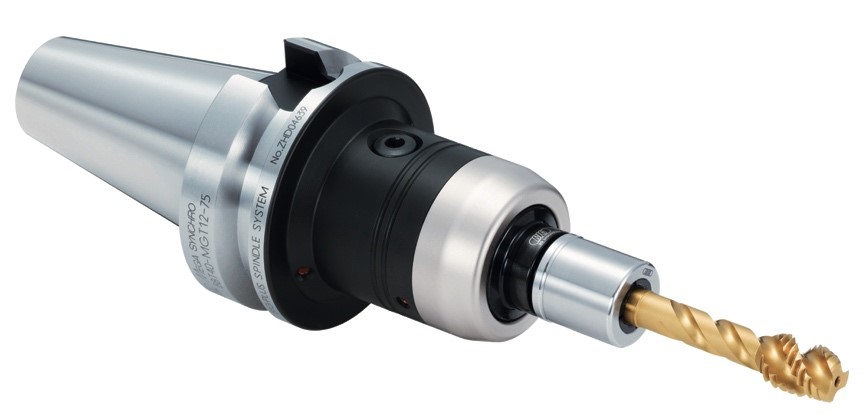
A modular boring-bar can permit partial customization for deep-hole boring.
At Tavis Metal, the boring insert’s corner radius was ground to 0.008 “. “The insert wouldn’t skip around at all,” Evans said. “It would follow straight, and it was extremely accurate all the way down.”
Anderson Dahlen likewise used an insert with a 0.008 ” corner radius. Also, Bond chose a tough carbide grade. “In case I did get vibration, the insert wouldn’t fracture on me,” he said.
Apply Specials
A shop may also avoid vibration in deep-hole boring by applying specials. King provided an example of a deep hole in which a larger-diameter segment gives way to a smaller-diameter segment. In that case, a shop can use “a custom boring bar that will help you extend the bar in the biggest diameter possible as far into the application as you can and only have a smaller diameter for a shorter distance,” King said.
Fleischer said a single-point fine-boring tool with guide pads is another way to avoid vibration because the pads limited tool deflection and the tool could be adjusted to the hole’s target diameter outside the machine.
“If it is a higher-volume job or a longer-running job, [a special] can usually get higher metal-removal rates, shorter cycle times, and—in the long run—reduce tooling costs and part costs for our customers,” Wilshire added.
Neither Tavis Metal nor Anderson Dahlen needed to apply a special, though. Tavis Metal’s tool helped it meet the hole’s specifications: 1.002 ” in diameter with a ±0.0015 ” tolerance and a surface finish of 32μm.
Anderson Dahlen likewise met its requirements: 7.25 ” in diameter with a ±0.0005 ” tolerance. “The part turned out perfect,” Bond said, “and the customer was happy.” CTE
About the Author: Joseph L. Hazelton is a freelance writer with 9 years of experience writing and editing articles for metalworking publications. He can be emailed at joe@hazeltonmedia.com.
What is deep-hole boring? Depends on who you ask
What constitutes deep-hole boring? Depending on who you ask, it varies from 3 to 15 diameters deep. Some industry sources cite 3 diameters deep as the starting point, while others begin higher.
“That’s a question that’s probably open to debate,” said Brian Wilshire of Kyocera Industrial Ceramics Corp. “From our standpoint, we look at anything that’s over about a 4:1 length-to-diameter ratio as deep-hole boring.”
Wilshire gave a ratio of 4 diameters deep because it is typically when chatter and deflection begin and surface finish and dimensional quality problems emerge.
For others it’s deeper. Mike Smith of Seco Tools Inc. defined deep-hole boring as 5 diameters deep. Jack Burley of BIG Kaiser Precision Tooling Inc. said it starts at 6 diameters deep and ends at 10 diameters deep. Mapal Inc.’s Roland Fleischer gave a range of 10 to 15 diameters deep.
Ken King of THINBIT said the definition of deep-hole boring depends on the boring-bar material. He provided approximate ratios for tool steel, 4 diameters deep; heavy metal, 6 diameters deep; and carbide, 8 diameters deep.
Fleischer’s range consisted of the ratio of the hole’s depth to its diameter. Everyone else’s diameter, though, was the boring bar’s diameter, not the hole’s.
In addition, it depends on whether the “depth” is considered the hole’s depth or the boring bar’s length.
For example, Wilshire defined his ratio as involving diameter and length, the length being from the tip of the boring tool’s overhang to where the tool enters the toolholder or the spindle, if mounted directly into it. The reason for the focus on the boring bar’s length, on that extension, is practical. “All the [cutting] forces are going to be on the extension that goes to the spindle,” Smith said.
With the bar’s length and diameter taking center stage, deep-hole boring may not even involve a deep hole. The hole may be shallow, but the tool may need to be long to clear fixturing and other workpiece features. It may be easy to change from thinking about a hole’s depth vs. its diameter to thinking about the boring bar’s length vs. its diameter. But, there’s a wrinkle to that ratio, too; it can vary depending on the workpiece material. That’s why Fleischer provided his depth range.
For materials requiring higher cutting forces, such as steel and titanium, Fleischer said deep-hole boring started at 10 diameters deep, whereas it wouldn’t start until 15 diameters deep in aluminum, which needs lower cutting forces.
—J. Hazelton
Contributors
Anderson Dahlen Inc.
(763) 852-4700
www.andersondahlen.com
BIG Kaiser Precision Tooling Inc.
(888) 866-5776
www.bigkaiser.com
Kyocera Industrial Ceramics Corp.
(800) 823-7284
www.kyocera.com/cuttingtools
Mapal Inc.
(810) 364-8020
www.mapal.us
Seco Tools Inc.
(800) 832-8326
www.secotools.com
Tavis Metal and Fabrication
(763) 428-8483
www.tavismetal.com
THINBIT
(888) THINBIT
www.thinbit.com
Glossary terms in this article
Related



 MFGAxis Discussion
Be part of the shop-floor conversation
Like, save, or comment on this CTE story.
MFGAxis Discussion
Be part of the shop-floor conversation
Like, save, or comment on this CTE story.


MFGAxis Discussion