

Tool steels’ dual personality
The guidelines for turning of tool steels include both tool- and part-making applications.
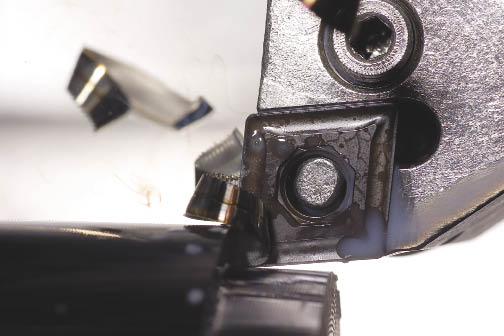
Courtesy of Walter USA
Roughing H13 tool steel.
The guidelines for turning of tool steels include both tool- and part-making applications.
Metalcutting should be treated as an integrated system, which includes three equally important elements: workpiece, cutting tool and machine tool. Traditionally, end users pay more attention to the cutting tool, less to the machine tool (assuming it has adequate power to do the job) and, unfortunately, much too little attention to the workpiece. The information about a workpiece is often limited to the type of work material, such as steel, cast iron, aluminum alloy, etc. The most important mechanical properties of work materials, such as hardness and ultimate tensile strength, sometimes are not provided or not requested by customers. If this data is missing, the integrated system of metalcutting becomes incomplete. In such a situation, maximum cutting productivity cannot be calculated.
Tool steels are high-carbon, alloy and high-speed steels capable of being hardened and tempered. Traditionally, they are used to make tools for cutting, forming and shaping. Other applications include making parts where wear resistance, strength, toughness and hardness are essential for the specified performance, and cannot be achieved with carbon, alloy or stainless steels.
Classification of tool steels is based on the system developed by the American Iron and Steel Institute (AISI). This system arranges tool steels into categories, which are based on heat treatment, application or the major alloying elements. There are six major categories and 10 subcategories identified by letters followed by one or two digits.
In addition to AISI classification, tool steels are identified by designations in the Unified Numbering System (UNS) for metals and alloys, established by the Society of Automotive Engineers and the American Society for Testing and Materials. The UNS designation system consists of the letter T followed by five digits: the first three identify the tool steel category and the last two identify the grade of a tool steel category.
Six major categories, 10 subcategories and identifying symbols of tool steels are shown in Table 1.
Table 1: Tool steels classification.
| Categories and subcategories of tool steels | Identifying symbols | |
| AISI | UNS | |
|
Water-hardening |
W |
T723 |
|
Shock-resisting |
S |
T419 |
|
Cold-work (three subcategories): |
||
|
Oil-hardening |
O |
T315 |
|
Air-hardening, medium-alloy |
A |
T301 |
|
High-carbon, high-chromium |
D |
T304 |
|
Special-purpose (two subcategories): |
||
|
Low-alloy |
L |
T612 |
|
Mold |
P |
T516 |
|
Hot-work (three subcategories): |
||
|
Chromium-base |
H |
T208 |
|
Tungsten-base |
H |
T208 |
|
Molybdenum-base |
H |
T208 |
|
High-speed (two subcategories): |
||
|
Molybdenum-base |
M |
T113 |
|
Tungsten-base |
T |
T120 |
Machining parameters for turning of tool steels (cutting speed, DOC and feed rate) and respective coated carbide grades were adapted from the Machining Data Handbook, Volume 1 and provided in the same order as the tool steel categories listed in Table 1.
Water-Hardening Tool Steels
The water-hardening tool steels are essentially carbon steels with 0.6 to 1.40 percent carbon. They are the least expensive tool steels.
Three standard AISI (UNS) types of water-hardening steels are in production: W1 (T72301), W2 (T72302) and W5 (T72305). Types W3, W4, W6 and W7 steels are no longer in common use.
The water-hardening tool steels have a 100 percent machinability rating, as a basis for comparison with other groups of tool steels. When compared with free-machining AISI 1212 steel, the machinability rating of water-hardening steels is 40 percent.
The hardness of water-hardening tool steels at annealed condition is 150 to 200 HB.
The water-hardening steels are used for cutting tools (shear blades, reamers, taps and twist drills), fixtures and dies for blanking, coining and threading.
Machining parameters for standard grades of the water-hardening tool steels at the annealed condition are shown in Table 2.
Table 2: Machining parameters for water-hardening tool steels.
| Grades and heat treatment | Brinell hardness,HB | DOC, in. | Feed rate, ipr | Cutting speed, sfm | Coated carbide grades specification, ANSI/ISO |
|
W1, W2, W5. Annealed |
150 to 200 |
0.300 |
0.020 |
450 |
C6/P30, M30 |
|
0.150 |
0.015 |
550 |
C6/P20, M20 |
||
|
0.040 |
0.007 |
700 |
C7/P10, M10 |
Shock-Resisting Tool Steels
Shock-resisting tool steels have been developed to provide effective combinations of high hardness, high strength and high toughness, or impact fracture resistance. These steels were originally developed for springs and are still widely used for spring applications that require good fatigue resistance.
There are five standard AISI (UNS) types of shock-resisting tool steels: S1 (T41901), S2 (T41902), S5 (T41905), S6 (T41906) and S7 (T41907). S3 and S4 are no longer in common use.
The major alloying element is silicon, with amounts varying from 1.0 to 2.5 percent, depending on the S-type steel. Silicon provides resistance to softening during tempering to maintain a fracture-resistant microstructure.
AISI S1 steel is the only grade that contains tungsten (1.5 to 3.0 percent). This steel is also referred to as tungsten chisel steel because it is used to make shock-resisting tools.
Shock-resisting tool steels have a machinability rating of about 75 percent compared to 100 percent for water-hardening tool steels.
The hardness of the shock-resisting tool steels at annealed condition is 175 to 225 HB.
Applications for these tool steels include heavy-duty blanking and forming dies, punches, chisels, shear blades, slitter knives, stamps, headers, piercers and forming tools.
Machining parameters for standard grades of the shock-resisting tool steels at the annealed condition are shown in Table 3.
Table 3: Machining parameters for shock-resisting tool steels.
| Grades and heat treatment | Brinell hardness, HB | DOC, in. | Feed rate, ipr | Cutting speed, sfm | Coated carbide grades specification, ANSI/ISO |
|
S1, S2, S5, S6, S7. Annealed |
175 to 225 |
0.300 |
0.020 |
400 |
C6/P30, M30 |
|
0.150 |
0.015 |
525 |
C6/P20, M20 |
||
|
0.040 |
0.007 |
675 |
C7/P10, M10 |
Cold-Work Tool Steels
Cold-work tool steels do not have the alloy content necessary to be resistant to softening at elevated temperatures. They are restricted in applications that require prolonged or repeated heating from 400° to 500° F (200° to 260° C). This category is divided into three subcategories (Table 1).
Oil-hardening tool steels derive their high hardness and wear resistance from their high carbon content of 0.85 to 1.55 percent and moderate contents of chromium, molybdenum, vanadium, tungsten and silicon.
There are four standard AISI (UNS) types: O1 (T31501), O2 (T31502), O6 (T31506) and O7 (T31507).
The most popular oil-hardening steel is O1. It has sufficient hardenability to produce adequate hardening and surface hardness depths, which extends service life. O1 steel has a slightly higher toughness than other oil-hardening steels and is the most widely available O-type steel. At 22 HRC, the tensile strength of O1 steel is 112 ksi compared with 108 ksi for O2 steel. At 31 HRC, the tensile strength of O1 steel is 133 ksi compared with 128 ksi for O7 steel. O2 steel exhibits the lowest dimensional changes on heat treatment. O6 steel contains free graphite in the microstructure to enhance machinability when making intricate dies. O7 is the most wear resistant oil-hardening steel and may be preferred for toolmaking applications.
The machinability rating of O6 is 125 percent, which means O6 steel is easier to machine than water-hardening tool steels. The machinability rating of other O-type steels is about 65 to 90 percent.
The hardness of oil-hardening tool steels at annealed condition is 200 to 250 HB.
All the oil-hardening tool steels are used for similar applications, including blanking, forming, thread-rolling, coining, molding, cold-trimming and drawing dies. These steels are also used to make reamers, taps, drills, small shear blades, slitting saws, circular cutters and hobs, spindles, gages, collets, broaches, burnishing tools, knurling tools and punches.
Air-Hardening, Medium-Hardening Tool Steels
Air-hardening steels achieve their performance characteristics because of combinations of high carbon (0.55 to 2.85 percent) and moderately high contents of other alloying elements, such as chromium, molybdenum, vanadium and nickel.
There are eight standard AISI (UNS) types of these steels: A2 (T30102), A3 (T30103), A4 (T30104), A6 (30106), A7 (30107), A8 (30108), A9 (30109) and A10 (30110). A5 tool steel is no longer in common use.
Air-hardening tool steels have high hardenability and a high degree of dimensional stability during heat treatment. They exhibit good wear resistance, fatigue life, toughness and deep-hardening qualities.
Air-hardening tool steels can be grouped as chromium grades containing 4.75 to 5.75 percent chromium and up to 1.0 percent manganese (types A2, A3, A7, A8 and A9), and manganese grades containing 1.60 to 2.50 percent manganese and 0.90 to 2.20 percent chromium (types A4, A6 and A10).
Chromium air-hardening types are more readily available and by far more widely used. The chromium types have higher wear resistance (at equivalent carbon contents) and greater hot hardness than manganese types. A9 steel is the toughest compared to other A-type grades, but also the least wear resistant. The manganese types, however, are less wear resistant and more difficult to machine.
The machinability rating of the medium-alloy, air-hardening steels are about 65 percent.
The hardness of air-hardening tool steels at annealed condition is 200 to 250 HB.
Applications of air-hardening tool steels include cold-forming dies, blanking dies, bending dies, forming rolls, drill bushings, knurling tools, muster dies and gages, and other uses that require low distortion in heat treatment and wear resistance.
High Carbon, High Chromium
The high-carbon, high-chromium tool steels are the most highly alloyed steels.
There are five standard AISI (UNS) types of these steels: D2 (T30402), D3 (T30403), D4 (T30404), D5 (T30405) and D7 (T30407). D1 and D6 are no longer in common use.
Each type contains 11 to 13 percent chromium as the major alloying element. All grades are characterized by a high carbon content of 1.40 to 2.60 percent.
The machinability rating of the high-carbon, high-chromium tool steels is 40 to 60 percent.
The hardness of high-carbon, high-chromium tool steels at annealed condition is 200 to 250 HB.
Applications for these steels include spindles, hobs, cold rolls, slitting cutters, blanking dies, forming dies, coining dies, bushings, taps, broaches, sand-blast nozzles and plug and ring gages.
Machining parameters for standard grades of the cold-work tool steels at the annealed condition are shown in Table 4.
Special-purpose tool steels include two subcategories: low-alloy steels (L-types) and mold steels (P-types). A subcategory of carbon-tungsten steels, F-types, is no longer in common use.
Table 4: Machining data for cold-work tool steels.
| Grades and heat treatment | Brinell hardness, HB | DOC, in. | Feed rate, ipr | Cutting speed, sfm | Coated carbide grades specification, ANSI/ISO |
|
O1, O2, O6, O7, A2, A3, A4, A6, A8, A9, A10. Annealed |
200 to 250 |
0.300 |
0.020 |
350 |
C6/P30, M30 |
|
0.150 |
0.015 |
450 |
C6/P20, M20 |
||
|
0.040 |
0.007 |
575 |
C7/P10, M10 |
||
|
A7, D2, D3, D4, D5, D7. Annealed |
200 to 250 |
0.300 |
0.015 |
200 |
C6/P30, M30 |
|
0.150 |
0.010 |
275 |
C6/P20, M20 |
||
|
0.040 |
0.005 |
350 |
C7/P10, M10 |
||
Low-Alloy Steels
Low-alloy steels are similar to water-hardening tool steels, but have a greater alloy content, which increases wear resistance and hardenability compared to the water-hardening steels. Two AISI (UNS) types are manufactured and used: L2 (T61202) and L6 (T61206). L1, L3, L4, L5 and L7 steels are no longer in common use because of falling demand.
L2 steels are produced as medium-carbon (0.45 to 0.65 percent) and high-carbon (0.65 to 1.10 percent) grades. Both grades contain 0.70 to 1.20 percent chromium as a major alloying element. The other alloying elements are vanadium, manganese and silicon. Medium-carbon L2 also contains molybdenum.
The combination of strength and toughness of L2 steel provides fracture and shock resistance. This steel is used for making various blades, chisels, dies, gears, spindles, drive shafts and arbors.
L6 steel contains 1.25 to 2.00 percent nickel as the major alloying element and about the same amounts of chromium, vanadium, manganese, molybdenum and silicon as L2.
Typical tool applications of L6 steel are woodworking saws and knives, shear blades, blanking dies and punches. Nontooling applications include spindles, clutch parts, gears and ratchets.
The hardness of L-type tool steels at annealed condition is 150 to 200 HB.
Machining parameters for standard grades of low-alloy tool steels at the annealed condition are shown in Table 5 on page 61.
Table 5: Machining parameters for low-alloy tool steels.
| Grades and heat treatment | Brinell hardness, HB | DOC, in. | Feed rate, ipr | Cutting speed, sfm | Coated carbide grades specification, ANSI/ISO |
|
L2, L6. Annealed |
150 to 200 |
0.300 |
0.020 |
400 |
C6/P30, M30 |
|
0.150 |
0.015 |
525 |
C6/P20, M20 |
||
|
0.040 |
0.007 |
700 |
C7/P10, M10 |
Mold Steels
There are seven standard AISI (UNS) types of these steels in use: P2 (T51602), P3 (T51603), P4 (T51604), P5 (T51605), P6 (T51606), P20 (T51620) and P21 (T51621). P1 steel is no longer in common use.
P2 to P6 are low in carbon content with 0.05 to 0.15 percent and are usually supplied at low hardness to facilitate cold hubbing of the impression. (Hubbing is a technique for forming mold cavities by forcing hardened steel master hubs into the mold, replicating the cavities to be formed into softer die blanks.) They are then carburized to develop the required surface properties for injection and compression molds for plastics.
P20 (0.28 to 0.40 percent carbon) and P21 (0.18 to 0.22 percent carbon) are usually supplied in prehardened condition, so the cavity can be machined and the mold placed directly in service. The machinability rating of P2, P3 and P4 steels is 80 to 90 percent. Other machinability ratings are: 60 percent for P5, 40 percent for P6 and 65 percent for P20 and P21.
The hardness at annealed condition ranges from 100 to 150 HB for P2, P3, P4 and P5 steels; from 150 to 200 HB for P6 and P20 steels; and from 250 to 270 HB for P21 steel.
Major applications of mold steels are for moldmaking with cavities for plastics molding and die casting of metals that melt at low-temperatures, such as tin, zinc and lead alloys.
Machining parameters for standard grades of mold tool steels at the annealed condition are shown in this article’s full version at www.ctemag.com (see Articles Archive Index).
Hot-Work Tools Steels
The hot-work tool steels represent the H-type category designated by the AISI. They have been developed to withstand the combination of heat, pressure and abrasion wear associated with operations. There are three subcategories of these steels, as shown in Table 1.
Chromium-base steels contain 3.00 to 5.50 percent chromium as a major alloying element. There are six standard AISI (UNS) types of these steels: H10 (T20810), H11 (T20811), H12 (T20812), H13 (T20813), H14 (T20814) and H19 (T20819). H15 and H16 steels are no longer in common use.
The machinability ratings are 55 to 65 percent for H11 and H12, 45 to 55 percent for H13 and 60 to 70 percent for H19.
The hardness of the chromium-base steels is 150 to 250 HB at annealed condition. These steels exhibit a hardness of 325 to 375 HB when quenched and tempered.
Typical applications of chromium hot-work steels include dies for aluminum, zinc and magnesium castings; forging dies; punches, piercers, mandrels, hot-extrusion tooling, shear blades and hot-work dies.
Machining parameters for standard grades of chromium-base, hot-work tool steels at the annealed, quenched and tempered condition are shown in this article’s full version at www.ctemag.com.
Regarding chromium-base tool steels, Terry Ashley, training manager for Walter USA, Waukesha, Wis., said: “In the Walter USA machine shop, we use the H13 grade for special and standard products. Our facility is responsible for the design and manufacture of inch product specials and inch drill standards and specials. All of the indexable drills and most of the special tools we manufacture are made using H13 steel. This includes special milling cutters and integral taper shank tools, special drills and multipocketed, multipurpose special tools and cartridges. We turn it, mill it, drill it, tap it and grind it. Mostly, we machine it in the annealed condition and then harden it. Occasionally, we machine it after it’s hardened to 43 to 47 HRC. Generally, we only finish the heat-treated material. We’ve tested competitive grades and our own grades and settled on the following turning parameters and tool characteristics in our shop.”
Rough turning of H13, annealed
Speed: 650 sfm
Feed: 0.013 ipr
DOC: 0.125 ” to 0.200 “
Insert: CNMG 432
Review the print ads from this magazine to continue
This quick advertiser review unlocks the rest of the article and keeps the full-screen reader focused on the ads instead of the page chrome.
Continue reading
October 2009
Related

 MFGAxis Discussion
Be part of the shop-floor conversation
Like, save, or comment on this CTE story.
MFGAxis Discussion
Be part of the shop-floor conversation
Like, save, or comment on this CTE story.


MFGAxis Discussion