

Thread history and measurement: Safety, Standards & Compliance
March 2009 Shop Operations column
Screw threads were used in the time of Plato, about 500 B.C., in grape and olive presses. About 100 years later, Archimedes was credited with inventing a water pump based on the screw to irrigate crops and remove water from ship bilges. Later, the Romans used this pump to dewater mines.
Until Jesse Ramsden, an English instrument maker, developed the first satisfactory screw-cutting lathe in 1770, all screw threads were cut by hand. This limited most threads to large wooden ones for presses and clamps until 1800, when Henry Maudslay, a machinist, produced a screw-cutting lathe.
The development of steam engines, trains and machine tools created demand for threads in the form of nuts, bolts and lead screws. But lack of standardization was a great obstacle to the widespread use of threaded fasteners. Each workshop had its own fastener designs and they were not interchangeable.
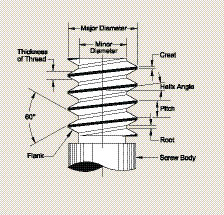
Courtesy of All images: Pamela Tallman
Parts of a thread.
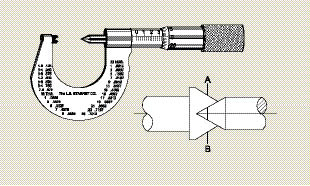
A screw thread micrometer.
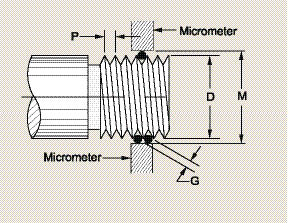
The three-wire method.
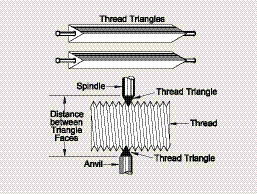
The thread triangle method.
To overcome these problems, Joseph Whitworth collected sample screws from a large number of British workshops, and in 1841 proposed that the thread angle be standardized at 55° and that the number of threads per inch should be standardized for various diameters. His proposals became standard practice in Britain in the 1860s.
In 1864, William Sellers, an engineer and machine tool builder in Pennsylvania, independently proposed another standard based on a 60° thread and set thread pitches for different diameters. This was adopted as the U.S. Standard and subsequently developed into the American Standard Coarse Series (NC) and the Fine Series (NF). In continental Europe, several different thread standards emerged, but German and French standards based on the metric system and a 60° thread prevailed, and metric threads were established.
Today, threads are used to actuate other mechanical components, such as wing flaps on aircraft, measure distance as micrometer threads, adjust and hold length as tie rods and turnbuckles, and fasten, as with nuts and bolts.
Review the print ads from this magazine to continue
This quick advertiser review unlocks the rest of the article and keeps the full-screen reader focused on the ads instead of the page chrome.
Continue reading
March 2009
Related


 MFGAxis Discussion
Be part of the shop-floor conversation
Like, save, or comment on this CTE story.
MFGAxis Discussion
Be part of the shop-floor conversation
Like, save, or comment on this CTE story.


MFGAxis Discussion