Taking The Edge Off: Design & Engineering
Aluminum's malleability makes it a go-to material for many machining applications, but that same quality also presents a challenge — burr formation.
Aluminum’s malleability makes it a go-to material for many machining applications, but that same quality presents a challenge — burr formation. Unlike harder metals such as titanium or stainless steel, aluminum is prone to bending rather than cutting cleanly during deburring, and that makes it more difficult to achieve a smooth, precise finish.
Addressing this challenge requires specialized tools and techniques. From carbide deburring tools engineered for cross-hole applications to cotton fiber abrasives that prevent material buildup, manufacturers have developed innovative solutions to streamline the deburring process. Advances in automated deburring, including robotics and precision-engineered filament brushes, are also helping shops maintain high efficiency while meeting stringent part specifications.
This article examines three methods available for deburring aluminum parts and explores how shops can optimize their processes to remove burrs effectively without compromising surface integrity or increasing cycle times.
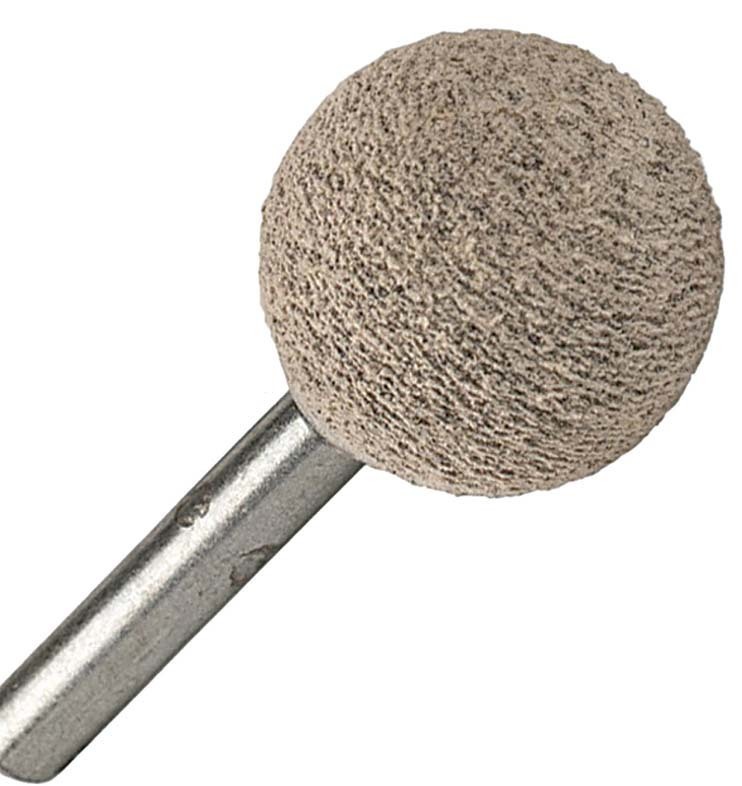
Cotton fiber mounted points from Rex-Cut Abrasives do not load when deburring. Rex-Cut Abrasives
This article examines three methods available for deburring aluminum parts and explores how shops can optimize their processes to remove burrs effectively without compromising surface integrity or increasing cycle times.
Cross-hole deburring with carbide tools
With a hardness ranging from about 15 HB for pure aluminum to approximately 150 HB for highstrength alloys like 7075, aluminum’s softness presents a tradeoff, said Stan Kroll, general manager of J.W. Done Corp. in Hayward, California. Whereas machining harder materials produces burrs that tend to be removed fairly easily, aluminum burrs often bend rather than break cleanly. Another challenge is aluminum’s gumminess. J.W. Done’s carbide Orbitool deburring tools address both challenges when duburring cross-drilled, or intersecting holes, such as difficult-to-reach ones found in aluminum hydraulic manifolds and fittings.
“The most common question I get is, ‘Does our tool get plugged up and gummed up with this material?'” Kroll said. If that condition occurred, effectively deburring subsequent holes after the first one would be challenging.
The design of the tool, with its fine cutting flutes and a flexible shaft that runs at a high spindle speed, eliminates that concern because burrs are turned into dust rather than chips that can clog the tool, he explained. “It’s almost acting more like a file, because when you’re filing material with a hand file it doesn’t really plug up.”
To ensure that only burrs are removed from the complex intersections and the surrounding area is not altered, a ring on the end of the tool above its cutter section protects any surfaces that the tool is riding along so only material at the edge where the cross-holes intersect is removed, Kroll said. “The disk is essentially a cam follower or training wheels for the tool. It just limits where the tool can go.”
Similar to a hand file, he added, the cross-hole deburring tool still does its job even as the carbide cutting edges chip and dull over time because of the fine flutes, flexible shaft and high-speed operation. Deburring 40,000 or more holes is possible in aluminum. “You seemingly use the same hand file for years. It always has this abrasive quality to it. That’s sort of what we find with our tool. Although it is preferred, we don’t absolutely require sharp teeth for the tool to effectively abrade the burr.”
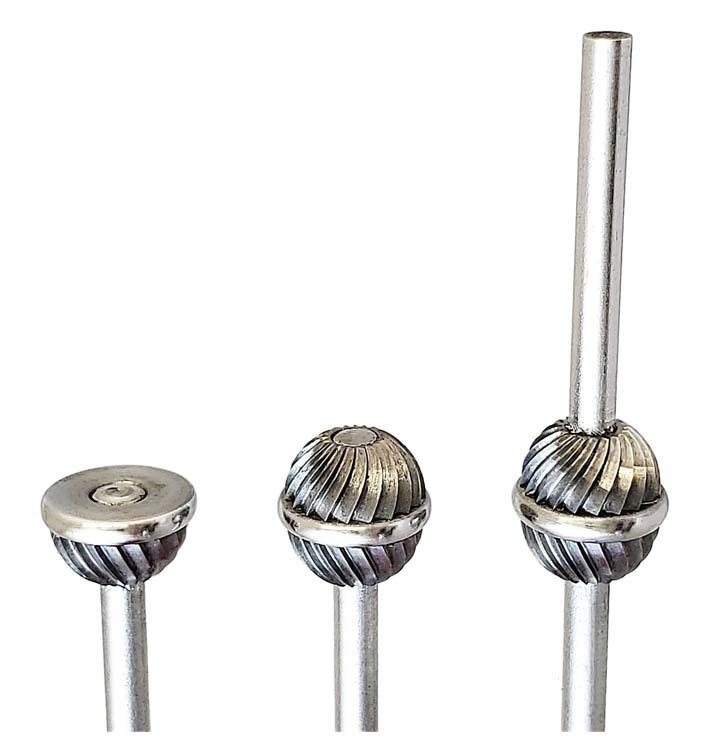
J.W. Done offers single, double and pilot versions of its Orbitool cross-hole deburring cutters. J.W. Done
As a result, although J.W. Done could coat its tool, all have been shipped uncoated since it was introduced about two decades ago, Kroll said. “Adding an extra cost to make it last even longer wasn’t a big advantage for us or the end user.”
The tool can be used manually, such as in a handheld Dremel grinder, or in a CNC machine, he said. The toolmaker frequently recommends new customers test the tool in a Dremel grinder to confirm that the tool works before using it in a CNC machine. When the tool is used in a CNC machine, such as a mill or lathe with live tooling, the Orbitool should enter the workpiece from the same direction and axis as the drill that generated the burr.
Although deburring and finishing is a requirement for virtually all parts, Kroll said deburring is not always just for cosmetic reasons but is often intended sometimes to enhance a fluid’s flow along the feature or to reduce stress concentrations that can lead to microcracks. A finer, less aggressive tool imparts a finer surface finish but cycle time increases, while a tool with coarser cutting flutes reduces cycle time but generates a rougher finish, so users must seek a balance to produce the required part specifications in a reasonable amount of time.
External Applications
J.W. Done initially designed the Orbitool, which is available with one- or two-hemisphere configurations specifically for deburring cross-holes, assuming that customers would use other tools such as a countersink for external deburring operations, Kroll said. However, some customers began requesting the Orbitool for deburring complex outside edges. For some of those applications, such as deburring a challenging “potato chip” external irregular edge, the toolmaker offers a pilot tool with a shaft protruding from the front of the tool.
While technically still a crosshole, such irregular external edges cannot be easily deburred with a simple countersink, according to Kroll. In addition, the same concept can be applied to external features that are not drilled holes.
As more part manufacturers gravitate toward lights-out machining, they want to increase automation of deburring, he noted. One way is with robot or collaborative robot work cells in which a robot arm transfers a machined workpiece from a CNC machine to a secondary finishing step.
In addition, Kroll said the toolmaker continues to target increasingly smaller cross-holes, which can be quite difficult to deburr. For example, J.W. Done recently launched a 1.1 mm (0.043″) tool and is working on one that’s 0.762 mm (0.030″) intended for 1 mm (0.040″) holes.
Cutting With Cotton
While it seems counterintuitive, in addition to carbide, cotton fiber is a suitable material for deburring aluminum. “Cotton fiber as a material does not load,” said Jonathan Costa, sales and marketing representative for Rex-Cut Abrasives in Fall River, Massachusetts. The company produces an array of cotton fiber mounted points, deburring and grinding wheels, as well as coated abrasives and cut-off wheels. “Cotton fiber chars and releases, always leaving a sharp edge when it cuts, so you don’t have to use any wax or lubricants, which is a common problem that a lot of people have when grinding or deburring aluminum.”
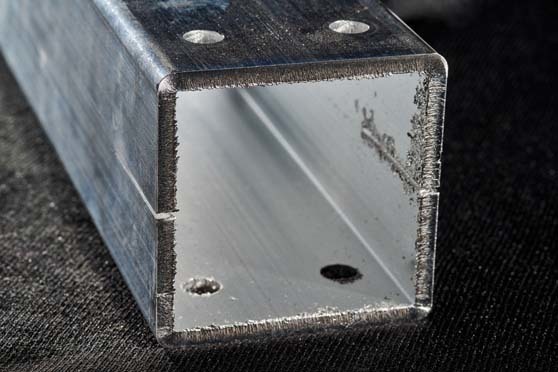
An end section of a part before and after deburring with an abrasive filament brush.
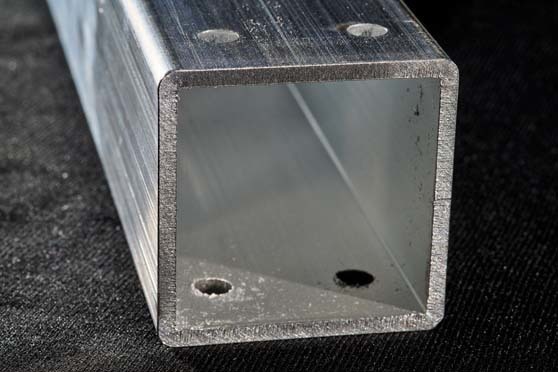
An end section of a part before and after deburring with an abrasive filament brush.
Typically, a wax or lubricant must be used to clean the loaded aluminum off the abrasive after deburring, he added, increasing cost and consuming more time. Cotton fiber mounted points are used dry, without any lubricants.
Costa explained that abrasive grains are embedded throughout the cotton fiber material, unlike coated abrasives where the grains are only on the surface. This makes the cotton fiber abrasives last significantly longer and enables a shop to use a mounted point or deburring wheel.
The chemicals used to bind the abrasive allow the tool to run cool, he added, and the cotton fiber material does not transfer heat or alter part geometry. “They are aggressive when they need to be and not so aggressive when they need to be, depending on the spec. In terms of damaging parts or harming the integrity of the material you’re working on, we haven’t experienced any of that at all.”
Review the print ads from this magazine to continue
This quick advertiser review unlocks the rest of the article and keeps the full-screen reader focused on the ads instead of the page chrome.
Advertisers included in this article experience
Print placements connected to this article
morsecuttingtools.com
High-Performance
Single-Margin Drills Drill Beyond Limits!
High-Performance Single-Margin Drills Drill Beyond Limits! morsecuttingtools.com
Visit morsecuttingtools.com View this placement in the issue recordPrint ads from this magazine
Single-Margin Drills Drill Beyond Limits!
High-Performance Single-Margin Drills Drill Beyond Limits! morsecuttingtools.com
Continue reading
March 2025
The aluminum alloy that is primarily machined and deburred is 6160, Costa noted, and about 10% of the applications for the company’s products involve aluminum.
Manual deburring is the most prone to errors, however cotton fiber abrasives minimize those errors due to their forgiving nature. Costa said a lot of customers do use Rex-Cut products for hand and machine deburring, especially fabricators, who might use the Aluminator non-loading aluminum grinding wheel or the Type 27 Max Flex blending wheel that is also suitable for finishing stainless steel, mild steel, brass and exotics.
In addition, robotic deburring is very precise, accurate and fast, and Rex-Cut sells a variety of products that are designed for robotic deburring, he noted, adding that the company sells mostly through distributors and big box industrial suppliers. More part manufacturers are incorporating automation into their deburring operations, but the transition is moving slowly. “A lot of the industry still operates on old terms; however, we are slowly seeing more creativity in deburring operations.”
Costa described the surface finish that a cotton fiber abrasive imparts as between light grinding and medium-fine finishing (from 20 μin. Ra to 80 μin. Ra), with one or more processes required to achieve a finer surface finish. “We don’t get to a true satin finish or polished finish in one step. We can get to paint grade. That’s about as high as we go in one step.”
Like virtually all metal removal operations, application is everything, Costa pointed out. “It truly depends on what the customer is trying to accomplish. It’s our job to try and offer products and solutions that reduce the customers’ time spent grinding or deburring and get them to the finish line faster.”
Brush Away Burrs
As industries such as automotive and aerospace look to reduce overall emissions from their products by lightweighting parts, aluminum parts are frequently seen as an effective solution. Those include aluminum extruded parts, which require end deburring to meet or exceed the demands of some of the world’s most quality-conscious manufacturers, according to Larry Johnson, inside sales and marketing for Abtex LLC in Dresden, New York.
For more information from J.W. Done about deburring, view the video presentation below.
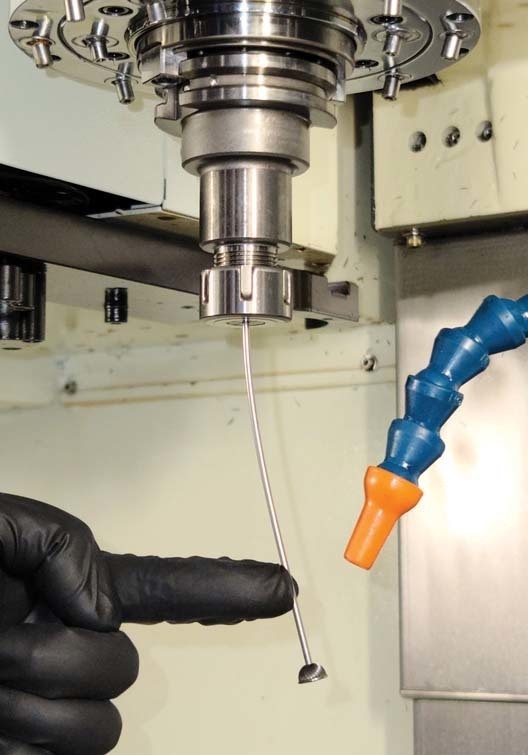
A flexible shaft is a key design feature of the Orbitool deburring tool from J.W. Done, which is available with one- or two-hemisphere configurations and a pilot version with a shaft protruding from the front of the tool. J.W. Done
He noted that traditional end deburring, in which an extruded part is manually held against some type of grinding wheel, is rarely used anymore. Increasing tight tolerance specifications require the part to presented to the abrasive in a way that allows every surface of both inner and outer edges to be deburred. A manual process, where penetration depth, dwell time and angle of attack are uncontrolled, is generally insufficient.
Abtex offers single- and double-end deburring machines, robotics and abrasive filament brushes for deburring aluminum. Single-end machines are for low volumes, and double-end machines have adjustable length features. Johnson said the brushes contain highly engineered filaments to manage deburring, edge radius finishing and surface finishing simultaneously. Filaments are composed of heat-stabilized nylon, coextruded with a mineral abrasive grit, which is applied throughout the filament and exposed on the external surfaces. As the filament wears with use, new abrasive grit is exposed, creating a self-sharpening action on both the tip and sides.
He added that a machine driving the brush operates at a low rpm, allowing the fiber to strike and wipe against the surface. Combined with the fibers’ flexibility, this action enables the brushes to finish irregularly shaped workpieces like aluminum extrusions.
Most brushes are made of silicon carbide, ceramic or aluminum oxide, and silicon carbide is the most effective for aluminum applications because the abrasive contains no free iron, Johnson explained. “There is no threat of corrosion from iron contamination.”
Grit sizes range from 600 up to 46 mesh, filament diameters range from 0.457 mm to 1.524 mm (0.018″ to 0.060″), and filament diameter increases with grit size to effectively bind the abrasive, he said. “Even though a large grit size can be applied, the filament’s flexibility strategically limits its cutting action, so burrs and sharp edges are preferentially abraded away. This enables the tool to deburr without affecting the dimensional tolerance of the part.”
For aluminum extrusions, two brush formats are generally used: the radial wheel and the disc, Johnson added. Radial wheels use fibers extending radially from a hub. The brush is mounted on a horizontal shaft and rotated in a single direction that causes the fibers to strike the part in a downward motion.
Radial-wheel end deburring is generally done by hand. The operator presents the profile to the wheel at roughly a perpendicular angle. The brush tips contact the upper horizontal edges of the profile, deburring the upper outside edge and the lower inside edge. The part is then rotated until deburring is completed. Although the fiber abrasive radial wheel is ideal for hand deburring, the process limits productivity, and quality is subject to operator skill.
The disc brush is more efficient, according to Johnson. This brush is constructed of a backing into which the filaments are embedded.
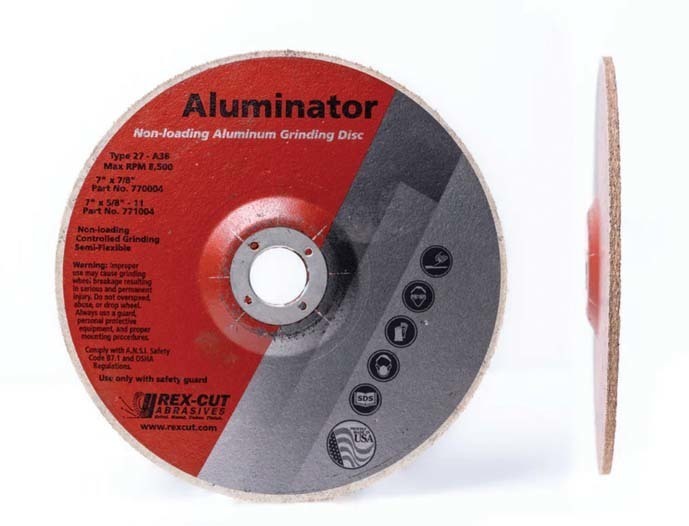
The Aluminator grinding wheel removes on average 190 grams of 6160 aluminum during the life of one 4½” wheel.Rex-Cut Abrasives
Unlike the unidirectional rotation of the radial wheel, the disc offers multidirectional wiping action. Disc brushes are almost exclusively used on dedicated machines. The disc is rotated on the vertical plane. The extrusion end is presented in a controlled manner and passed from left to right through the top half of the brush. As the extrusion enters into the face, the fibers strike in a downward motion, deburring each edge.
When the part moves to the center, he noted that fibers travel from right to left and the filaments deburr the right-facing, vertical surfaces. As the part exits the disc, the fibers move from bottom to top to deburr the bottom horizontal surfaces. The part is then brought back through the lower half of the brush, where the fibers wipe from left to right, deburring the remaining vertical edges. This process offers 360° deburring regardless of profile geometry.
Regardless of the method employed, improving the quality, safety and productivity of aluminum deburring processes is possible by selecting the proper tools and equipment for specific applications.Glossary terms in this article