

Swiss Made: Drilling Performance
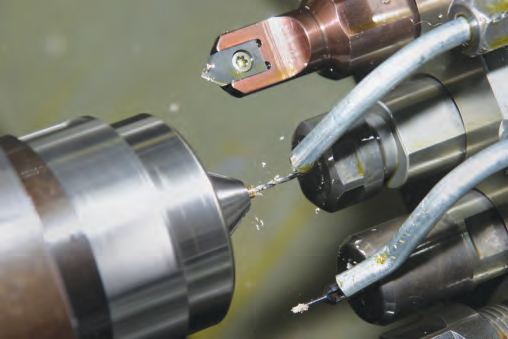
Courtesy of B. KennedyOn a Marubeni Citizen-Cincom K16 Swiss-style CNC lathe, a 0.047 "-dia. drill working from a slide servicing the subspindle creates a hole in a brass workpiece used to verify the setup for machining a dental abutment screw.Tactics and tools for Swiss-style machining.Swiss-style CNC lathes provide outstanding precision and flexibility while also posing special process control challenges and considerations.
Courtesy of B. Kennedy
On a Marubeni Citizen-Cincom K16 Swiss-style CNC lathe, a 0.047 “-dia. drill working from a slide servicing the subspindle creates a hole in a brass workpiece used to verify the setup for machining a dental abutment screw.
Tactics and tools for Swiss-style machining.
Swiss-style CNC lathes provide outstanding precision and flexibility while also posing special process control challenges and considerations. They offer machining capabilities and process control advantages apart from those of conventional CNC machines.
However, effectively operating a Swiss-style machine requires a different approach than machining on a conventional lathe. This article covers several key areas of Swiss operations, including segmentation, workpiece options, bushing maintenance, tooling, machine size and burr avoidance.
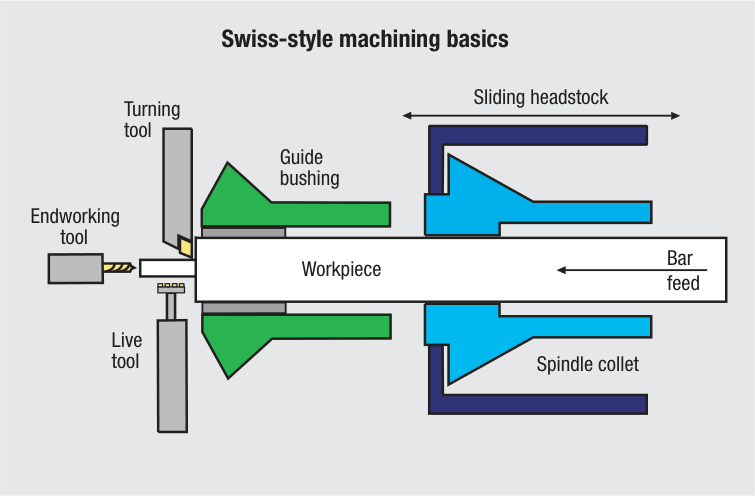
A Swiss-style machine differs from a standard lathe by virtue of a sliding headstock that feeds a rotating bar-fed workpiece through a guide bushing. Static and rotating side- and end-mounted tools cut within millimeters of the guide bushing, effectively eliminating workpiece overhang and part deflection. Multiple axes and driven tools perform nonturning operations, including milling, drilling and deburring. CNC technology enables standard tool geometries to produce complex and nonround shapes, and twin-spindle configurations facilitate finishing both ends of a part.
Swiss-style machines are categorized by their maximum bar capacity, typically from 2mm (0.08 “) to 38mm (1.50 “). Most smaller-capacity machines 16mm (0.63 “) in diameter and smaller can handle 1⁄16 “-dia. bars with minimal difficulty. In operation, Swiss-style machines can produce long runs of consistently precise, complex parts complete in one chucking. The machines routinely turn diameters down to 0.003 ” or smaller, and can machine features as small as 0.0003 “. Tight tolerances are the norm. A ±0.001 ” tolerance is considered wide open on a Swiss-style machine; shops running the machines typically work in four decimal places, and some shops consistently maintain tolerances of ±0.0002 “.
Part Segmentation
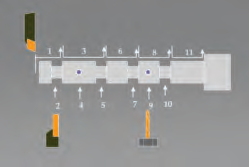
A Swiss-style machine’s sliding headstock and guide bushing provide superior workholding rigidity. To take full advantage of this inherent rigidity, the workpiece material must always remain in contact with the guide bushing. This requires the workpiece to be segmented—machined to completion one section at a time.
For example, all ID work is performed first. The material is fed through the guide bushing where a tool turns the part’s first diameter. Then the next feature, such as a groove or cross-hole, is machined. When the material advances through the guide bushing, the next feature, such as a diameter, is turned. This sequence continues through completion.
Segmentation assures that the workpiece is always supported by the guide bushing. As a result, rough and finish turning usually are not performed separately but in one pass. A rigid Swiss-style screw machine permits much heavier DOCs than a conventional lathe.
Material Significance
Workpiece material condition has a strong influence on the precision of parts produced on a Swiss-style machine. Most of all, the bar stock diameter must be consistent and typically is centerless-ground to a diametric tolerance of ±0.0002 “, particularly for exotic alloys. For example, titanium stock must be ground because it tends to be inconsistent and somewhat out of round.
Courtesy of B. Kennedy
In a Swiss-style lathe, a sliding headstock feeds rotating stock through a guide bushing, eliminating overhang and deflection.
Courtesy of G. Crews
A key Swiss-style machining tactic is segmentation, in which the workpiece is closely supported by the guide bushing and machined to completion one section at a time.
But there is no requirement for more precision than necessary. Many material suppliers provide screw-machine-quality material that will handle perhaps 98 percent of a typical shop’s work without any difficulty. These higher-quality drawn materials generally have a tolerance of ±0.0005 “.
More important than absolute tolerances, however, is maintaining a consistent diameter along the entire length of the bar. A bar may be 0.0005 ” undersize, but as long as the entire bar is undersize by the same amount, adjustments can be made to produce the required part dimensions. In general, a Swiss-style machine can hold 60 percent of bar stock tolerance; that is, if bar stock varies by 0.001 “, the part can vary by as much as 0.0006 “.
Bar stock should be straight, exhibiting a bow of less than 0.001 ” per 12 ” of length. It also must be round. If the material is out of round, the machined part will be out of round, too.
That fact highlights a significant difference between Swiss-style and standard turning. On a conventional lathe, an out-of-round bar can be chucked between centers and turned until round. Conversely, in a Swiss-style machine, an out-of-round bar will be rotating in the guide bushing, and the machined part will be out-of-round as well.
Bushing Guidance
The configuration, adjustment and quality of the guide bushing are major factors in successful Swiss-style machining. An inaccurate or worn guide bushing often causes problems with dimensional control or tolerances.
The two most common styles of guide bushings are synchronous rotary and fixed. For parts with tolerances looser than ±0.0005 “, a rotary guide bushing is preferred. The rotary bushing and headstock rotate in sync with the workpiece material.
Courtesy of Marubeni Citizen-Cincom
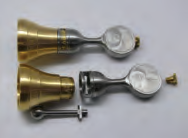
This three-part bell was produced using three different Marubeni Citizen-Cincom Swiss-style machines. The handle was machined from 1 “-dia. stainless steel, the clapper turned from ½ “-dia. stainless, and the bell body was machined from 1¼ “-dia. brass.
Tighter-toleranced or smaller-diameter parts may require a fixed guide bushing, which remains static while the bar stock spins within it. A fixed guide bushing is adjustable and must be sized so the bar stock fully contacts the bushing but can still spin freely without seizing. The operator’s “feel” for the relationship between the bar and bushing helps determine a fixed guide bushing’s effectiveness. A good Swiss-style machine provides consistent repeatability, but if the bar stock, workholding or toolholding components are inconsistent, it doesn’t matter how accurately the machine can repeat.
Tooling Requirements
In Swiss-style machining it is essential to apply cutting tools engineered specifically for producing small parts, but until recently, these tools were difficult to find. Fortunately, a growing number of cutting tool manufacturers provide Swiss-style tools.
In general, turning tools for Swiss-style machines should have sharp edges, small nose radii and large clearance angles behind the cutting edge. Sharp tools minimize cutting forces. The greater the radius of the cutting edge, the more cutting force it generates, and the greater the possibility of workpiece deflection. Chipbreakers should be ground—not molded—into the cutting edge to ensure they cut and bend the chip effectively.
Courtesy of B. Kennedy
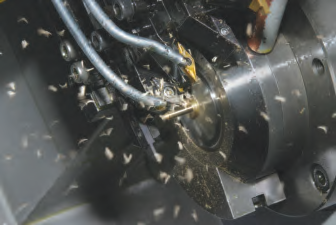
A carbide insert turns a brass workpiece, part of a 3½-minute process on a Marubeni Citizen-Cincom Swiss-style CNC lathe that involved 16 tools.
Clearance angles are an issue because Swiss-style tools operate in close proximity to the workpiece; sufficient clearance behind the cutting edge prevents it from rubbing on the workpiece. As part features shrink in size, tools with smaller nose radii are required.
Some tooling issues become less important as parts and machines grow in size. Clearance angles are not quite as critical. Tool settings need not be as precise—there is more margin for error, for example, in adjusting tool center height. Larger machines also offer more room to work.
Challenges in acquiring and caring for small tools also decrease when machining the contours of larger parts. Machining characteristics and toolholding requirements are dramatically different for a 0.025 “-dia. endmill compared to a ¼ “-dia. tool. You can push a ¼ “-dia. tool much harder than a 0.025 “-dia endmill.
Although toolmakers are expanding their offerings of Swiss-style tools, specials may still be needed for certain applications. For example, appropriate reamers were unavailable for a job requiring holes with a ±0.0003 ” finished tolerance. The solution was custom, tight-tolerance drills that achieved the finished hole tolerance without reaming.
A Machine that Fits
Review the print ads from this magazine to continue
This quick advertiser review unlocks the rest of the article and keeps the full-screen reader focused on the ads instead of the page chrome.
Advertisers included in this article experience
Print placements connected to this article
Iscarmetals
15,000 COMBINATIONS
One Tool Body Carries Many Different Types of Heads IS #70.
15,000 COMBINATIONS One Tool Body Carries Many Different Types of Heads IS #70 www.iscarmetals.com
Visit Iscarmetals View this placement in the issue recordPrint ads from this magazine
One Tool Body Carries Many Different Types of Heads IS #70.
15,000 COMBINATIONS One Tool Body Carries Many Different Types of Heads IS #70 www.iscarmetals.com
Continue reading
April 2011
Larger Swiss-style machines can handle occasional runs of smaller-diameter bar stock and produce smaller parts, but efficiency issues arise during long runs. A shop that regularly runs ¼ “-dia. and larger stock on a 32mm (1.26 “) machine can easily machine a few thousand parts from 1⁄8 “-dia. material. But if 100,000 of those parts are needed, a machine engineered for a smaller maximum bar diameter will be more efficient. Tool movements will be shorter, and the machine will be better suited to handle smaller parts.
For some parts, smaller, less complex machines actually run faster than larger machines. In some cases, simple and compact Swiss-style machines can rival the speed of cam-controlled screw machines, which are well known for high-speed production of less-complex parts.
Larger Swiss-style machines have larger work envelopes, more axes and can mount more tools than smaller machines. Those features are beneficial when dealing with complex work, and can also enable a Swiss-style machine to be set up to handle different parts without retooling. The machine turret and/or gang plate can be tooled for two or three different jobs, and the machine tool programmed to minimize changeover time. This arrangement enables shops to run small lots and achieve cost savings by slashing the time spent setting up between jobs.
There are many other ways to expedite setups on a Swiss-style machine. Tooling manufacturers offer a variety of quick-change systems, and in some cases the same tools can be used for a variety of operations and parts. For example, the same center drill, turning tool and cutoff tool can be applied to different workpieces. Then, when it’s time to change over to a new part, a tool change is not required.
A programming technique to speed setups involves the use of macros. The operator only has to enter a variable to adjust a macro for a certain part length, for example, and the rest of the program remains the same. Using techniques like these, changeovers can be done in literally 30 seconds by just plugging in a different part number.
Burr Avoidance
Other techniques can also improve Swiss-style machining. For example, operations that prevent and/or remove burrs while a part is still on the machine can eliminate the time and expense of secondary deburring operations.
Courtesy of Marubeni Citizen-Cincom
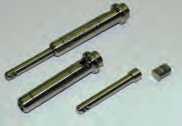
In some cases, Swiss-style machines can perform operations other than machining. In a demonstration, a slide whistle was machined and also assembled on a Swiss-style machine.
In some cases, running a drill through a hole more than once limits burr formation. Or, after a cross-hole is drilled, a pass with a turning tool across the hole mouth removes a burr. Another alternative is to drill the hole in two steps, first performing a predrill close to finish size, then finish-drilling the hole to the final diameter. The second pass removes minimal material and leaves no burr.
Cross-holes and other features can be deburred with nylon wheels or brushes for use with hand-held tools or in the machine. Applied in a live spindle, the brush knocks the burr off without scratching the part. Some shops adapt tiny dental burs to remove heavier burrs or make their own deburring tools.
Swiss-Driven Innovation
The multiple axes and tooling options available on a Swiss-style machine provide the capability to perform processes and produce parts not possible on other equipment. In one case, a part required support on both ends during a series of aggressive milling operations. A live center was loaded into a drill station in the Swiss-style machine. The machine’s subspindle was programmed to pick up the center and move it to support the free end of the part during milling. When milling was completed, the subspindle replaced the center in the drill station for use on subsequent parts.
With a little creative thinking, a Swiss-style machine can perform operations other than machining. In a demonstration, a slide whistle was machined and assembled on a Swiss machine (see photo above).
For the whistle body, bar stock was center drilled, drilled, bored, profile turned and milled, then cut off and picked up by the machine’s subspindle. The subspindle moved the body down to endworking tools below the guide bushing for work on the part’s back end. During those operations, the whistle plunger was milled and turned in the guide bushing.
When the plunger was completed, the subspindle brought the machined body back up to the guide bushing and slid the body over the plunger, which then was cut off. Finally, a small plug was machined in the guide bushing and pressed, via headstock motion, into the end of the plunger. The three-piece, fully assembled whistle dropped out of the subspindle complete. A video of this 3-minute, 37-second operation, performed on a Citizen K16-VII Swiss CNC lathe, can be viewed at www.youtube.com/watch?v=Ep0crJUFEIc.
Courtesy of Genevieve Swiss Industries
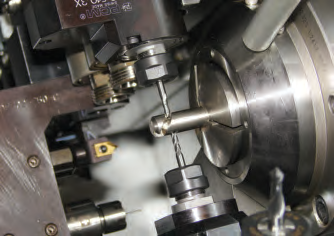
Simultaneous high-speed pinch milling, shown here in a Marubeni Citizen-Cincom M32-Y machine, is one of the capabilities of Swiss-style lathes.
The full range of capabilities provided by Swiss-style machines is not widely recognized. One shop owner at a trade show saw a demonstration part and said, “I never would have thought to make that on that machine.” As a rule of thumb, a Swiss-style screw machine should be considered for processing any part that can be machined from bar stock 1¼ ” in diameter or smaller.
Swiss-style machines are growing more sophisticated, with some machines adding tooling capability to permit even complex parts to be machined complete in a single fixturing. Compared to running a part through a series of operations on different machines, such arrangements speed throughput and maximize part quality because all features are machined in one fixturing.
No Mystery
Despite its reputation among some shops as an arcane art, there is no unsolvable mystery to Swiss-style machining. Perhaps the two main contributors to success in working with Swiss-style automatic lathes are patience and a desire to produce precision parts.
Courtesy of Marubeni Citizen-Cincom
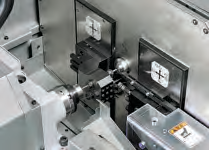
Larger Swiss-style machines can handle occasional runs of smaller-diameter bar stock and produce smaller parts, but efficiency issues arise for long runs. This 7mm-dia. capacity R07 machine from Marubeni Citizen-Cincom offers shorter tool movements, and the machine is better suited to handle smaller parts. For some parts, smaller, less complex machines run faster than larger machines.
Patience is required to monitor and control every facet of the process, from the workpiece material, workholding and toolholding components to the cutting parameters. For truly challenging parts, processes don’t always work the first time around, and patience again plays a role in developing a solution.
Swiss-style machining does involve factors that aren’t common in conventional CNC machining. Builders of Swiss-style machines and tooling representatives can supply a great deal of practical information. It’s their job to demystify the process and help shops facilitate the production of consistent, high-quality parts. CTE
About the Authors: Glen Crews is western regional sales manager for Marubeni Citizen-Cincom Inc., Allendale, N.J. He is based at the company’s office in Fountain Valley, Calif. E-mail: gcrews@mcc-h-b.com. For more information about the company’s Swiss-style machines, call (201) 818-0100, visit www.marucit.com or enter #340 on the I.S. Form on page 3. Bill Kennedy is a contributing editor for CTE. Contact him at (724) 537-6182 or by e-mail at billk@jwr.com.
Swiss-style programming for challenging parts
Even moderately complex Swiss-style machined parts often can be manually programmed. For more challenging jobs, however, Swiss-specific automated CAM systems are available. A shop should weigh the cost of such a system and decide if the level of sophistication it provides is required for the parts the shop produces.
Key to effective use of a Swiss-style CAM software package is learning to exploit its full capabilities. The programmers should already be familiar with manual programming of Swiss-style machines, which will allow them to recognize the codes being generated and have a sense of their appropriateness for the parts at hand. A CAM system may generate codes that are not precisely suited for what a shop wants to do, but a skilled programmer can change the automatically generated codes to most efficiently fit a specific application.
For very small parts, the speeds and feeds recommended by toolmakers may not be realistic. In turning, for example, reaching the recommended surface speed may require a spindle speed of 25,000 to 30,000 rpm, a speed generally not available on standard machines. To some degree, however, a machine can be upgraded via modifications such as spindle liners and reduction sleeves for the pickoff spindle to achieve an increased spindle speed.
Compromises are often necessary, and, in many cases, effective. Tool geometries play an important role in finessing machining parameters. For example, sharper geometries work better at slower surface speeds because they cut with lower force. Dialing in the most productive program will come down to testing and experience; when a part is machined, the results can be documented and a root cause analysis performed to find what is causing the result and make any needed adjustments.
—G. Crews
The automation option
Often described as “Swiss automatics,” Swiss-style machines are designed to run unattended. Theoretically, a Swiss-style machine can run overnight and hold the same tolerances as when it is attended.
Running lights-out is a common practice, but it involves risk. If a tool breaks or the material seizes up in a fixed guide bushing, the machine can crash or start a fire.
The machining characteristics of the workpiece material help guide the decision to run lights-out. Some materials are good candidates for unattended machining; brass, for example, is free-cutting and can usually run for days unattended. Other materials must be monitored. Certain materials tend to cause rapid tool wear or breakage, and, typically, the more exotic the material, the greater the risk.
Titanium, for example, usually is not a good candidate for running lights-out. If a tool breaks or dulls in titanium, it can heat the material to the point that the machine’s cutting oil will flash and catch fire. Gummy materials can also be a problem. If chips ball up, they can interfere with the tool and break it.
Lights-out machining comes down to process control. Shops usually don’t decide to run unattended until their processes are controlled. And lights-out doesn’t have to mean an entire shift. If a shop determines it can complete 100 parts trouble-free, it can set a parts counter to shut the machine off after 100 parts run unattended.
After a process is under control, the repeatability of a Swiss-style machine will allow it to be run with inspection intervals much longer than those seen when making parts on other machines. I’ve run flat X-bar charts (graphs that measures variation above and below a certain nominal point) for Swiss operations with no measureable variation for an entire day.
–G. Crews
Glossary terms in this article
QR codes and videos from this issue
Print QR codes, video callouts, and in-magazine links for this article now point to the CTE video hub in the HTML version.
Related




Subscribers can use MFGAxis notes, saves and discussion tools with their innoNET account.


