

A Structured Repair
With a structured cutting tool repair program, significant cost savings are realized while tool quality remains intact.
With a structured cutting tool repair program, significant cost savings are realized while tool quality remains intact.
Regrinding, repairing and otherwise refurbishing cutting tools and related tooling is a well-established practice. However, not all part manufacturers are aware of the cost savings a tool repair program can generate without sacrificing tool quality.
“We find even nowadays the biggest competition is still the garbage can,” said Kevin Began, sales manager for GKI Inc., Crystal Lake, Ill., which specializes in repairing indexable insert cutters and is also a full-line tooling distributor. “We fight that all the time.”
Began explained that a repaired tool functions as good as new while costing considerably less when the repair is performed properly. “The whole goal of tool repair is cost reduction,” he said, noting that tool life of a repaired tool is equal to a new one, in part because GKI hardens the repaired pocket area to 36 to 42 HRC. “If it needs to be harder as per a blueprint spec, we will do that.”
GKI, for example, repairs several hundred tools a year for Velan Valve Corp. and the valve manufacturer saves about half the cost compared to buying new tools, noted Mark LeClair, tooling engineer for the Williston, Vt., company. He added that Velan uses GKI to repair toolholders, such as a 6 “×6 “×8 ” toolholder block for an old Bullard vertical turret lathe. “They’ll machine some of our holders that we can’t get or are very difficult to purchase,” LeClair said.
This article covers the elements of a structured, or integrated, cutting tool repair and management program, including tool collection, shipping and pricing. In addition, it examines what an end user should consider when targeting a proactive repair program, the benefits that can be realized and potential pitfalls to avoid.
No ‘Cookie Cutting’
The initial stage in establishing a structured tool repair program involves a “meeting of the minds,” noted Julie Reiling, president and owner of Carbide Tool Services Inc., Anoka, Minn., which repairs indexable cutting tools. That meeting includes the end user’s operators, engineers and purchasing personnel, as well as CTS’ sales team and cutting tool specialist. Together, the team determines customer needs, when tools are released for repair, pricing structure, components included in a repair and frequency of when repaired tools are released.
“It can get very complicated, depending on the customer,” said Pat Hjelm, cutting tool specialist for CTS. Therefore, the company customizes every program.
One fairly straightforward aspect of a tool repair program is determining what damaged tools to send for repair. “In most cases, we would just receive all of the damaged tooling and then we would determine what should and should not be repaired,” Reiling said.
Began concurred, noting that about 99 percent of damaged indexable tools are repairable and GKI prefers making that judgment call based on its inspection techniques, experiences and evolving repair capabilities. “Tooling that even we would have turned away a few years ago, we can now repair because of improved techniques,” he said. That includes tools with pockets that were entirely burned off and extensively damaged screw holes.
Of course, some tools are obviously not repairable, such an indexable drill that was split down the middle after a crash. “It’s just not worth it,” LeClair said.
On the flipside, some tools that look repairable to the eye might be bent and distorted or have hairline cracks down the flute that, if repaired, could compromise tool integrity. “We catch that here when we do the upfront evaluation,” Hjelm said.
Courtesy of US Tool Group
US Tool Group workers repair cutting tools on Walter CNC tool grinding machines.
Other tools, such as cutoff tools with thin-wall pockets, might also be beyond repair even though damage doesn’t appear to be extensive. “You risk the metal becoming brittle and fatigued when you do too much welding and machining and apply too much heat,” Began said.
Packaging and shipping the damaged tools is also straightforward. “We use a 6 “×8 “×8 ” cardboard box, and when that is about full, we send it off,” LeClair said.
Began noted that when a GKI sales person packages damaged tools for transport in his vehicle, when feasible, or via a delivery service, he will pack them in paper or Styrofoam to prevent movement in the box. “Typically, anything going out for repair is already damaged, so it almost doesn’t matter,” he said.
Reground Round
In addition to indexable-insert cutters, structured repair programs are available for rotary cutting tools, such as drills, reamers, taps and endmills. One company resharpening rotary tools is US Tool Group, Desloge, Mo., which has 380 employees at its reconditioning site and also sells new tools and manufacturing supplies, as well as providing refurbishment of cutter bodies and toolholders through a partner. “We are an integrated supplier,” said Bruce Williams, president of US Tool. That includes managing toolcribs and vending equipment for manufacturers. “It’s one-stop shopping for our customers where, at the end of the month, they pay from one invoice and are supplied all required manufacturing supplies from one source.”
The process of efficiently delivering products to the manufacturing floor provides considerable cost savings for customers, according to Williams. For example, he noted that some aerospace manufacturers experience costs of up to $300 to place a purchase order themselves.
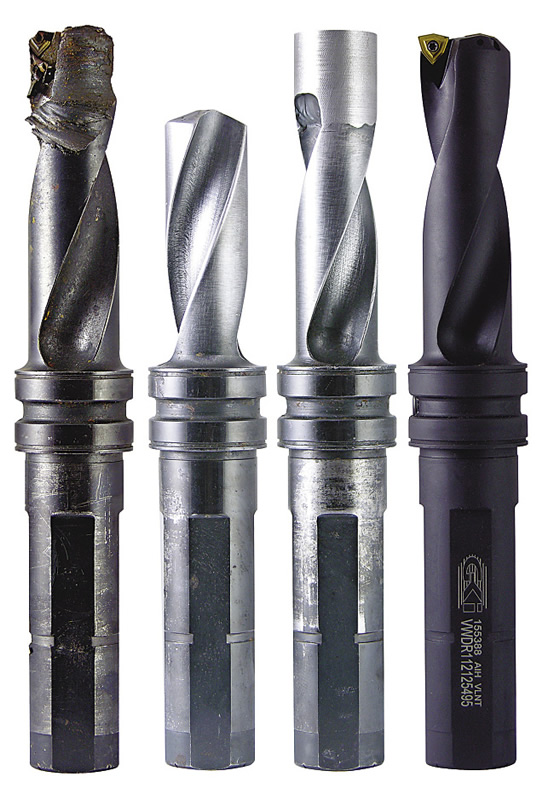
Courtesy of GKI
Even a badly damaged indexable-index drill (left) can be repaired. Regardless of damage, GKI states that it removes the entire damaged section of the tool, adds material congruent with the parent metal to the damaged tool and machines tool features, such as pockets, screw holes and coolant holes, into the tool.
When US Tool receives a shipment of worn tools, it sorts the jumbled assortment according to diameter and material/catalog code and determines what tools are viable for resharpening based on tool history and upcoming customer needs. In addition to reducing costs, a well-managed cutting tool repair program reduces shop inventory, noted Mike Baugh, vice president of business development and supplier management for US Tool. “We have visibility of the product going through the reconditioning process,” he said, “where end users who are managing their own tools may be buying new tools when, in fact, they have dull tools going through the regrind process because they don’t have that visibility.”
Courtesy of Carbide Tool Services
Before-and-after images of a long-edge endmill repaired by Carbide Tool Services.
US Tool’s reconditioning process also includes chemically cleaning the tools to remove any buildup or contamination, reoxidizing drills with a black oxide surface treatment, sharpening and placing a bar code of the customer’s part number on the tool packaging. “The reground package often contains more customer-specific information than what was available when the tool was received as a new item,” Baugh said.
Williams added that in addition to “reblackening,” tools can be recoated with TiN, TiCN, TiAlN and other performance-enhancing coatings. “Our reground tools look like they are going to perform as new and they do perform as new,” he said. “Looking new is very important to generate a good attitude from the machinist using the tools.”
GKI’s Began agreed. A repaired cutter with an unblended weld or without a black oxide coating, for instance, can function, “but it’s ugly, quite honestly,” he said. “There are not a lot of machine operators who are going to take a tool like that and use it. If you can’t tell a tool has been repaired, we have done our job properly.” Began added that the only noticeable difference should be the identification information GKI laser etches into each repaired item.
Price Point
Review the print ads from this magazine to continue
This quick advertiser review unlocks the rest of the article and keeps the full-screen reader focused on the ads instead of the page chrome.
Continue reading
January 2011
Related


 MFGAxis Discussion
Be part of the shop-floor conversation
Like, save, or comment on this CTE story.
MFGAxis Discussion
Be part of the shop-floor conversation
Like, save, or comment on this CTE story.


MFGAxis Discussion