

Starting mass finishing: General Industry Coverage
There is much to consider when choosing a mass-finishing system, what with operational variables from machine size and design to cutting media, compound abrasives, water volume…
Mass finishing—finishing many parts simultaneously—can accomplish numerous goals, such as brightening, cleaning, deburring, removing rust and surface finishing. Although plenty of methods exist to deburr and surface-finish, mass finishing is an effective way to process large quantities of parts.
The operational variables of mass finishing—from machine size and design to cutting media, compound abrasives, water volume, cycle time and more—have countless combinations.
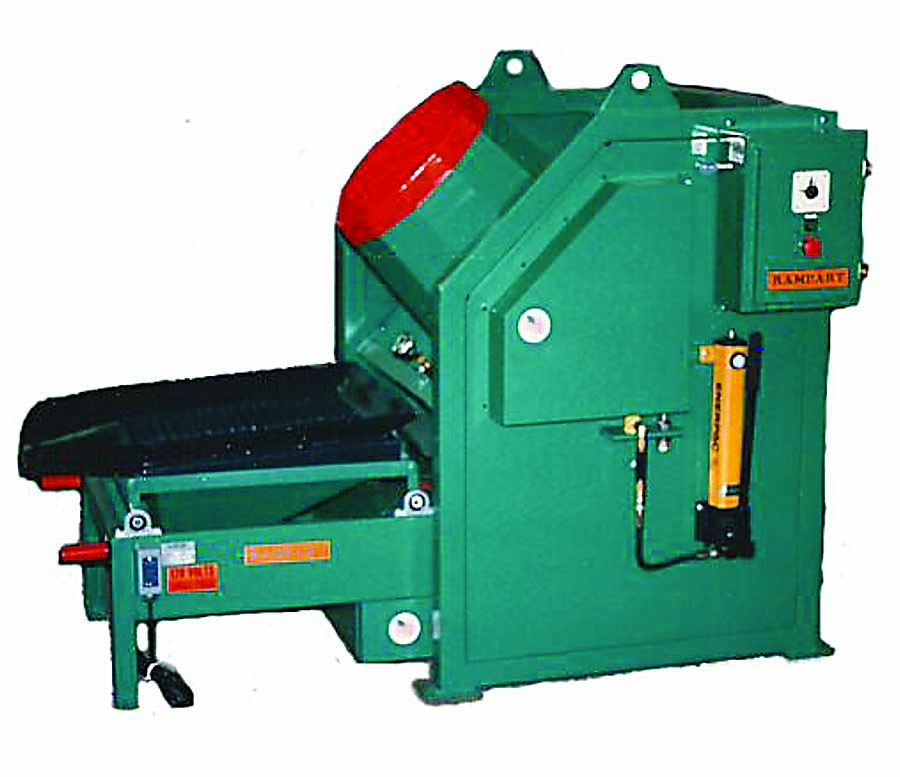
A TB-4 tilting barrel tumbling machine with an SS-24 screener from Oakland-Rampart Equipment has an enclosed frame and carriage, which reduces the possibility of workers accidentally contacting the drive mechanism. Image courtesy of Oakland-Rampart Equipment.
However, once a mass-finishing system is chosen, only tens of thousands of variables remain, said LaRoux Gillespie, a deburring and surface-finishing consultant who literally wrote the book on mass finishing, the Mass Finishing Handbook, as well as many other books and articles about finishing.
Helping to simplify things a bit are two common machines for deburring, which is the removal of protruding pieces of metal, and surface finishing, which applies desired levels of finish to parts: barrel and vibratory systems.
Barrel finishing acts similar to a rock tumbling and skidding down the slope of a hill, said Steven Schneider, technical sales manager at surface-finishing company Kramer Industries Inc., Piscataway, N.J. As the barrel rotates, the barrel’s corners lift the load—a combination of parts, media, abrasives and/or water—until it reaches a point where it slides down the side of the barrel. Parts are abraded and deburred as they bump and scrape against the media and each other.
Gillespie said barrel finishing machines are simple in design, relatively low in cost, and available in a wide variety of sizes and types.
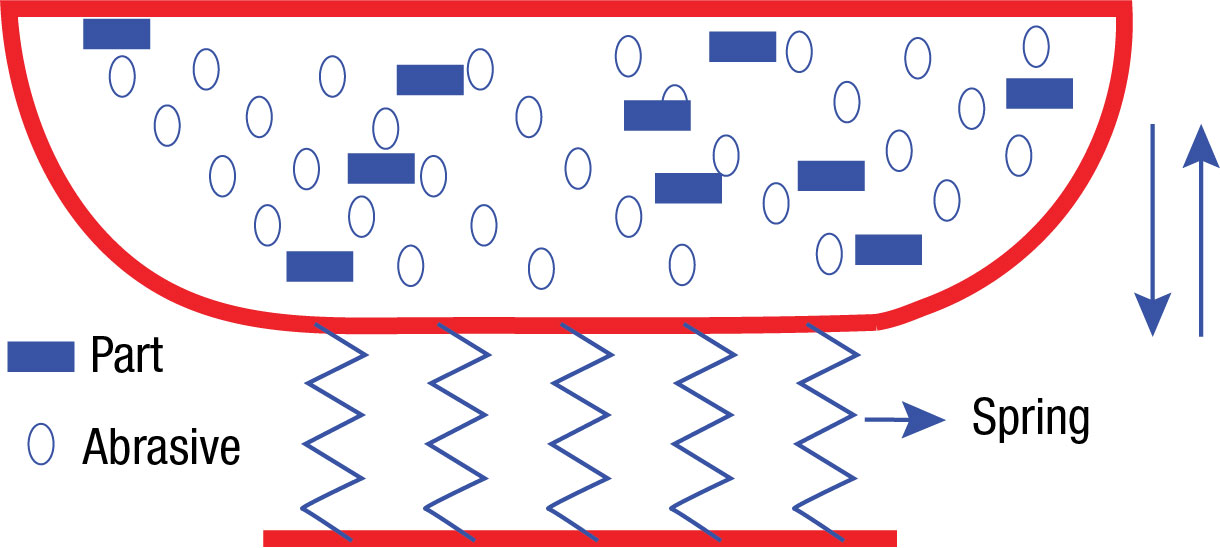
A diagram of a vibratory finishing machine with a round bowl.
“Conventional rotary barrel tumbling is the original mass-finishing technique,” he said. “Ancient Chinese and Egyptians used tumbling barrels with natural stones as media to achieve smooth finishes on weapons and jewelry.”
Vibratory finishing acts similar to filing, Schneider said. The abrasive media surround the parts. Eccentric, rotating weight shakes the machine vertically or in a circular motion. The forces of movement cause a shearing action as parts and media rub against one another. Gillespie said vibratory equipment comes in two basic configurations: a rectangular tub or a round bowl.
“The first tub-type vibratory finishing machine was introduced commercially in 1957 and the bowl-type about 5 years later,” he said. “Vibratory finishing is now the most popular type of mass finishing and, next to hand deburring, the most common surface conditioning method used by industry.”
Which system to use depends on a lot of factors. Among the top considerations are part details, processing speed and cost.
Parts
When visiting a customer who is debating which system to buy, the first question from Danny Covington, metalworking specialist at industrial distributor W.W. Grainger Inc., Lake Forest, Ill., is how many parts will be run an hour.
“If it’s hundreds an hour, then vibratory is appropriate,” he said, citing its typically faster work rate. He cautioned, however, that varying sizes of parts and machines can make a big difference to any setup.
Covington next asks about the surface finish requirement for the part before asking for the customer’s geometric tolerance for the part.
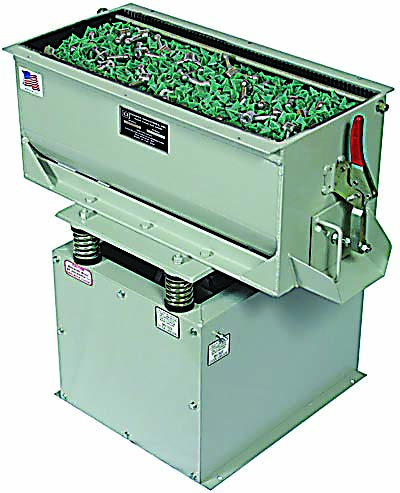
DB tub vibrators, such as the DB300 unit, are designed as starter machines for novices or shops on a limited budget. Image courtesy of Kramer Industries.
If the geometric tolerance is ±0.03″ (0.762mm) or tighter, he said, the customer should not use a barrel system because it could dent the part. Vibratory systems knock down sharp edges but do not dent parts. He compares a barrel
system to a clothes dryer with machined parts tumbling around inside, hitting each other and the media, whereas the vibratory style allows the media to smooth edges with more finesse.
“If you have a high-precision, good-quality part,” Covington said, “as long as it’s a 3D part with a tight tolerance or a fine finish requirement, it’s going to go into a vibratory system. If your finish requirements and geometric tolerances aren’t tight, then a barrel makes sense. That equipment is cheaper.”
Schneider pays attention to similar criteria. From deburring and polishing to imparting a particular surface finish, there are many considerations, he said. But the first is what the goal is—what the finishing should do to the parts.
“You want to look at the size of the parts, the geometry of the parts and some of the features, like holes and slots and grooves,” Schneider said. “You want to consider how aggressive or nonaggressive a process you need. Once you have all that information, then you can start to figure out what kind of a process makes the most sense. In a lot of cases, you could go either way.”
Les Reitz, owner and president of manufacturer and distributor Oakland-Rampart Equipment, Franklin, Pa., said barrel and vibratory systems often can deliver the same results if operators alter the aggressiveness of the media.
He recommends barrel machines for high-quality polishing of parts, such as seat belt buckles and transmission and bearing shims. “They’re very shiny and very polished and made out of stainless steel, normally, which polishes up really nice,” he said.
Speed
As indicated earlier, vibratory systems generally are faster than barrel systems. Gillespie said barrel tumbling takes at least 8 hours and vibratory finishing takes no more than 3 hours, often much less.
Review the print ads from this magazine to continue
This quick advertiser review unlocks the rest of the article and keeps the full-screen reader focused on the ads instead of the page chrome.
Continue reading
January 2018
Related


 MFGAxis Discussion
Be part of the shop-floor conversation
Like, save, or comment on this CTE story.
MFGAxis Discussion
Be part of the shop-floor conversation
Like, save, or comment on this CTE story.


MFGAxis Discussion