Reducing setup times frees up time for making chips
Setup reduction is a common goal of every machine shop.
Setup reduction is a common goal of every machine shop. Setup does not add value because it does not provide any measureable productivity. In short, when you are not running a machine, you are not making chips, and, therefore, you are not making money.
Setup involves numerous non-value-added activities, including tool measurement, fixture alignment and setting coordinate systems, or offsets. As the term suggests, value-adding activities make a workpiece more valuable by changing its shape or physical properties.

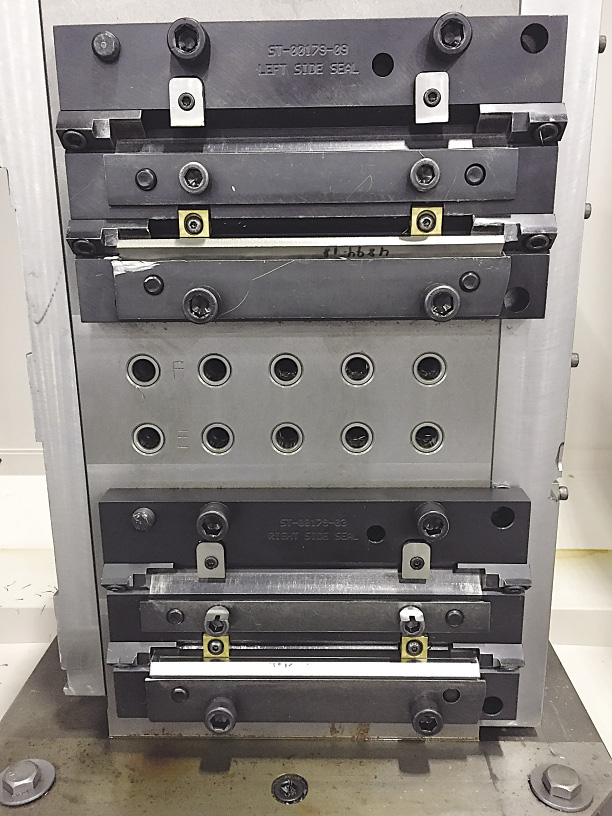
A tombstone on a horizontal machining center at Mitsubishi Hitachi Power Systems Americas’ machine shop is an example of a fixture that can be used on all machining centers, including verticals, because it has a common locating pattern.
All images courtesy C.Tate.
Many years in and out of machine shops and manufacturing plants have given me ample opportunities to see and establish some unique and familiar methods for reducing setup times and generating savings.
For example, I visited a job shop that ran small orders, usually fewer than 25 pieces, and reduced setup times by eliminating tool setting during changeovers. Previously when the shop began a new job, it would remove tools from their holders and replace them with different tools before loading them into the machine. Because the shop generally produced small quantities of parts, a lot of time was consumed taking tools in and out of toolholders.
Then, during a planning phase, the shop identified a set of common tools that could machine the components. Next, it began creating programs that used only the tools on the list. The final step was to purchase a machining center that had a toolchanger with adequate capacity to hold all the tools. After the project was completed, the shop no longer had to set tools during changeovers.
Necessary Function
Tool setting and measuring is a necessity that will never go away. On newer machines, it is possible to automate these processes by embedding electronic data chips into the retention studs of toolholders. These chips record tool measurements from a tool presetter and are read by the machine tool when the toolholder is loaded into the machine. This eliminates error from human input and makes tool setting less disruptive to production.
At a previous job, our shop needed to stock hundreds of special tools for the production of aerospace components. Although our machining center could hold more than 100 tools, it lacked the capacity to hold everything needed for all our jobs. Therefore, we periodically changed tools to support the jobs in our production plan.
Reducing changeover time was a challenge because the age of our machine would not allow the use of embedded-chip technology, but the lead operator in the cell devised a simple plan. After a tool was set and measured, it was labeled with a string tag, which had the necessary tool information on it. Tools were left mounted in their toolholders and stored with their labels so changeover only required the operator to load tools in the appropriate space in the ATC (automatic toolchanger) and enter tool information into the control.
Another Necessity
As with tools, setting and aligning workholders is also a necessity. At Mitsubishi, we use tombstones for horizontal machining centers and plates for vertical machining centers with identical mounting holes evenly spaced in a grid pattern. All fixtures and other workholders have a matching pattern, and dowel pins are employed to align the workholder to the plate or tombstone.
This approach allows us to accurately place the fixture inside the machine and eliminates manual alignment of the workholder to the machine tool. In addition, it can eliminate the need to enter coordinate system values into the control.
When the fixture is accurately returned to the same place inside of the machine’s work envelope, it is possible to write a G-code program with the necessary values into the control’s memory. This can reduce setup time from hours to minutes.
Review the print ads from this magazine to continue
This quick advertiser review unlocks the rest of the article and keeps the full-screen reader focused on the ads instead of the page chrome.