

Reasons for stable milling zones
In his October 2012 Machine Technology column, Dr. Scott Smith, professor at the William States Lee College of Engineering at the University of North Carolina at Charlotte, outlines the reasons stable milling zones appear the way they do.
The stability lobe diagram for milling shown in Figure 1 illustrates characteristic features of all stability lobe diagrams for milling. The diagram shows stable (chatter-free) and unstable (chattering) cutting conditions for a given radial DOC when slotting. The combinations of axial DOC and spindle speed that will cause chatter are shaded red, while those that will not cause chatter are shown in white.
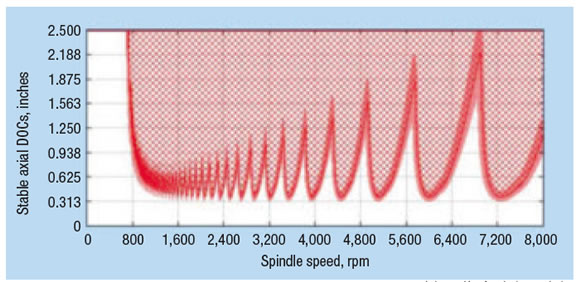
Figure 1. The red-shaded areas in a stability lobe diagram show where the spindle speeds will cause chatter, while those that will not cause chatter are shown in white.
Notable stable zones occur around 8,000, 6,800, 5,700 and 4,850 rpm. There are additional, smaller peaks, which diminish as the spindle speed decreases. Finally, there is a large stable zone below about 800 rpm.
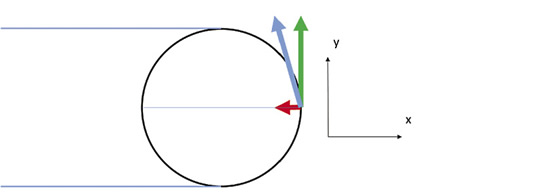
Why do these stable zones appear the way they do? The answer is connected to the physical mechanism that causes chatter. The cutting tool is stiff, but it is not infinitely stiff. When an individual tooth contacts the workpiece, the tool may deflect and vibrate because of the cutting forces (Figure 2). The vibrating tool causes the teeth to leave behind a wavy surface.
All images courtesy of S. Smith
Figure 2. Regeneration of waviness occurs when an individual cutting tool tooth contacts the workpiece and the tool deflects and vibrates because of the cutting forces.
The next tooth to pass over the wavy surface encounters a variable chip thickness, in part because of the waviness left on the surface and in part because of the current tool vibration. The variation in the chip thickness causes a variation in the cutting force, which, in turn, causes a vibration that generates a wavy surface. This “regeneration of waviness” is the primary mechanism responsible for chatter when milling.
Review the print ads from this magazine to continue
This quick advertiser review unlocks the rest of the article and keeps the full-screen reader focused on the ads instead of the page chrome.
Continue reading
October 2012
 MFGAxis Discussion
Be part of the shop-floor conversation
Like, save, or comment on this CTE story.
MFGAxis Discussion
Be part of the shop-floor conversation
Like, save, or comment on this CTE story.


MFGAxis Discussion