

Pumping innovation
April 2009 Part Time column
Eddie Paul opened an auto body shop near Los Angeles in the 1970s. One day a man walked in and asked for delivery of 48 1950s-era cars—within 2 weeks—for an upcoming movie called “Grease.” Paul hired local hot-rodders to work on the cars, gathered the appropriate equipment and completed the job on time. Today, E.P. Industries Inc., Segundo, Calif., still builds movie cars, such as 58 vehicles for “The Fast and the Furious” and three rolling, driving, full-size promotional versions of vehicles from the animated movie “Cars.” Paul also fabricates and machines products as diverse as artificial sharks for movies and research and a rotating scanner that enables 3-D films to be shot with one camera instead of two.
Less dramatic but no less innovative is E.P. Industries’ CEM (Cylindrical Energy Module) positive-displacement rotary pump. Paul invented and patented the pump, which features six double-ended pistons that reciprocate axially in a single cylindrical pump body. CEM pumps are widely used in fire suppression applications, including spraying compressed air foam.
Courtesy of E.P. Industries
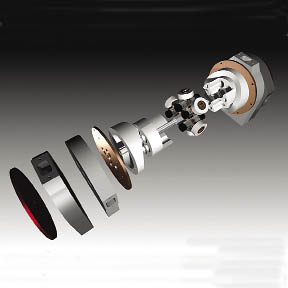
Eddie Paul said the wave-shaped split cam of his company’s CEM pump is the most difficult of its components to design and machine. In this exploded view of the pump, the mirror-image cam halves are visible next to the bronze-colored mounting plates.
On a pin in the center of each piston is a roller that follows a circular cam around the ID of the pump body. The cam’s wave-shaped contour—which looks like a bushing split horizontally into two mirror-image halves—produces the back-and-forth motion of the pistons.
Paul said the CEM pump is smaller and lighter than a positive-displacement piston pump of equal output, or flow volume, and pumps air or liquid in either direction. “I call it a virtual 24-cylinder pump. Six double-ended pistons and two pump cycles per rotation makes 24 pump cycles in one revolution,” he said. The pumps typically run at about 1,000 rpm.
Paul makes the pumps in various sizes, ranging from the diameter of a felt-tip marker to 3 ‘ in diameter.
Despite the size differences, the basic pump design remains the same. “If we need more pumping power we just scale it up,” Paul said. “Enlarging the pistons from 1 ” to 2 ” in diameter, we double the diameters but cube the output; output of 100 gpm with 1 “-dia. pistons grows to 800 gpm with pistons of 2 ” in diameter. If we have a 1 “-dia. pump in AutoCAD and somebody wants a ½ “-dia. pump, we take the drawing and scale it by one half and then machine it.”
Paul machines pump components from a variety of materials, depending on the application. Most are made from advanced thermoplastic-based resins with ultralow friction characteristics, such as Teflon, Tercite and UHMW-PE. The plastics are basically self-lubricating. “The cam could be Tercite and the rollers might be Teflon,” Paul said. “We just need one of the surfaces, usually the cam, to be a lubricant.”
Review the print ads from this magazine to continue
This quick advertiser review unlocks the rest of the article and keeps the full-screen reader focused on the ads instead of the page chrome.
Continue reading
April 2009
Related


 MFGAxis Discussion
Be part of the shop-floor conversation
Like, save, or comment on this CTE story.
MFGAxis Discussion
Be part of the shop-floor conversation
Like, save, or comment on this CTE story.


MFGAxis Discussion