Presetting Tools Pays Off
Tool presetting offers manufacturers increased efficiency and precision, reducing downtime by optimizing the tool setup process before machining begins.
Poll any group of machine shop owners and chances are every one of them wants to reduce setup times, decrease changeover time between jobs and increase machine tool uptime. But ask them about the technology they use to be more efficient, and their responses will likely reveal a range of approaches.
Even so, as the manufacturing industry’s persistent skilled worker shortage drives interest in productivity-boosting solutions, smalland medium-sized job shops are increasingly recognizing the time and money they can save with tool presetters. These offline machines measure various dimensions of cutting tools, including length, diameter and offsets, before the tools are installed in a machine tool.
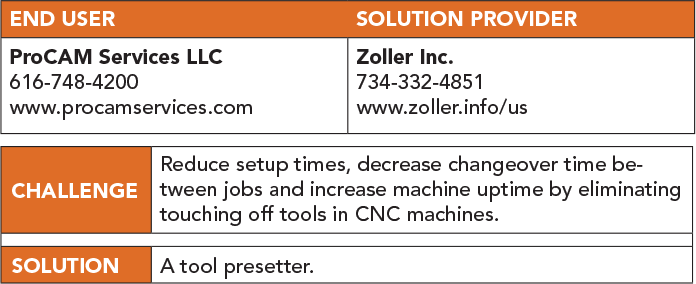
Job shop owners frequently have the misconception that presetters are not for them, according to Dietmar Moll, director of sales at Zoller Inc., an Ann Arbor, Michigan-based company that provides manufacturing hardware and software, including presetters. “But often when we get the presetter into their shop and they see the results, their only complaint is they wish they had purchased one sooner.”
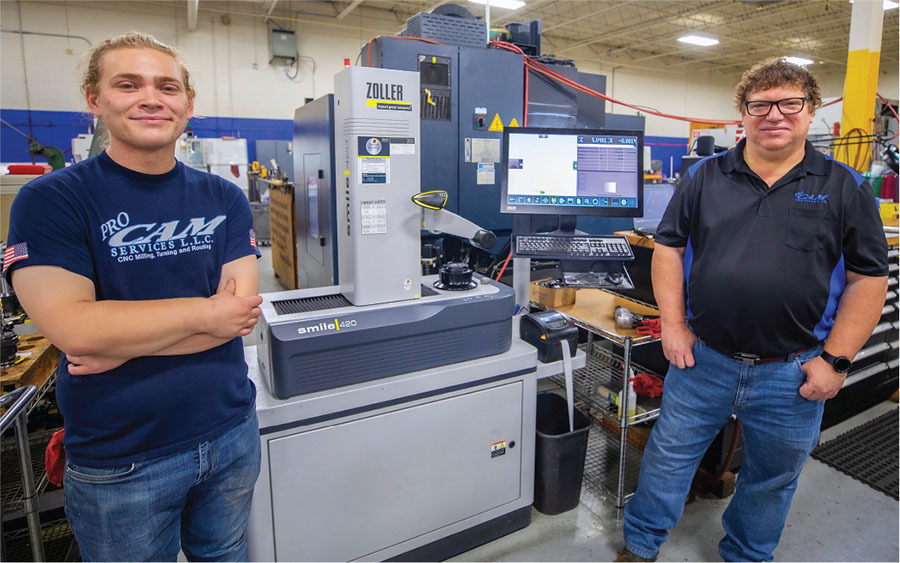
That’s what happened at Pro-CAM Services LLC, a family-owned CNC machine shop that Tom Bassett II established nearly 30 years ago. Initially skeptical of tool presetters, Bassett’s reservations vanished after he purchased the Zoller »smile 420« about five years ago and incorporated the presetter into the workflow of his busy shop in Zeeland, Michigan.
Zoller reports that its internal tests show measuring with a tool presetter is at least 45% faster than with the machine tool’s internal control. Setting up jobs on the presetter also freed up time Pro- CAM machinists previously spent touching off tools in the shop’s CNC machines. This streamlined approach where a machinist measured tools for one job while the machine cycled through another job allowed ProCAM to accept more orders.
In the company’s first year using the tool presetter in 2019, sales increased by $300,000, and then grew by another $700,000 the next year. Bassett said he attributes the bulk of that $1 million increase to more efficient processes that improved the productivity of all the shop’s machine tools. “I don’t think I’ve ever had a piece of equipment that I’ve gotten in the shop that changed things so much.”
Bassett said he believed presetters didn’t belong in shops like Pro- CAM with its high mix and low volume of orders and frequent job changes. ProCAM positions itself as an agile job shop that beats its competitors on lead time without sacrificing quality. Each of the company’s machinists often cycle through 20 to 30 tools a day to fulfill orders.
The 3,530-sq.-m (38,000-sq.-ft.) shop includes eight milling machines — vertical and horizontal mills and three-, four- and five-axis mills — three lathes, including one six-axis unit, and two CNC routers.
“We’ve had customers call in the morning and say, ‘Hey, we’re broken down. We need this,’ and then we’ve delivered the part to them in the afternoon,” Bassett said. “It doesn’t always go that way, but most of the time, our backlog is about two weeks because we cycle through things so fast.”
Review the print ads from this magazine to continue
This quick advertiser review unlocks the rest of the article and keeps the full-screen reader focused on the ads instead of the page chrome.