

Why Precision Is Critical in Micromachining Systems
A unique collet-and-cartridge workholding system for machining small parts.
In the world of micromachining, precision is relative—the smaller the work, the greater the need for accuracy in all aspects of the process. End users must optimize the entire micromanufacturing system to be efficient, competitive and successful.
Traditional techniques for achieving precision may work well for macro-scale parts, but can be subtly awkward or downright clumsy when applied to smaller work. Workholding is a classic example of this, noted Matt Saccomanno, a principal who handles product design, engineering and R&D for Masa Tool Inc.

Images courtesy of Masa Tool
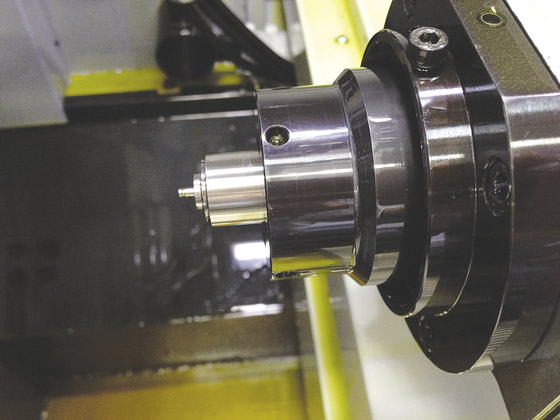
Masa Tool’s Microconic workholding system (pictured above) consists of (clockwise, starting at 12 o’clock) a cartridge, collet, hex key wrench and collet wrench with graduations for adjusting the collet closure. Below: The Microconic system can be installed in the subspindle of a Swiss-style CNC lathe.
He added that a collet is often the best workholding method because it firmly grips the workpiece and is highly accurate in a production setting.
However, the collet system installed by the machine builder accommodates the largest workpiece the machine was designed for, such as a Swiss-style machine with a 20mm capacity. Although collets for smaller bores to hold smaller workpieces are available, the rest of the system (collet body, spindle nose and closing mechanism) is sized for 20mm, creating problems when chucking smaller parts, according to Saccomanno.
Therefore, Masa Tool developed the Microconic collet system specifically for holding workpieces from 10mm (0.39 “) to 0.75mm (0.03 “) in any machine that has a collet-type chuck. The system consists of two major components: the cartridge, which transforms the work spindle for miniature workholding, and the “right-sized” collet, which fits in the cartridge. For the system’s introduction, the company offers a cartridge for draw-type, 5C collets and one for push-type, or “dead-length,” TF25 collets, which are typically used on the subspindle of Swiss-type lathes. Market demand will dictate future versions, he added.
Review the print ads from this magazine to continue
This quick advertiser review unlocks the rest of the article and keeps the full-screen reader focused on the ads instead of the page chrome.
Continue reading
March 2014
Related


 MFGAxis Discussion
Be part of the shop-floor conversation
Like, save, or comment on this CTE story.
MFGAxis Discussion
Be part of the shop-floor conversation
Like, save, or comment on this CTE story.


MFGAxis Discussion