

Night moves: Drilling Performance
Five shops use different lights-out machining strategies, but all are focused on creating stable processes.
Courtesy of Morsch Machine
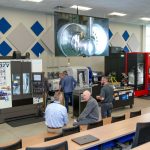
The lights are on but nobody’s around at Morsch Machine, which employs lights-out machining to run 24/7. Here, a pallet changer (left) feeds a machine tool (right).
Five shops use different lights-out machining strategies, but all are focused on creating stable processes.
If you ask five machinists how they make a part, they’ll have six ways of doing it. The same appears to be true with lights-out machining. While the shops interviewed for this article take different routes to the goal of unattended operations, they all agree the foundation of the process is to have a stable, repeatable process.
Fully Developed
The rule at L&S Machine Co., Latrobe, Pa., is a process must be fully developed before any lights-out job is run. For example, an ongoing job at L&S involves machining an 8½ “×8½ “×0.600 ” stainless steel adapter plate. Lights-out processes performed on a Haas vertical machining center include drilling more than 600 holes 0.192 ” and 0.221 ” in diameter using solid-carbide, through-coolant drills from OSG. The holes and the edge of the plate are chamfered. The shop fixtures parts in the machine in groups of five, and it takes about 6½ hours to process each set.
L&S Machine’s operation in Marion Center, Pa., makes prototype and production parts, with an emphasis on the nuclear power industry. “We run them from 6 a.m. until 10 p.m. manned, then for 3 to 5 hours lights out,” said Foreman Dave Smathers. L&S fine-tuned the process at its main shop in Latrobe before committing to lights-out production. “We took our time,” he said. “We didn’t go unmanned until we knew we had problems like drill breakage solved. It didn’t go unmanned until about a year ago. We started running it without anybody here, then moved it to Marion Center.”
Courtesy of B. Kennedy
Copious coolant flow aids consistency of drill life in lights-out machining at L&S Machine.
Process monitoring helps maintain reliability. After each plate is drilled, the VMC’s spindle moves to a Renishaw OTS tool-length sensor, which confirms a drill is intact. If the sensor detects a broken drill, the machine stops. A drop in coolant pressure below a predetermined level will also halt machining.
L&S prefers not to use load-monitoring technology. “We know the drills run anywhere between 30 and 36 percent on the spindle load meter. You can set the monitor to stop drilling any time load spikes up. That way, you won’t break a drill,” Smathers said. But the shop found that even minor variances in the work material triggered a machine stoppage. “It’s easier to just probe between parts. If a drill breaks, it usually shatters, so we don’t really lose a part over a broken drill,” Smathers said.
However, drill breakage is essentially nonexistent because the process has been thoroughly proven and the drills have consistent life. “We know our drills last for 15 pieces,” Smathers said. The shop doesn’t baby the drills. “We run them as hard as we can,” he said. “We found a sweet spot of speed and feed at which the drills are really consistent.”
Copious through-the-spindle coolant flow at 1,000 psi aids that consistency. “The coolant keeps the end of that tool nice and cool and assists in chip evacuation,” Smathers said. At the same time, coolant from multiple external nozzles floods the face of the plate to help evacuate chips. Then, between the drilling and hole-chamfering operations, the shop employs a Clean-Tec fan from Lang Technik to blow away any remaining chips that might damage the chamfering tool that follows the drill. The fan has a tapered-flange shank that enables it to be stored in the machine’s tool magazine, and its spring-loaded polymer blades deploy via centrifugal force when it makes two passes over the plates at 5,000 to 8,000 rpm. The combination of thorough process development and machining technology permits shop staff “to shut the lights out, leave and let it go,” Smathers said.
The Long Grind
Lights-out tool grinding involves many of the same issues as other metal-removal processes. Professional Tool Grinding Inc., South Easton, Mass., manufactures specials for the aircraft, aerospace, automotive and medical fields. PTG may run six or fewer prototype tools for customer tests, but according to Mike Hilbert, tool design and production engineer, production runs “get into the hundreds, even thousands,” which provides an incentive to reduce labor costs by running lights out.
Courtesy of B. Kennedy
After drilling a stainless steel adapter plate at L&S Machine, the Haas VMC spindle moves to a Renishaw OTS tool-length sensor, which confirms the drill is intact. If not, the machine stops.
Typically, unattended production takes place for 4 hours on weeknights and over the weekend. Hilbert agreed that establishing a sound process before running lights out is critical. “We wouldn’t do a setup piece and then leave. For a job running over the weekend, we set it up Friday afternoon and run it for a couple hours to make sure everything is leveled out and on the right path.”
Tolerance requirements help determine if a job is right for lights out. Tools ground unattended are still precise, but tolerances are ±0.001 ” rather than ±0.0005 “, for example. “Over the weekends, we will find jobs with more open tolerances,” Hilbert said.
Tools that require less operator intervention are also logical choices for lights-out operation. Hilbert said the shop’s Walter grinding machines produce consistent work whether attended or not, but grinding wheel wear is a consideration. In some cases, Hilbert noted, PTG employs software that measures parts while the machine is running and makes adjustments for wheel wear.
Grinding speed and feed rates do not change for unmanned operation, Hilbert said, “but for lights-out operation over the weekend, we might slow the rapid movements of the machine to 80 percent to minimize wear and tear on the machine.”
A Flexible Schedule
Joe Salontai, CEO of Morsch Machine Inc., Chandler, Ariz., said his shop “absolutely” determines a machining process is stable before running it lights out. “We make sure that a part is running well, and then we will commit it to overnight production. We are rambunctious but not foolhardy!”
Another word to describe Morsch Machine is ambitious, in regard to its approach to flexible production scheduling and lights-out operation. The company machines, assembles and finishes enclosures, support components and chassis—most from aluminum—for the electronics and avionics industries.
The facility runs 24/7, operating four machining cells with a focus on flexible automation. One large cell includes three Hitachi Seiki horizontal machining centers, two with 120-tool magazines and one with 210 tools, serviced by a rail-guided vehicle shuttling 44 pallets. The plant’s newest cell features a Toyoda HMC with 494 tools and 18 pallets, also with an RGV.
Morsch Machine uses the flexibility of cellular production in both manned and lights-out scenarios. Salontai said the shop developed its own Excel spreadsheet-based scheduling system that multiplies the cycle time for each part by the volume required to determine total machining time for a job. Earlier this year, the system was changed to enable machining time data to be apportioned to the day, night and lights-out shifts.
Every Friday morning, a group meets to devise a production schedule for the upcoming week. “We focus on unused minutes,” Salontai said. “There is always going to be downtime. The goal is always zero, but we never get there. We usually are able to limit downtime to 400 to 600 minutes a week.”
Using cellular manufacturing helps minimize downtime. “That’s the neat thing about the flexibility of a cell,” Salontai said. “You can put parts into reserve in the cells so they will run at specific times, or you can line them up by pallet so that they will run one after another. We have the flexibility to pull a pallet into a machine that needs a little extra time.”
Morsch produces its parts in small runs, typically 100 per week at most. The flexibility of the cells and creative scheduling can enable economic production, in some cases, of as few as one part per day, Salontai said.
A key element of automation and effective lights-out operation is consistency among machining processes, which Salontai said is facilitated by the company’s Zoller heat-shrink and presetting system. The rigid toolholding method minimizes runout and enables tool lengths to be set within 0.0001 “. “That plays into lights-out operation,” he said. “We can replicate the tools very well in the cells. Sometimes, one tool running lights out will machine seven or 10 different part numbers, and we want to make sure it produces the same results on each part.”
The facility does have stand-alone VMCs available for quick-response jobs, but the shop wants to move more work into the automated cells to maximize productivity and minimize labor. “To compete with offshore entities, you are trying to minimize labor input” with lights-out machining, Salontai said.
The shop’s 24/7 schedule includes running through the weekend on a modified lights-out basis. Both Saturday and Sunday, two-person work teams come in for 2 hours in the morning and return for 2 hours late in the day. “We have about eight people who arrange the schedule among themselves and share the weekend responsibility,” Salontai said. Their tasks include monitoring machine health, fixing machine problems, unloading completed parts and loading new workpieces. “It gives them the opportunity to get some overtime, and gives us the peace of mind that we are still producing throughout a weekend.”
Salontai pointed out that such an arrangement is not practical on a daily basis. “You are running almost 24 hours a day, and you can’t do that,” he said, because regular manned shifts include process monitoring, inspection, toolsetting and maintenance, as well as machining parts requiring operator attention.
Although Morsch’s machines can send alarms via telephone, the shop doesn’t use that capability. “We tried that originally; we had a paging system. If a machine were to stop for some reason and there was an alarm, the problem was that somebody would get a page at 1 a.m. People get tired of that,” Salontai said.
Review the print ads from this magazine to continue
This quick advertiser review unlocks the rest of the article and keeps the full-screen reader focused on the ads instead of the page chrome.
Continue reading
September 2010
Related
 MFGAxis Discussion
Be part of the shop-floor conversation
Like, save, or comment on this CTE story.
MFGAxis Discussion
Be part of the shop-floor conversation
Like, save, or comment on this CTE story.


MFGAxis Discussion