Multibenefit Machines
CNC lathes have evolved greatly over the past few decades.
CNC lathes have evolved greatly over the past few decades. What were once simple 2-axis turning machines have become a bewildering array of extremely capable metalcutting equipment, most of which offer two spindles, multiple turrets, robust milling capabilities and can complete many parts in a single setup.
In other words, they have become multitask machines.
Despite the obvious benefits, however, many parts manufacturers look at the $500,000 price tag of a multitasker and cringe. They can buy three or four conventional lathes or machining centers for that amount and, therefore, crank out more work and eliminate the eggs-in-one-basket worry of a single supermachine breaking down and bringing production to a standstill.
They might also look at a tool-changing, multispindle, live-tool machine and wonder who’s going to run the darned thing. Good machinists and programmers are in short supply—good luck hiring one that can set up a machine with eight or more axes, dozens of tools and the crash potential of a stock car race. With its complexity and high price, multitasking is perceived by many in the machining world as a headache that should be avoided. Not so, say sellers of multitask machines.

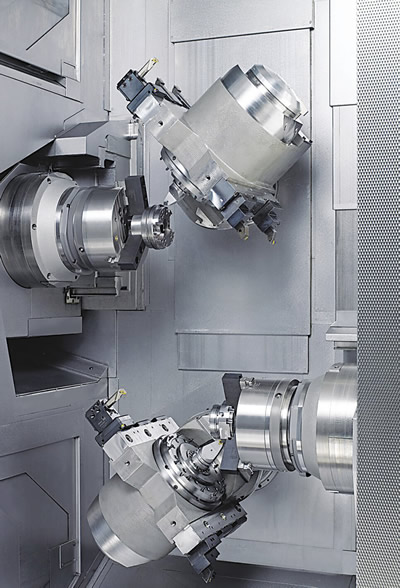
An INDEX R300 turn-mill center performs simultaneous 5-axis machining on the main and counter spindles. Image courtesy INDEX.
Goodbye, Old School
Robert Appleton, applications manager for Doosan Machine Tools America, Pine Brook, N.J., said there are many reasons to maintain the machine tool status quo, but—in most cases—multitaskers produce more-accurate parts in less time, make better use of available floor space and provide greater flexibility than conventional machine tools.
“This is especially true for job shops,” he said. “You never know what’s coming through the door. With a multitasking machine, you can quote pretty much anything that fits on the machine and have confidence you can get it done quickly.”
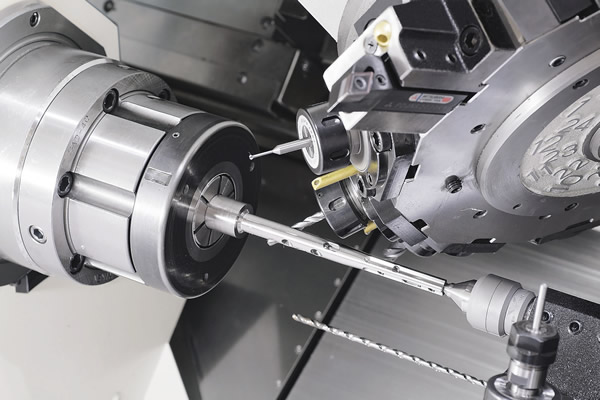
Machining long shafts and deep holes are just two of the possibilities with this twin-turret, live-tool, B-axis multitask machine from Methods Machine Tools. Image courtesy Methods Machine Tools.
Furthermore, the notion that shops will be unable to find qualified operators is false, Appleton said. Aside from the occasional engine lathe or manual mill operator who’s new to CNC machining, most on the shop floor acclimate quickly to the challenges of multitask machining.
“Most of these machines are really nothing more than two lathes with a machining center on top,” Appleton said. “If you can break the programming and setup into smaller pieces, tackling the part one machining process at a time, it comes together pretty naturally. Typically, we figure from 2 to 4 months and the customer will be up and running and well on their way.”
Appleton said the steepest part of the learning curve with multitaskers is rethinking part processing. Gone are the days of worrying whether the part will collapse during the second operation, wondering how to clamp it on a machining center. No more work in process or scrapping hundreds of parts on the final operation.
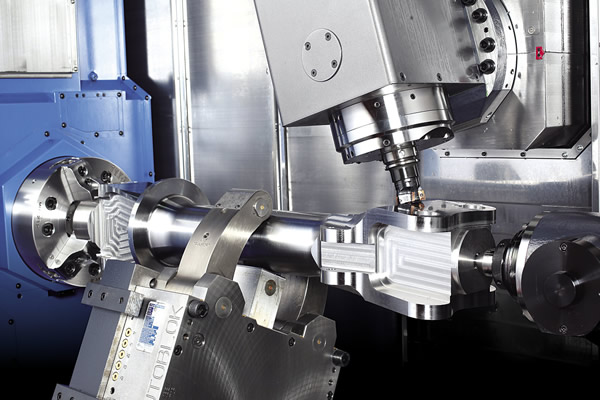
Multitaskers can often machine parts, such as this aircraft landing gear strut, in a single setup. Image courtesy Doosan Machine Tools America.
“It may seem ironic, but machining is much simpler with a multitasker,” he said. “You load some bar stock or chuck a sawed blank, push cycle start and a few minutes or half an hour later out comes a finished product. Part handling and human error are virtually eliminated with a multitasking machine. Best of all, we find pretty consistently that parts are completed in about half the time.” For a deeper look at Maxing out multitasking: 5-Axis Machining, see this supporting resource.
Cash is King
“With conventional machine tools, you typically have a couple of lathe operations, then the job heads to the milling department,” said Rich Parenteau, director of applications development at Methods Machine Tools Inc., Sudbury, Mass. “The parts have to wait in between machines, so there’s work in process sitting around. You have to build fixtures, pay for material and employees. The entire process takes weeks and often much longer.
“With a multitasker, the part comes out of the machine, you wash it, pack it, ship it and invoice it the same day. Not only is it more efficient, but you’re getting paid quicker. For small shops especially, this is a big boost to cash flow,” Parenteau said.
He agreed that multitask machine setup and programming is nothing to fear. Many machines have onboard CAM software with simulation capabilities, so potential collisions are easy to spot. A variety of M codes and other functions exist, making synchronization of the various machine axes—and commensurately shorter cycle times—simpler to achieve. Finally, elimination of multiple fixturings makes it easier to meet tight tolerances.
Review the print ads from this magazine to continue
This quick advertiser review unlocks the rest of the article and keeps the full-screen reader focused on the ads instead of the page chrome.
Continue reading
July 2016