

Mold fusion: Lasers making mark on moldmaking industry
Laser technology has taken hold in the moldmaking industry, offering new possibilities for fabrication, detailing, maintenance and repair.
Mold and die makers have long incorporated lasers into their arsenal of fabrication and repair tools; today, new advancements in laser technology have expanded the realm of possibilities.
While traditional machining methods are still used to remove material from the core cavity, lasers can create complex features in molds, fashion intricate mold coolant systems, repair worn molds and even provide routine mold maintenance. The benefits include fine surface finishes, high accuracy and cost and time savings for ablative and additive laser technologies.
Cavity Search
One of the broadest applications of lasers in mold and die making is in patterning the mold cavity, according to Greg Hyatt, senior vice president and chief technical officer at machine builder DMG Mori USA, Hoffman Estates, Ill. While traditional patterning methods, such as chemical erosion or mechanical machining, can achieve simple, repetitive patterns, lasers offer unmatched flexibility, he said.
“The accuracy and speed could be matched using conventional machines for simple repeating patterns, but there is a range of intricacy for which there’s no other technical solution. The laser is really the only way to produce more involved or irregular patterns,” Hyatt said.
In addition to ablating intricate patterns on the mold surface, laser beam sources, such as the redEnergy line of pulsed fiber lasers from Southampton U.K.-based SPI Lasers, can be used to perform deep engraving at depths up to 0.030 “.
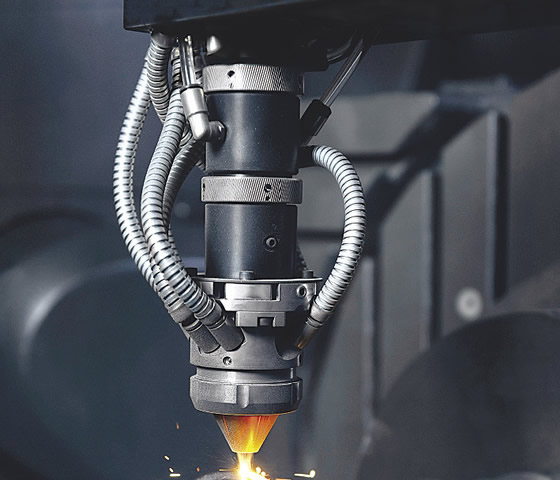
Courtesy of DMG Mori USA
With the Lasertec 65 additive manufacturing machine, DMG Mori incorporates laser deposition welding and 5-axis milling into a hybrid machine.
“Molds are typically made from hardened steels, which are difficult to machine by any means, and certainly lasers are no exception,” said Dr. Ken Dzurko, general manager of SPI Lasers LLC, Santa Clara, Calif. “What you need depends on whether you want to machine the entire mold to a fine surface finish using the laser, or if you are using the laser to imprint a rough pattern and then clean it up using wet chemistry.” The same laser would be utilized in either process, he continued, but the software to direct the laser for fine finishing would need to be considerably more powerful, which is where the cost differential comes into play.
A “brute-force” deep-engraving laser system costs from $30,000 to $60,000, Dzurko said, while a workstation with high-resolution capability can cost well over $100,000—with the bulk of the price difference being the operating software. “To render a 3D object with high spatial resolution and low residual surface roughness takes a lot of programming power.”
Like other lasers, SPI’s machines are controlled using three parameters: pulse duration, frequency and optical power. The lasers can produce pulses from 3 to 500 ns, which can vary in frequency from 1 kHz to 1 MHz, and the operator maintains analog control over the rate of power, Dzurko explained. “With those three knobs to turn, you essentially have an artist’s palette in terms of what you can achieve with that laser,” he said.
Hybrid Vigor
In addition to removing material to create patterns and textures, lasers can be used for additive processes that build mold features. DMG Mori, in conjunction with its subsidiary Sauer GmbH, Pfronten, Germany, has developed a machine that performs both processes: The Lasertec 65 combines laser deposition and 5-axis milling (see photo above).
In the laser deposition process, powdered metal is sprayed into the beam of a high-powered diode laser, with the powder spray focused by a surrounding stream of argon gas, according to Friedemann Lell, sales manager for Sauer. “The powder is directly melted in the laser and deposited to build up complete mold components.”
The machine uses pure metal powder (no additives or binding agents) with grain sizes from 30µm to 100µm, which reduces the cost compared to sintering applications requiring finer powders or additives. The laser deposition process is fairly well established for applying coatings on cutting and hole-punching tools, he explained, but has not previously been utilized to build mold components.
The all-in-one workstation allows mold components to be completed quickly by cutting down on changeover, he said. When the process requires laser deposition, the machine spindle automatically picks up the spray nozzle in an HSK toolholder; when milling needs to be performed, the same machine spindle picks up the milling tool. In this way, the downtime resulting from switching between machines is eliminated. Turning and grinding options can also be added, further increasing the versatility of the multitask machine.
“If there are complex internal coolant channels that would be difficult or impossible to drill, we can manufacture those by deposition,” Hyatt said, “and if those channels require machining before they’re closed, we can do that easily because the turning or milling or grinding is happening in the same machine as the deposition.”
According to the company, the Lasertec 65 has several advantages over powder-bed laser sintering, in which a powder bed in the form of the part is laid down and a laser then sinters that bed into a solid metal part or feature.
The machine’s main advantage is workpiece size. While the area of a typical powder bed is from 200mm to 300mm (8 ” to 12 “)—roughly the size of a microwave oven—the 28.9 “×25.6 “×22 ” (734.06mm × 650.24 mm × 558.8mm) envelope of the additive laser allows for much larger molds and mold inserts to be manufactured.
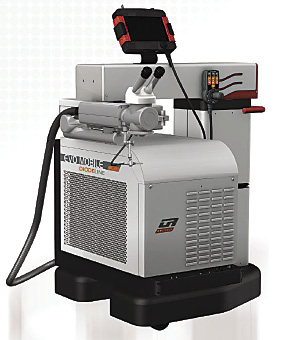
Courtesy of O.R. Lasertechnology
O.R. Lasertechnology’s EVO mobile laser welding station allows for precise repair of mold components.
The other primary advantage is production speed. “Powder beds are designed to achieve a high level of initial accuracy to minimize post-production machining,” Hyatt explained. “But because of the nature of our machine, we don’t have that concern. We focus on productivity and achieve final part accuracy by milling after deposition. As a result, our deposition rates are 10 to 40 times faster than a powder bed, capable of depositing material at a rate of 0.9kg per hour per kilowatt of laser power.” The laser power is adjustable, he explained, allowing for fine control over the deposition process.
While the machine isn’t commercially available—a working prototype was shown at DMG’s open house in Pfronten in February—the company has already received many inquiries, according to Lell. “We have introduced a lot of new technology, but have never had this kind of response, and from different types of customers—from prototypers to additive manufacturing job shops to the aerospace industry to mold and die makers,” he said. “We don’t know how to handle all the inquiries and we don’t even have a machine to sell at this point.” The Lasertec 65 will be introduced to the North American market at IMTS 2014 in September.
A similar machine, the Lumex Avance-25, is distributed by MC Machinery Systems Inc., Wood Dale, Ill. The hybrid laser sintering and milling machine, from Matsuura Machinery Corp., Fukui City, Japan, allows for one-machine, one-process manufacturing of complex molds and parts.
Precision and Power
Review the print ads from this magazine to continue
This quick advertiser review unlocks the rest of the article and keeps the full-screen reader focused on the ads instead of the page chrome.
Continue reading
April 2014
Related
 MFGAxis Discussion
Be part of the shop-floor conversation
Like, save, or comment on this CTE story.
MFGAxis Discussion
Be part of the shop-floor conversation
Like, save, or comment on this CTE story.


MFGAxis Discussion