

Mind your modules: Drilling Performance
Modular automation increases productivity and flexibility at a lower price point than custom solutions.
While great for increasing productivity, customized automation systems might simply be out of reach for some shops’ budgets. Fortunately, alternatives exist—ones that don’t involve paying operators to load and unload parts for their entire shift. Modular automation allows machine shops to increase efficiency without paying top dollar for customized systems.
These modular systems come in many forms, from pallet loaders to conveyers to self-contained machine cells. “Automation has been around since the 1960s, and today I can leave my office, drive 10 miles in any direction and probably find an integrator that can build me an advanced, custom automation system to accommodate whatever job I’m doing,” said John Roskos, product manager at machine tool builder GF Machining Solutions LLC, Lincolnshire, Ill. “What a modular system offers is more flexible, scalable automation, without the added costs that come with custom engineering.”
Loading Up
GF Machining Solutions sells its Transformer system, a modular automatic loader capable of serving multiple machines. Originally developed for tool, mold and die shops to transfer electrodes manufactured on CNC mills to EDMs, the system has been scaled up to the point where the largest pallets are capable of handling 440 lbs. (200 kg) and is appropriate for job shops, Roskos said.
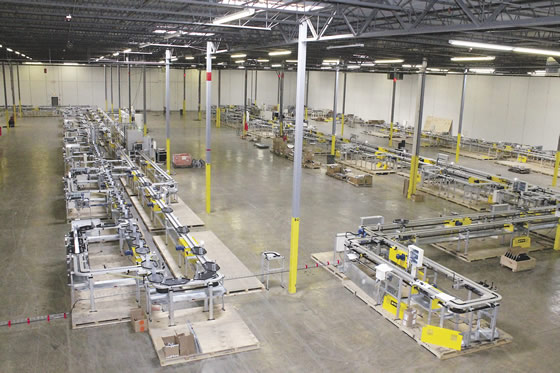
Wes-Tech Automation’s Tech-Trak Mega Modules can be assembled into a conveyor system.
“We’ll build a solution for you, but we’re not engineering it from the ground up,” he explained. “We’ll look at your application—part size, cycle times, machine tools—and come up with a unique cell using standard components.”
The goal is to eliminate production bottlenecks, Roskos added. Because many shops only run a single shift, the machine where the bottleneck occurs can be connected to a Transformer loading system, which lets the machine run overnight.
Because the Transformer’s 2.5-axis rotary loader can feed multiple machines, he continued, shops can then look for other bottlenecks and bring those machines into the cell as well. The system can load as many machines as can be fit within 370° and 60 ” (1,524mm) of the loader’s travel. If the cell expands beyond that, a linear track can be added between machines to extend that reach. And when jobs change and new bottlenecks arise, the cell can be reconfigured.
“Job shops’ workloads are constantly changing,” Roskos said. “The system might be loading one machine today, but in 6 months that job is over; with a modular solution, other machines can be moved into the cell for the next job.”
Pallet Pals
While the Transformer loads and unloads palletized workpieces and changes workholding, machine tool builder Okuma America Corp., Charlotte, N.C., offers another option. Its Palletace system, built by Tampere, Finland-based Fastems, is a flexible manufacturing system that stores and moves those pallets.
“Let’s say you have a horizontal machining center with 10 or 12 dedicated jobs,” said Rod Tojdowski, senior manager, applications engineering for Okuma. “Instead of tearing off the old fixture, putting the next fixture on, indicating it, setting it up and proving everything out, you can set an FMS in front of the machine and program it to run the jobs in the order you need.”
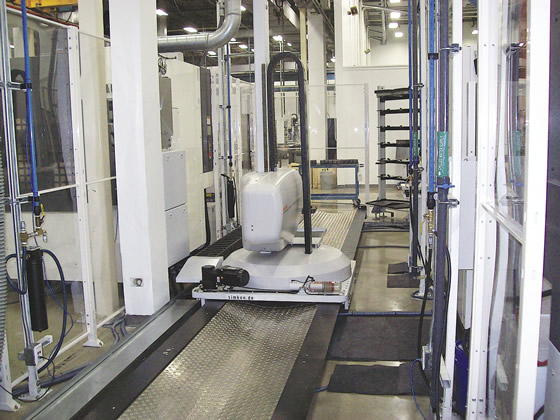
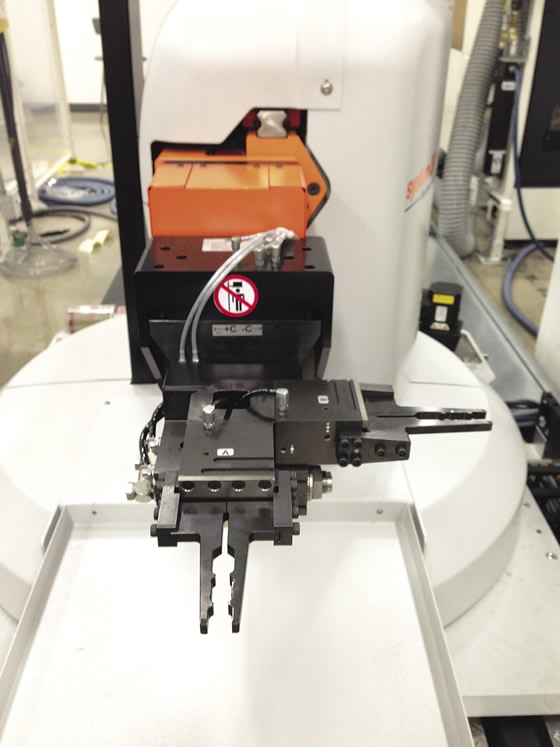
Left: The GF Machining Solutions Transformer robotic loading system at the former Rexam Mold Manufacturing plant in Buffalo Grove, Ill., now owned by Berry Plastics, loads parts and tooling from two rotary turrets into a variety of machines placed around its track. Top: A double gripper on the Transformer robot.
The Palletace FMS, he continued, allows machine operators to schedule jobs one after another, setting up the fixturing and tooling, feeding the pallets, running the job and cycling to the next one. As long as it has jobs programmed and pallets to load, the systems can run virtually nonstop. After an initial setup and prove-out for new jobs, subsequent runs are automatic.
“What sets Palletace apart is the modularity,” Tojdowski said. “If you were to add a second machine, you’d be able to add a second Palletace container very easily, without buying an additional cell controller.” At that point, two machines can run unattended as long as the pallets are loaded. Depending on the size of the machines and the jobs, a third machine can be added to the cell without adding a third container. “In some cases, you might even be able to run multiple machines from just one container. You just need to specify which job goes to which machine and the system takes care of the rest,” he added, noting up to three Palletace systems can be linked on the same controller.
Jobs with short cycle times or that rarely repeat may not see significant efficiency gains, but longer, repeat jobs do because Palletace eliminates the need for an operator to perform basic job setups, according to Tojdowski. While the Palletace clientele has historically been large companies with big budgets, he said the line has been gaining popularity with smaller shops.
Building Blocks
Conveyors are another key part of automation systems, but most systems are custom built. Wes-Tech Automation Solutions, Buffalo Grove, Ill., launched its Tech-Trak Mega Modules at IMTS 2014, a palletized conveyer system comprised of standard modules that can be linked in many configurations.
“We’ve been in business for almost 40 years and have had conveyor products for almost 30 of them,” said Technical Sales Engineering Manager Bill Bauer. “The typical way we had been building our conveyors was like an Erector set, where we would start with individual pieces, then put each conveyor together piece by piece according to customer specifications.”
While such an engineered solution delivers exactly what the customer needs, it takes longer to design and build a custom system from scratch. Wes-Tech noticed that a lot of customers ended up using similar automation modules, so the company standardized those modules, assigning each one a single catalog number. This allows customers to assemble different configurations and rearrange them as needed.
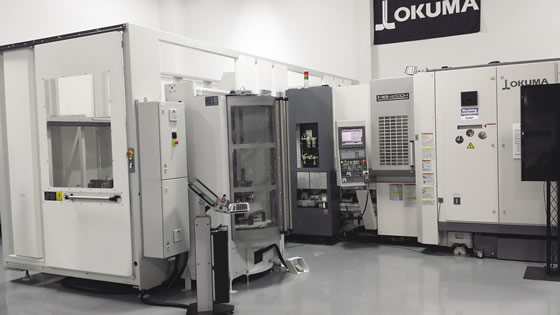
Okuma’s Palletace, shown here (left) with an Okuma MB-4000H horizontal machining center (right), is capable of feeding various jobs to multiple machines 24/7, allowing for lights-out manufacturing and switching from one job to another.
Review the print ads from this magazine to continue
This quick advertiser review unlocks the rest of the article and keeps the full-screen reader focused on the ads instead of the page chrome.
Continue reading
March 2015
Related
 MFGAxis Discussion
Be part of the shop-floor conversation
Like, save, or comment on this CTE story.
MFGAxis Discussion
Be part of the shop-floor conversation
Like, save, or comment on this CTE story.


MFGAxis Discussion