

A milling tools overview
An array of milling tools is available, including endmills, facemills and plain mills.
An array of milling tools is available, including endmills, facemills and plain mills. Typical milling applications include facing, filleting or edge cutting, profiling, slotting, pocketing and blind slotting.
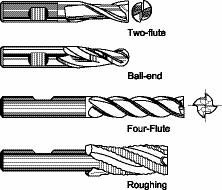
There are several common endmill designs. Two-flute endmills with square ends are applied because they can make plunge cuts into the work like a drill and cut sideways. Their end teeth extend to their centers to allow plunge cuts. Some 3-flute endmills can also perform plunge cuts. Both 2- and 3-flute endmills are suitable for milling nonferrous metals. Two-flute endmills with a ball end produce rounded-bottom slots or filleted edges.
Four-flute finishing endmills with a square end make smoother cuts than 2-flute endmills and stay sharp longer, but cannot make plunge cuts. These tools are best suited for cutting ferrous metals. Four-flute roughing endmills remove metal faster with less horsepower, cutter deflection and vibration than 4-flute finishing endmills, and their chipbreakers produce smaller, more controllable chips.
Courtesy of All images: Pamela J. Tallman
Common endmill designs include (from top to bottom): 2-flute endmill, 2-flute ballnose endmill, 4-flute finishing mill and 4-flute roughing mill.
The helical shape of an endmill’s flutes reduces chatter. In operation, one or more points of the helical flutes remain in contact with the workpiece and cut metal at all times. This presents a continuous load to the machine instead of a pulsing load, which occurs each time a tool with a straight flute begins and ends contact with the work. Although making helical flutes is more complex and costly than straight ones, the reduction in chatter and the finer finish they produce is worth the extra cost.
Various common options are available for solid endmills. They are available for right-hand or left-hand cutting. Left-handed cutters are used when the direction of cutting forces must be reversed to avoid stressing the workpiece. In addition, endmills are offered with varying flute lengths, including stub, regular, long and extra long. Endmills can also have tapers. They are commonly tapered at ½°, 1°, 1½°, 2°, 3°, 5°, 7°, 10°, 15°, 20° and 25° per side. These are especially useful in moldmaking to provide draft, or taper, to ease the release of the molded product.
Review the print ads from this magazine to continue
This quick advertiser review unlocks the rest of the article and keeps the full-screen reader focused on the ads instead of the page chrome.
Continue reading
September 2009
Related


 MFGAxis Discussion
Be part of the shop-floor conversation
Like, save, or comment on this CTE story.
MFGAxis Discussion
Be part of the shop-floor conversation
Like, save, or comment on this CTE story.


MFGAxis Discussion