

Methodical maintenance
Advances in machine tool controls and software drive better maintenance.
Advances in machine tool controls and software drive better maintenance.
Courtesy of Fanuc CNC America
CNC technology can help shops streamline maintenance schedules and tailor them to the shop’s actual activity, and at the same time detect maintenance and repair issues that might otherwise lurk unforeseen.
As electronic automotive engine management systems have grown in sophistication, car maintenance practices have evolved from the rigid 3,000-mile oil change to service intervals and maintenance actions based on actual use as determined by feedback from engine management electronics.
CNC technology has also evolved over its 60-plus years of commercial availability. It has progressed from the first NC units that controlled manual machine tools modified with motors that moved the controls to follow points fed into the system on paper tape, to the point where today CNC technology can help streamline maintenance schedules, tailor them to actual machine activity and detect otherwise unforeseen maintenance and repair issues.
Custom Intervals
Most CNCs record and save data regarding machine tool operations. Kurt Zierhut, director of electrical engineering at Haas Automation Inc., Oxnard, Calif., said Haas puts that data to use via a periodic-maintenance screen that displays action intervals for 14 machine maintenance items, including fluid level checks, fluid and filter replacement and various component inspections. Default maintenance intervals are determined in terms of machine uptime, time in cycle or number of tool changes, but users can set intervals to fit their experience and usage patterns.
In addition, the maintenance screen provides six spare slots where users can specify both the maintenance item and the desired interval for action. When the specified interval for any item has elapsed, the machine displays a “maintenance due” message to alert an operator that maintenance action should occur, but doesn’t force an action or stop production.
In a step toward automated maintenance, Haas recently introduced its minimum lubrication system to reportedly optimize delivery of lubricant to the machine spindle and linear travel axes. The system monitors the number of times the spindle turns and the distances the axes travel and, at specified intervals, releases a small amount of oil or grease to the monitored machine component. Haas engineer Mike Teitel said most spindles receive lubrication after 112,000 rotations, or every 30 minutes if running at a relatively low speed. When any axis travels more than a kilometer, it and the other axes are automatically lubricated.
“The thought was that a slowly turning spindle needed a lot less lube, and we realized that it was exactly dependent on the number of revolutions,” Zierhut explained. “It used to be that we’d give a squirt of oil to the spindle and axes every half an hour whether they needed it or not. Now they get it when they need it, and it’s a much smaller squirt of oil; we expect the reservoirs to last for a year or more.”
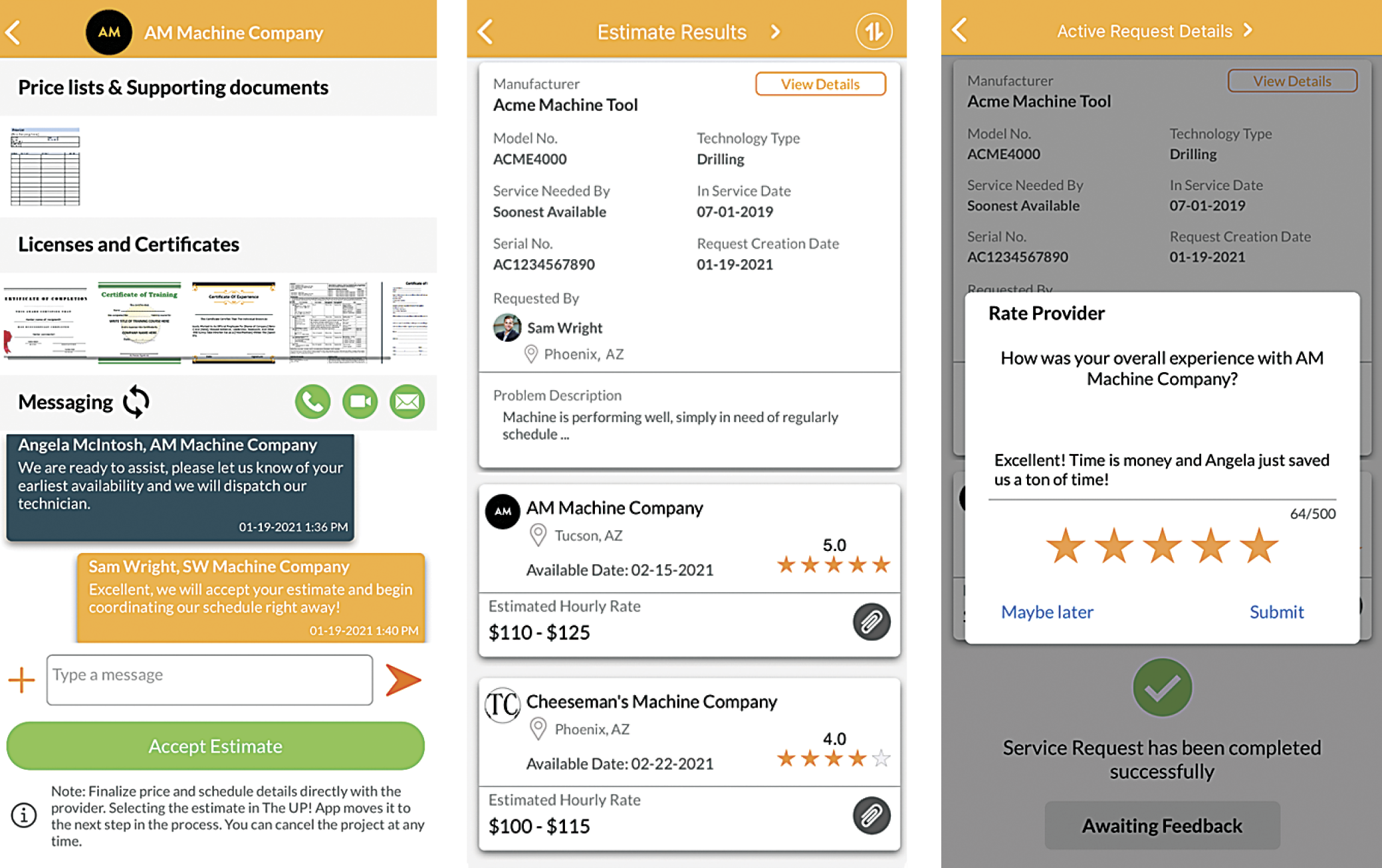
Courtesy of Haas Automation
Machine on-time, time in motion and tool change frequency information recorded by a CNC can be used to manage maintenance activity. These screens from a Haas control show maintenance items with user-adjustable default intervals.
For monitoring data from a number of machines, Haas offers the M-Net data-networking feature. Zierhut said M-Net takes advantage of data stored in the CNC, using macro variables that label a variety of functions and are accessible from outside the machine. The data includes run time, alarm conditions, axis motion, axis speeds and loads, and spindle speeds and loads.
According to Zierhut, a typical M-Net user is a shop with 100 machines and a central computer monitoring them. “The central computer is connected to a network, and once every minute or two it will send out a request to all the machines and give a dashboard kind of display of the entire shop floor,” he said. Full use of the application usually requires third-party machine monitoring software from such suppliers as Spectrum CNC Technologies, Corona, Calif., or Refresh Your Memory (RYM) Inc., San Jose, Calif.
Although large shops are the most logical candidates for machine data networking, smaller shops can also take advantage of M-Net via messaging. “We put in a fairly basic ability to send a text message out of the machine,” Teitel said. “It still requires a network and an exchange server, but once you have the exchange server and can send e-mails, the machine can send either an e-mail or a text message on an alarm. So if a shop is running a part overnight and there is a machine status change or an alarm, the machine will send a text message to an off-site operator.”
Baseline Comparisons
In conjunction with supplying CNC units for machine tool builders to incorporate in their products, Fanuc CNC America, Hoffman Estates, Ill., provides servo and spindle motors, the amplifiers that provide the power to the motors and the I/O modules that connect input and output devices. Paul Webster, manager of product engineering, said a number of maintenance features and a troubleshooting guide for the Fanuc components are built into the control. “If the motor or the amplifier has an alarm—for example, the motor is pulling too much current—the software determines the cause of the failure and puts up a smart troubleshooting screen that lists choices for action,” he said.
Beyond troubleshooting, Fanuc offers Servo Guide software that accumulates baseline information regarding machine performance. Machine tool builders routinely perform a series of standard tests for accuracy, circularity, vibration levels and other performance parameters for each machine they produce. Loaded on a PC and connected to the control via a PCMCIA LAN card, the Servo Guide software can run the tests and tune the machine.
Courtesy of MAG Americas
To facilitate efficient maintenance, the eWare software package from MAG features a control-resident module called eConnect that collects machine and process data. The information is analyzed by a series of five other modules that focus on specific condition and productivity issues.
When testing and tuning are complete, parameters are set and the software saves the baseline data. The builder can provide that data in a report format to the machine’s purchaser. Then, on a periodic basis or if a problem occurs, the shop can connect a PC with the software to the machine, run the original tests and compare the new data to the old.
“The shop can retune the machine in the software and account for the changes, or analyze the data to determine if bearings are failing, if there is coolant infiltration in a motor, or if there is a bad ballscrew or a bad linear motion guide,” Webster said. “They can use that information to predict if at some point the component is going to fail.”
Although the package was originally engineered for builders performing machine tuning, it also permits baseline tracking of the machine by shops. “Servo Guide software is not so much an ‘it’s good or bad’ tool; rather, it provides analysis of servo responses,” Webster explained. “You’d typically want a baseline when the machine is installed, but you can do the tuning anytime.”
For maintenance issues involving machine components other than those supplied by Fanuc, the company provides a unit that can receive information from multiple sensors and send it through an I/O link to the CNC. Software monitors input from shock and thermal sensors mounted throughout the machine. For example, a shock sensor that can read up to ±80 Gs in three dimensions can detect a spindle crash.
Sensitivity of specific sensors can be set to threshold values that will trigger a maintenance message, an alarm or a machine shutdown. Thermal sensors can be located throughout the machine to read bearing and coolant temperatures and then, for example, display a warning if temperatures reach a certain threshold and shut the machine down if a second threshold is met.
Sensor location is mostly up to machine builders, according to Webster. “We give them a variety of data gathering and analysis tools, but the way they interface with the machine is up to the builder,” he said. “They know about their machines. A lot of research and development has to be performed to implement these features.”
Interface Integration
One approach to control-based maintenance strategies integrates the machine control and operator interface systems, thereby enabling users to create applications tailored to their needs. Bryan Newman, THINC product specialist at Okuma America Corp., Charlotte, N.C., said the machine builder’s Windows-based THINC control runs on a single Intel processor. “We have our CNC software running on our real-time system, and the screens are run on the Windows side,” Newman explained. “A robust application program interface exposes the data on the NC side to the Windows side, so it is easy for third parties and customers to write applications leveraging that data.”
Review the print ads from this magazine to continue
This quick advertiser review unlocks the rest of the article and keeps the full-screen reader focused on the ads instead of the page chrome.
Continue reading
July 2010
Related
 MFGAxis Discussion
Be part of the shop-floor conversation
Like, save, or comment on this CTE story.
MFGAxis Discussion
Be part of the shop-floor conversation
Like, save, or comment on this CTE story.


MFGAxis Discussion