
Making the grade: General Industry Coverage
When selecting the right tungsten-carbide grade, you need the full picture.
Selecting a tungsten-carbide grade for an application is similar to putting together a jigsaw puzzle. “You can’t just look at one attribute and determine the quality is going to be good based on that,” said Rich Deptola, quality and continuous improvement director for TechMet Carbides Inc. “There are quite a few things that fit together that give you a full picture of the grade.”
Founded more than 20 years ago, the Hickory, North Carolina-based company provides tungsten-carbide technology and products to fabricators and OEMs.
Those puzzle pieces include the size of the tungsten-carbide grains, the percentage of binder content, the quantity of lesser alloying elements — or refractory carbides — in the mix and the level of wear resistance.
Against the Grain
The classifications for grain size at TechMet include nanograin, ultrafine, submicron, fine, medium, coarse and extra coarse, Deptola noted. A nanograin measures around 0.2 µm (0.000008″) while an extra-coarse grain is larger than 6 µm (0.000236″). Between those two are ultrafine at 0.2 µm to 0.5 µm (0.00002″), submicron at 0.5 µm to 0.8 µm (0.000031″), fine at 0.8 µm to 1.3 µm (0.000051″), medium at 1.3 µm to 2.5 µm (0.000098″) and coarse at 2.5 µm to 6 µm.
“The technologies that have been developed have been pushing the boundaries of smaller and smaller grain sizes over the years,” Deptola said. As a result, nanograin carbide, which provides a higher level of hardness compared with grades with larger grains, is easier to manufacture than in the past. To minimize grain growth during the sintering process, he added that refractory carbides, such as vanadium carbide and chromium carbide, are added.
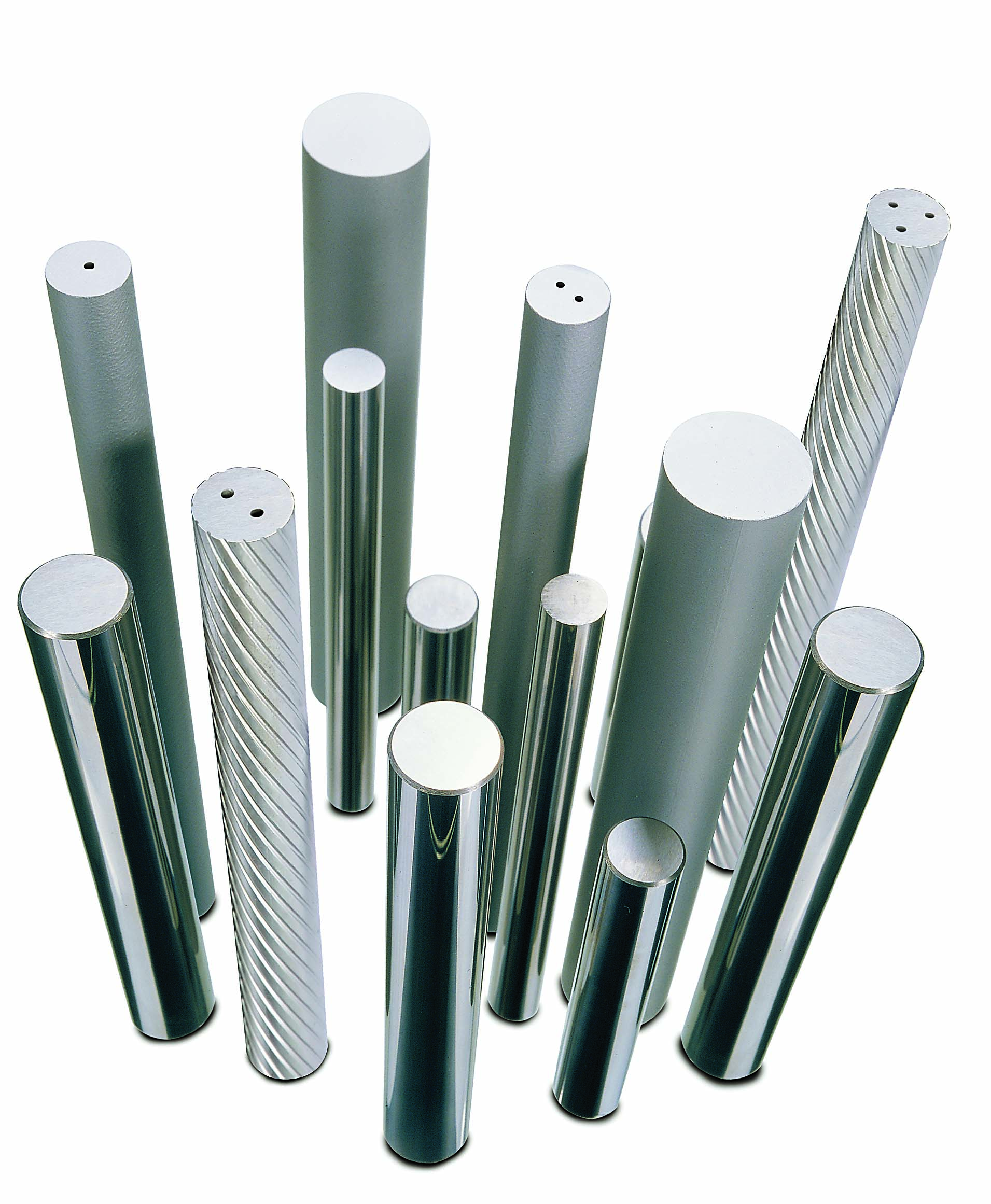
Displayed is an assortment of rotary cutting tool blanks. Image courtesy of TechMet Carbides
Carbide hardness is measured in the HRA scale. At TechMet, the hardness of grades ranges from 81.5 to 94 HRA. At the high end is a grade made with ultrafine grain. Although some grades have a variety of grain sizes, such as ones for producing mining bits, Deptola said grain size is typically uniform in cutting tools. “The goal is to have a nice, homogenous microstructure.”
Held Tight
Review the print ads from this magazine to continue
This quick advertiser review unlocks the rest of the article and keeps the full-screen reader focused on the ads instead of the page chrome.