



Machining parts more efficiently, while increasing part size
END USER: Sonaca Montreal Inc., (450) 434-6114, www.sonacamontreal.com. SOLUTION PROVIDER: Fives Liné Machines Inc., (450) 372-6480, www.fivesgroup.com. CHALLENGE: Machine aerospace parts more efficiently and precisely while increasing part size. SOLUTION: A 5-axis, high-rail vertical gantry mill.
END USER: Sonaca Montreal Inc., (450) 434-6114, www.sonacamontreal.com
SOLUTION PROVIDER: Fives Liné Machines Inc., (450) 372-6480, www.fivesgroup.com
CHALLENGE: Machine aerospace parts more efficiently and precisely while increasing part size.
SOLUTION: A 5-axis, high-rail vertical gantry mill.
Plenty of machine tool builders offer equipment for producing large parts; significantly fewer provide machines for cutting gargantuan workpieces.
Sonaca Montreal Inc., Mirabel, Quebec, was manufacturing wing skins up to 57′ (17.37m) long and 8.5′ (2.59m) wide for business and regional aircraft on three long-bed gantry mills but needed a high-performance machine to add capacity while increasing productivity and part accuracy, said Paul Stafiej, vice president of strategy, business development and innovation. Those parts include classic skins without integral stringers and monolithic ones with stringers. The company also makes empennage panels and other wing structures, such as spars.
All the company’s gantry machines have vacuum tables for holding parts. “We hold the skins directly on the table without any fixturing,” Stafiej said.
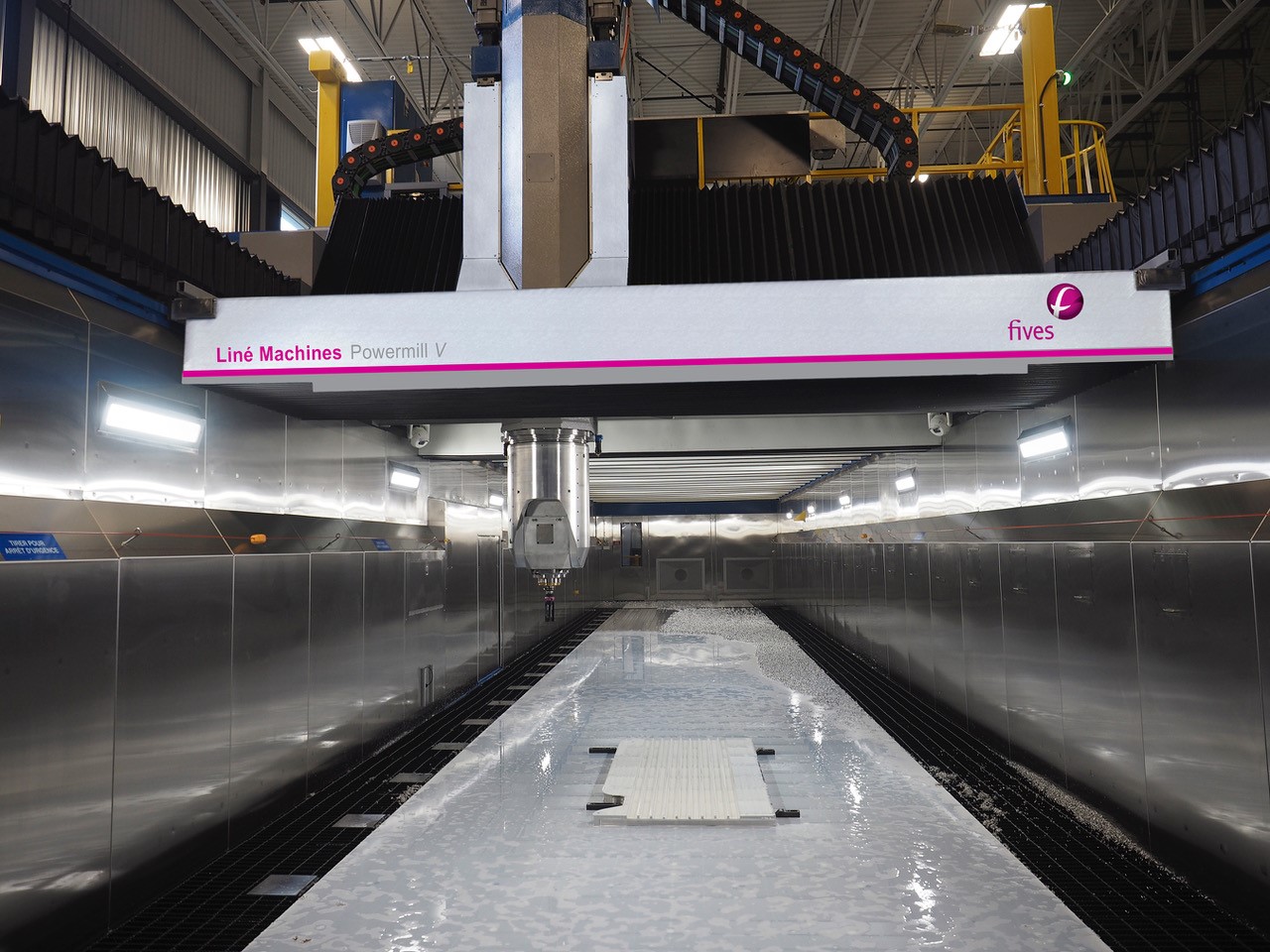
Sonaca Montreal purchased a Powermill V 5-axis vertical gantry mill to machine large aerospace parts, such as wing skins up to 70′ long. Image courtesy of Fives Liné Machines.
Stafiej estimates that there are about half a dozen builders of suitable machines in the world, and the company considered purchasing a machine from three or four of them. Ultimately, Sonaca Montreal selected Fives Liné Machines Inc., Granby, Quebec, because it has considerable experience building long-bed gantry mills, including ones for Boeing Co., Chicago, and is located less than 100 miles (161km) away, he said. “Being close is certainly a good thing.”
Stafiej added that Sonaca Montreal was looking for a high-performance machine with the latest technology to support its organic growth. “We are also trending toward Factory 4.0,” he said.
The older gantries, which still produce parts, have three 10,000-rpm spindles, require cutting tools to be manually changed and don’t have the ability to evacuate chips, so machine stops are scheduled to allow the operator to remove chips from the cutting zone. Also, the gantries are open to the shop environment.
“We can machine up to three parts at a time,” Stafiej said, “but when you have a wide part, then you can only cut with one spindle and you don’t have the efficiency of three spindles.”
In contrast, the new Powermill V 5-axis, high-rail vertical gantry mill, which can machine a part up to 70′ (21.3m) long and 10′ (3.05m) wide, has one 30,000-rpm spindle with an HSK A63/F80 tool taper, an automatic toolchanger and a system to blow chips off a part to minimize stops. Also, the mill is enclosed under a full-length machine roof to better control temperature fluctuations and, therefore, significantly reduce thermal expansion and contraction of the aluminum workpieces. “The better you can control the environment, the more precise the parts,” he said.
The new gantry mill also has a thermal-compensation system, a mist collector, a 100-psi (6.9 bar) external coolant system, a programmable through-coolant system that applies fluid at up to 1,000 psi (69 bar), tool and part probing systems, and high-definition cameras to enable an operator to view cutting conditions from a safe, remote location. In addition, the operator station includes a monitor of remote gages to provide real-time feedback for machine utilities and critical components. “Those indicators are there to make sure we are in an optimized mode,” Stafiej added.
For periodic quality-assurance verifications, a machine health-check system examines machine geometry, and the head-check cycle assesses the geometry of the milling head. A fully detailed report is automatically created, and, if needed, suggestions are provided for what must be done and where so maintenance personnel can bring the machine back into tolerance, he said. “The machine is also linked into our maintenance system, so the maintenance guys know the condition of the machine on a minute-by-minute basis or hour-by-hour basis.”
To accommodate the machine, Stafiej said Sonaca Montreal added a 5,300-sq.-ft. section to its machine shop and an 82′-long × 21′-wide × 14′-tall (25m × 6.4m × 4.3m) concrete foundation. The rails of the high-rail mill are installed on the elevated foundation, providing a natural enclosure. The lead time for the machine was 15 months.
Even though the parts are often enormous, Stafiej said it’s important to meet tight tolerances, and, depending on the part design, the Powermill V can achieve a geometric tolerance of ±0.010″ (0.254mm) and a skin thickness tolerance of ±0.005″ (0.127mm). He added that OEMs expect a high level of precision from parts suppliers to reduce part weight. “That puts a lot of strain on suppliers, particularly those with older equipment.”
The new gantry mill will enable Sonaca Montreal to meet those tighter tolerance specifications while improving throughput. “We don’t have hard data yet,” Stafiej said, “but we should be seeing 15 to 25 percent cycle-time reductions.”
To help the company acquire new technology and improve competitiveness, the Canadian and Quebec governments supported the purchase of the machine through long-term loans.
Glossary terms in this article
Related



Subscribers can use MFGAxis notes, saves and discussion tools with their innoNET account.


