

Machine Technology: Hybrid upsides and design considerations
A milestone in the 3D printing revolution is the appearance of CNC metalcutting machine tools incorporating additive-manufacturing capabilities.
A milestone in the 3D printing revolution is the appearance of CNC metalcutting machine tools incorporating additive-manufacturing capabilities. Manufacturers of the hybrid additive/subtractive systems tout their advantages over conventional machine tools, but the hybrids raise important issues that their builders and users must address.
A selling point of hybrids is they allow a part to be completed in one setup. “With metal additive manufacturing, the part finish is rough, so it requires machining,” said Ken Vartanian, vice president of marketing at Optomec Inc., Albuquerque, N.M., a supplier of additive-manufacturing systems. Using a hybrid machine tool, “the operator can build up and finish-machine a part all on the same machine.”
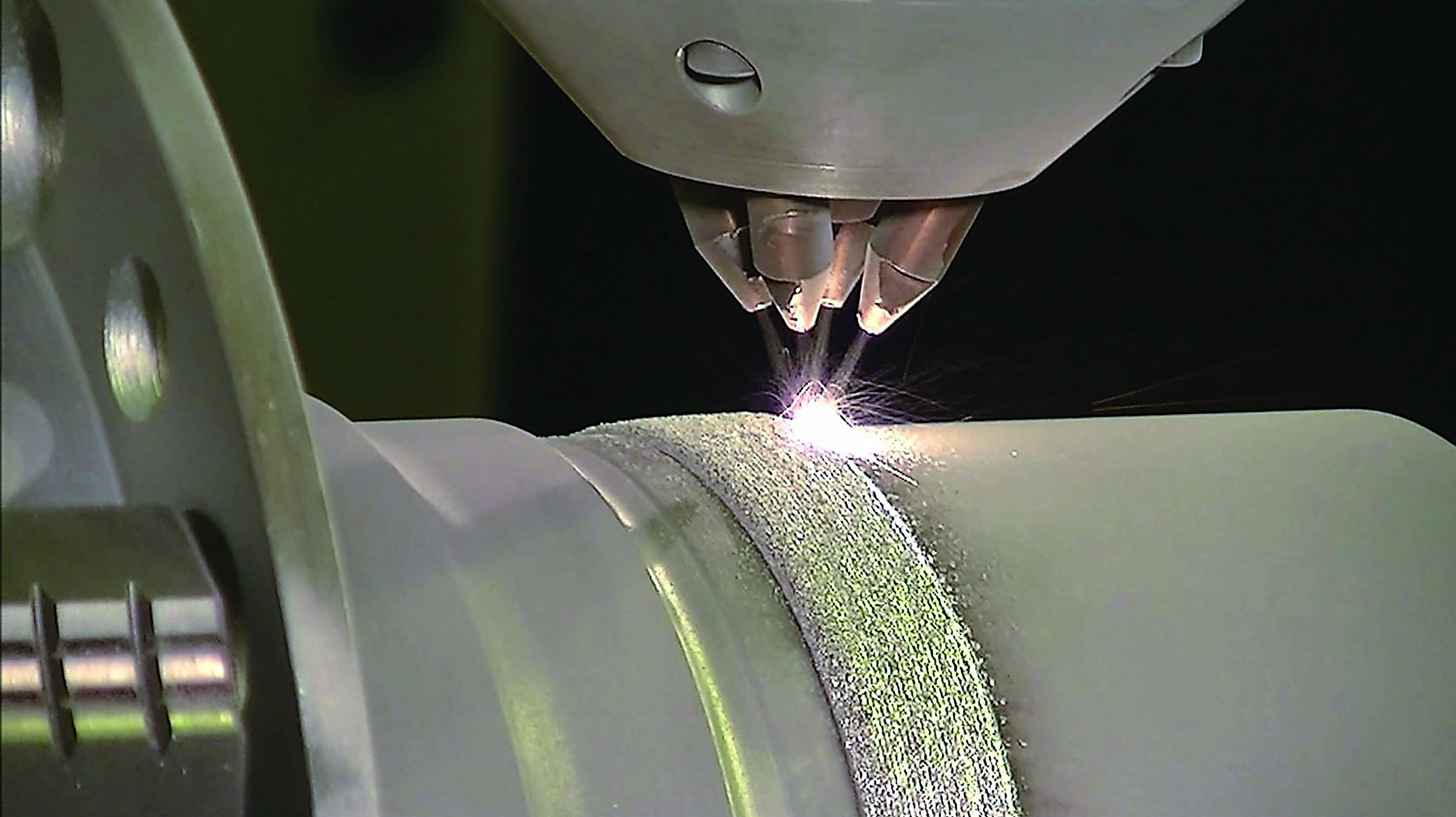
Optomec’s LENS process adds material to resurface a shaft. LENS is the additive process employed in the company’s hybrid machines. Image courtesy of Optomec.
Or consider the repair of a part like a turbine blade. Vartanian said this process usually starts with a machining step to remove material, such as a corroded area. Then an additive step builds the blade back up, followed by finish machining of the deposited material. If a hybrid isn’t used for this process, Vartanian said, the part may be moved multiple times between two machines.
Optomec entered the hybrid arena last year through its LENS series, which has configurations combining a compact CNC mill platform with the company’s LENS (Laser Engineered Net Shaping) metal-additive-manufacturing process.
Another hybrid unveiled last year was the Vertex 55X-H from Mitsui Seiki USA Inc., Franklin Lakes, N.J. Suitable for repairing aerospace, energy, power-generation and other parts, the 55X-H combines a vertical machining center with a spindle-adapted, laser direct-energy deposition, powder-fed nozzle.
Besides handling tasks that require both adding and subtracting material, hybrids can serve as straight additive or subtractive machines. An owner could run a hybrid as an additive machine for weeks at a time, then convert it to a straight-up milling machine by exchanging the additive processing nozzle for a suite of milling tools, noted Robb Hudson, CEO of Mitsui Seiki USA.
Review the print ads from this magazine to continue
This quick advertiser review unlocks the rest of the article and keeps the full-screen reader focused on the ads instead of the page chrome.
Continue reading
August 2017
Related
 MFGAxis Discussion
Be part of the shop-floor conversation
Like, save, or comment on this CTE story.
MFGAxis Discussion
Be part of the shop-floor conversation
Like, save, or comment on this CTE story.


MFGAxis Discussion