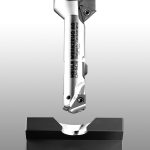

High Production Threaded Holes

Author Cutting Tool Engineering
Published
November 16, 2025 - 06:00pm
view magazine
Machinist’s Corner

I enjoy learning about advancements in science and technology. During the 50-plus years of my metalworking career I was not involved in high-volume part production. A few months ago, I wrote two columns about thread milling. During that time, I had correspondence with an EMUGE-FRANKEN USA engineer who lives in the high-volume part production world. He introduced me to tools that shine when making threaded holes in large quantities.

First a little background about myself. The highest part volumes I have been involved with were in the 1990s when I manufactured a line of chrome-plated accessories for custom V-twin motorcycles. Chromeplated billet aluminum was the rage so I made a lot of chips from 6061- T6 alloy. I recall a taillight housing that had four blind holes with 6-32 threads 3/8" deep. That alloy will make long stringy chips. The housings were machined from 2" x 2" bar stock on a vertical machining center except for the threading operation. That was done on a drill press with a Procunier tapping head.

Why?

Drilling a 0.65" deep hole with a #29 twist drill and a G81 drilling cycle will produce one chip going up each gullet of the drill that will wrap around the drill and cause trouble. The solution to that problem is to use a G87 peck drill cycle. That cycle drills at a prescribed feed rate for a short distance, then makes rapid moves up and down to break the chip, and repeats until the depth of the hole is reached.

When using a tap to thread a blind hole it is best to use a spiral flute tap. Those taps are shaped like a twist drill in that they have helical gullets to pull the chips out of the hole. The problem is you can’t peck with a tap.

So, tapping this hole produced long stringy chips wrapped around the tap. I tapped the holes manually on a drill press and cleaned the chips off the tap after every hole. Kind of slow, but better than breaking a tap and scraping a part that had 15 minutes of machining time into it. There is a burr caused by the tap entering the workpiece. I cleaned that off with an abrasive disk in a right angle die grinder.

A hole can also be made with an endmill, and I don’t mean plunging the tool into the work. Using an endmill that is smaller in diameter than the hole to be made — and using helical interpolation for the tool path — an accurately sized hole can be made and the chips will be small, regardless of the workpiece material.

Now back to the EMUGE tool for blind holes — the THRILLER-MAX. It has an endmill end and threadmill teeth on the side of the cutter (see THRILLER-MAX image). With this tool using helical interpolation the hole is drilled and threaded in one or two passes depending on the amount of material to be removed in the threading operation. One tool can do the operations of two tools. This results in the elimination of one tool change operation and milling cycle and the associated rapid moves between holes. You also don’t have to worry about breaking a tap.

image of THRILLER-MAX, Circular drill THRILLER-MAX, Circular drill – thread mill. EMUGE-FRANKEN
image of THRILLER, drill – thread mill THRILLER, drill – thread mill – chamfering cutter. EMUGE-FRANKEN

These coated or uncoated solid carbide tools can be used with high pressure through the spindle coolant for altogether rapid threaded hole making. And another thing, EMUGE offers resharpening and recoating services so they can partner with you to keep your production up and running.

EMUGE also has tools for through holes that include a feature for chamfering. This tool is called the THRILLER and is shown in the THRILLER image. The procedure is to peck drill through, engage the threading teeth, thread with one or two revolutions of helical interpolation (depending on thread pitch and material), center the tool in the hole, chamfer and then retract. Pretty darn quick.

If you have a high-volume threaded hole-making operation, you may know better than me that seconds matter. At 77 years of age, this old dog has learned some new tricks.
Related Glossary Terms

  • abrasive

    abrasive

    Substance used for grinding, honing, lapping, superfinishing and polishing. Examples include garnet, emery, corundum, silicon carbide, cubic boron nitride and diamond in various grit sizes.

  • burr

    burr

    Stringy portions of material formed on workpiece edges during machining. Often sharp. Can be removed with hand files, abrasive wheels or belts, wire wheels, abrasive-fiber brushes, waterjet equipment or other methods.

  • chamfering

    chamfering

    Machining a bevel on a workpiece or tool; improves a tool’s entrance into the cut.

  • coolant

    coolant

    Fluid that reduces temperature buildup at the tool/workpiece interface during machining. Normally takes the form of a liquid such as soluble or chemical mixtures (semisynthetic, synthetic) but can be pressurized air or other gas. Because of water’s ability to absorb great quantities of heat, it is widely used as a coolant and vehicle for various cutting compounds, with the water-to-compound ratio varying with the machining task. See cutting fluid; semisynthetic cutting fluid; soluble-oil cutting fluid; synthetic cutting fluid.

  • drilling machine ( drill press)

    drilling machine ( drill press)

    Machine designed to rotate end-cutting tools. Can also be used for reaming, tapping, countersinking, counterboring, spotfacing and boring.

  • endmill

    endmill

    Milling cutter held by its shank that cuts on its periphery and, if so configured, on its free end. Takes a variety of shapes (single- and double-end, roughing, ballnose and cup-end) and sizes (stub, medium, long and extra-long). Also comes with differing numbers of flutes.

  • feed

    feed

    Rate of change of position of the tool as a whole, relative to the workpiece while cutting.

  • gang cutting ( milling)

    gang cutting ( milling)

    Machining with several cutters mounted on a single arbor, generally for simultaneous cutting.

  • interpolation

    interpolation

    Process of generating a sufficient number of positioning commands for the servomotors driving the machine tool so the path of the tool closely approximates the ideal path. See CNC, computer numerical control; NC, numerical control.

  • machining center

    machining center

    CNC machine tool capable of drilling, reaming, tapping, milling and boring. Normally comes with an automatic toolchanger. See automatic toolchanger.

  • metalworking

    metalworking

    Any manufacturing process in which metal is processed or machined such that the workpiece is given a new shape. Broadly defined, the term includes processes such as design and layout, heat-treating, material handling and inspection.

  • milling

    milling

    Machining operation in which metal or other material is removed by applying power to a rotating cutter. In vertical milling, the cutting tool is mounted vertically on the spindle. In horizontal milling, the cutting tool is mounted horizontally, either directly on the spindle or on an arbor. Horizontal milling is further broken down into conventional milling, where the cutter rotates opposite the direction of feed, or “up” into the workpiece; and climb milling, where the cutter rotates in the direction of feed, or “down” into the workpiece. Milling operations include plane or surface milling, endmilling, facemilling, angle milling, form milling and profiling.

  • milling machine ( mill)

    milling machine ( mill)

    Runs endmills and arbor-mounted milling cutters. Features include a head with a spindle that drives the cutters; a column, knee and table that provide motion in the three Cartesian axes; and a base that supports the components and houses the cutting-fluid pump and reservoir. The work is mounted on the table and fed into the rotating cutter or endmill to accomplish the milling steps; vertical milling machines also feed endmills into the work by means of a spindle-mounted quill. Models range from small manual machines to big bed-type and duplex mills. All take one of three basic forms: vertical, horizontal or convertible horizontal/vertical. Vertical machines may be knee-type (the table is mounted on a knee that can be elevated) or bed-type (the table is securely supported and only moves horizontally). In general, horizontal machines are bigger and more powerful, while vertical machines are lighter but more versatile and easier to set up and operate.

  • pitch

    pitch

    1. On a saw blade, the number of teeth per inch. 2. In threading, the number of threads per inch.

  • tap

    tap

    Cylindrical tool that cuts internal threads and has flutes to remove chips and carry tapping fluid to the point of cut. Normally used on a drill press or tapping machine but also may be operated manually. See tapping.

  • tapping

    tapping

    Machining operation in which a tap, with teeth on its periphery, cuts internal threads in a predrilled hole having a smaller diameter than the tap diameter. Threads are formed by a combined rotary and axial-relative motion between tap and workpiece. See tap.

  • threading

    threading

    Process of both external (e.g., thread milling) and internal (e.g., tapping, thread milling) cutting, turning and rolling of threads into particular material. Standardized specifications are available to determine the desired results of the threading process. Numerous thread-series designations are written for specific applications. Threading often is performed on a lathe. Specifications such as thread height are critical in determining the strength of the threads. The material used is taken into consideration in determining the expected results of any particular application for that threaded piece. In external threading, a calculated depth is required as well as a particular angle to the cut. To perform internal threading, the exact diameter to bore the hole is critical before threading. The threads are distinguished from one another by the amount of tolerance and/or allowance that is specified. See turning.

  • twist drill

    twist drill

    Most common type of drill, having two or more cutting edges, and having helical grooves adjacent thereto for the passage of chips and for admitting coolant to the cutting edges. Twist drills are used either for originating holes or for enlarging existing holes. Standard twist drills come in fractional sizes from 1¼16" to 11¼2", wire-gage sizes from 1 to 80, letter sizes A to Z and metric sizes.