

High-fiber diet: Drilling Performance
Superabrasive tools can be applied to efficiently machine carbon fiber-reinforced plastics.
Superabrasive tools can be applied to efficiently machine carbon fiber-reinforced plastics.
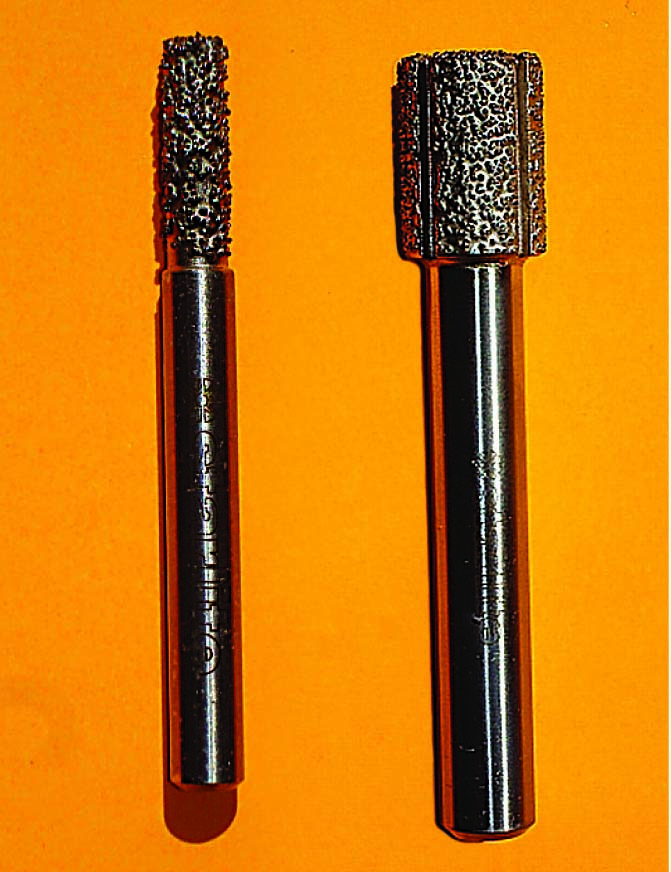
Courtesy of Abrasive Technology
A shop seeking heavy, fast removal of CFRP can employ a superabrasive router with sharp, large diamond crystals, low bond levels and a widespread grit concentration. According to Abrasive Technology, its P.B.S. process permits specifying diamond size, shape and spacing and the bond level.
More manufacturers are climbing on the weight-loss bandwagon. But rather than magic diets or brutal exercise programs, their mass-reduction efforts involve the use of lightweight—yet strong—workpiece materials. In a growing number of products, those materials are carbon fiber-reinforced plastics. CFRPs are most notably found in fuel-saving aircraft, typified by Boeing’s 787 Dreamliner, which is comprised of more than 50 percent carbon fiber by weight. Other burgeoning uses include giant wind power generator blades, high-end automotive and marine parts and sports equipment.
As is often the case, however, the high-performance materials present high-level machining challenges. A CFRP composite consists of a network of tough carbon filaments molded in a resin matrix. The combination of relatively soft, temperature-sensitive resin with abrasive fibers makes machining the composites “sort of a catch-22,” according to Bill Herbst, president of Global Superabrasives LLC, Springfield, Mass. The key to success when machining CRFPs, he said, is maintaining a sharp cutting edge that cuts the fibers cleanly but at the same time minimizes heat generation. The abrasive carbon fibers quickly dull the edges of HSS and carbide cutting tools, so many manufacturers are applying wear-resistant diamond superabrasive materials, particularly in high-volume production.
Those materials used are produced in three basic configurations: PCD compacts, CVD diamond coatings and films and tools and grinding wheels employing synthetic or natural diamond particles bonded via electroplating or brazing.
In the high-temperature, high-pressure process used to synthesize PCD cutting materials, a catalyst metal or binder, usually cobalt, promotes bonding between diamond grains, and creates a continuous diamond lattice with interspaced residual metal. The larger the grain size, the greater the intergrowth between grains, and the tougher and more wear-resistant the tool. PCD is manufactured in sheets, which are EDMed or laser cut into segments and then brazed on cutting tool edges.
CVD diamond coatings can be applied to tools in thicknesses from a few microns to 25µm. The CVD process requires no binder, and therefore the coating is pure diamond. For machining composites, typical thickness is 7µm to 10µm. In reference to products like his company’s DiaBide coating, Erik Koik, president and CEO of sp3 Cutting Tools, Decatur, Ind., said, “Like everything else, there is no free lunch.”
The thicker the coating, the more abrasion resistant it is and the longer the tool life. A thicker coating, however, rounds the cutting edge more than a thinner one, reducing its sharpness and making it less effective when cutting composites. “There is a sweet spot in coating thickness that is dependent upon what you are trying to cut,” Koik said.
Thick-film CVD diamond is produced much like diamond coating, but the material is deposited in flat sheets. Koik said sp3’s TFD thick-film product typically is grown and polished to produce 0.5mm-thick segments. “Then, it is used [cut into segments and brazed on to cutting edges] essentially in the same way as PCD,” he said.
The cobalt-free makeup of thick-film diamond materials can be an advantage when machining CFRPs. Koik said some composite materials contain resins that chemically leach cobalt out of PCD and cause the tool to break down. The mechanism is similar to when coolant leaches cobalt binder from a tungsten-carbide cutting tool. With no cobalt catalyst, the thick-film diamond tools avoid the leaching problem.
Grain Size Matters
One similarity between PCD and CVD diamond tools when machining CFRPs is the influence of diamond grain size on tool performance.
The manufacturing processes for both PCD and CVD diamond permit control of grain size, Koik noted. “There are some real advantages to varying the grain sizes of the diamond, depending on the material being cut,” he said. “We have found that if the diamond crystal is larger than the diameter of the fiber you are trying to cut, you will have better results. It’s a strength issue.”
The diameter of individual fibers in CFRPs typically ranges from 5µm to 10µm. Although the fibers are usually bundled in threadlike groups called “tows” about 50µm in diameter, the individual fibers are being cut.
Diamond grain size also determines the wear and fracture resistance of a PCD tool. A larger grain size promotes more intergrowth between grains, reducing the need for a metal catalyst or binder. This means the PCD tool is more wear-resistant because ultrahard diamond predominates. Conversely, PCDs with smaller grains and a higher proportion of metal catalyst or binder are tougher because the metal is more fracture-resistant than diamond.
Dr. Peter Mueller-Hummel, senior manager, aerospace and composites for Mapal Dr. Kress KG, Aalen, Germany, said the optimal balance of metal catalyst to diamond for some applications is determined by machine tool rigidity. “With a very rigid machine, we can go to more diamond and less metal binder. If we have a weak machine, we use less diamond and more metal binder material,” he said.
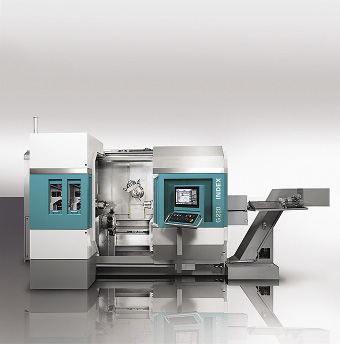
Courtesy of Mapal
Tools for machining CRFP must maintain sharp cutting edges that cut carbon fibers cleanly while minimizing heat generation, which can melt the resin matrix. Because abrasive fibers quickly dull the edges of HSS and carbide cutting tools, many manufacturers apply tools with wear-resistant diamond superabrasive materials, such as this PCD-fluted tool from Mapal.
The fibrous filler of CFRPs can make it difficult to impart a smooth machined finish. When not cleanly sheared, fibers fray and produce a rough surface. When cutting conventional materials, high cutting speeds help lower cutting forces and facilitate fine surface finishes, Koik said, but machining composites “isn’t intuitive. A very high rpm and a low feed rate to try and achieve smoothness is not always the optimal way to machine composites. Sometimes pushing the tool a little harder, with a little higher chip load, makes for a better cut and increases machining productivity.”
He described a case where an airframe manufacturer was applying a ½ “-dia. router running at 17,000 rpm and a 20-ipm feed rate on a CFRP component. Koik suggested trying a 0.006 “-per flute chip load for the tool. “We did some calculations and we backed the rpm down to 5,000 and doubled the feed rate. It cut much better and produced much more quickly than at the low feed rate.”
True Grit
The dissimilar nature of the materials that comprise CFRPs complicates the application of tools such as grinding wheels and discs, drills and saw blades that employ a single layer of diamond particles held on the tool form via electroplating. In electroplating, diamond crystals are entrapped in layers of metal on the tool surface. To hold the crystals on the tool, the layers typically cover 50 to 75 percent of the crystal height. The soft resin of CFRPs can clog gaps between the particles, especially when heavy material removal is desired.
“Plated products don’t, in general, work very well in production composite applications involving fast material removal, due to tool loading. They can, however, be effective in low-material-removal operations or polishing.” said Loyal Peterman, co-founder and president of Abrasive Technology Inc., Lewis Center, Ohio. “There are some applications where an electroplated tool is appropriate, but they always have a full concentration of abrasive, where the diamond particles are pushed closely together.”
Peterman said the company’s proprietary P.B.S. brazed bonding system offers a way to control diamond concentration. In the P.B.S. process, a layer of nickel-chrome alloy is melted and bonds, or brazes, the diamond crystals to the desired tool form. The method produces a variety of tool shapes and configurations with control of the lateral spacing of the diamond particles and the amount of diamond exposed above the braze material, he noted.
“In electroplated products, you have to cover up at least half of the diamond to be able to hold it into the bond,” he said. “With the P.B.S. product, we only need about 30 percent of the diamond covered, and therefore we have more swarf clearance vertically as well as swarf clearance between the diamond particles, which is not possible with electroplated products.”
The process employs diamond particles from 45µm to 600µm. “The particles are not round, and they are not square,” Peterman said. “They have an aspect ratio of length to width, and you can buy very blocky crystals or very sharp crystals.”
For machining composites, sharp crystals are preferred because they cut rapidly and run cool. “Blocky crystals cut more slowly and generate more heat, but give you more life,” he said.
Diamond size, shape and spacing, as well as the level of the bond, can be specified in the P.B.S. process for a particular application, according to Tom Namola, manager of product and application development at Abrasive Technology. “We found that the best way to apply superabrasives is to work with an end user, understand their application, and then engineer the tool to their specific material, how it is they are cutting and the equipment they have to do it on,” he said.
For example, a shop seeking heavy, fast stock removal would employ a superabrasive tool with sharp, large diamond crystals, low bond levels (with grits placed farther apart) and a wide concentration. Stock removal would be fast, and the resulting surface finish would be relatively rough. A different tool configuration with smaller diamonds and tighter concentration would be appropriate for finishing. For polishing, fine electroplated particles can be applied via electroplated hand pads or gloves, Namola added.
Peterman said P.B.S. and electroplated tools can be lower-cost alternatives to PCD or CVD diamond tools for short-run, just-in-time manufacturing. Such applications often are industry-dependent; Namola said the composite machining market currently does not see automotive-level production volumes, for example.
On the other hand, Peterman said, large-volume holemaking in CFRPs stacked with titanium, aluminum or other workpiece materials may require premium tools. As an example, he cited the company’s Everlast PCD-veined drills, which feature a PCD drill tip integrated with a carbide drill body. The PCD tip is sintered into the drill, not brazed, and can be modified to provide specific characteristics, such as minimizing breakout on the exit side of a hole. The ability to change the tip geometry, Peterman said, “gives you a pallet to work from” in regard to providing multiple ways to maximize holemaking productivity in CFRPs.
Need To Know
Since PCD or electroplated or diamond CVD tools all work on composites, the key is to find which is best for a particular application, according to Bill Herbst of Global Superabrasives, which represents small U.S. manufacturers of specialized superabrasive tools.
Courtesy of Abrasive Technology
Review the print ads from this magazine to continue
This quick advertiser review unlocks the rest of the article and keeps the full-screen reader focused on the ads instead of the page chrome.
Continue reading
June 2010
 MFGAxis Discussion
Be part of the shop-floor conversation
Like, save, or comment on this CTE story.
MFGAxis Discussion
Be part of the shop-floor conversation
Like, save, or comment on this CTE story.


MFGAxis Discussion