

Hard metal machines
All metals are not created equal.
Machine tool design and recommendations for processing difficult-to-cut metals to make aerospace parts.
All metals are not created equal. Therefore, neither are the machine tools for cutting them. Parts for extreme aerospace applications, such as in engines, landing gear and flap tracks, must be made of a heat- and corrosion-resistant metal, which typically has a high Young’s modulus of elasticity and is difficult to machine. These include titanium, stainless steel and high-nickel alloys.
The “hard metal” machines that process the parts must be stiff, typically requiring a large mass, and have a large servomotor to create lots of thrust. They also need a high-torque spindle to effectively move the cutter through the material and a high thrust load on the axes of the ballscrews, which often have a low 8mm pitch, to offer an effective mechanical advantage, according to Scott Walker, president of machine tool builder Mitsui Seiki USA Inc., Franklin Lakes, N.J. He explained that the machines are built that way because aerospace customers typically run them slower than 600 rpm, require around 2,000 ft.-lbs. of torque and take maximum chip loads from 0.002 to 0.006 ipt. “So you build this big, rugged machine,” Walker said.
Courtesy of Mitsui Seiki USA
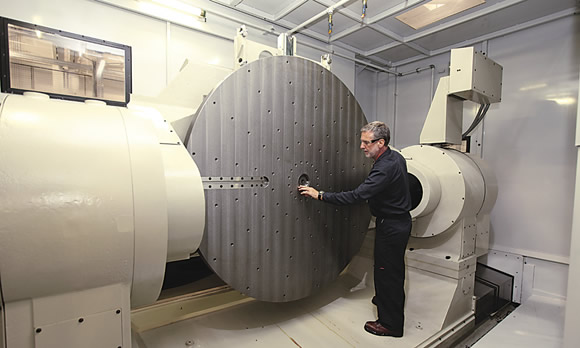
A custom 1,900mm-dia. pallet for a helicopter rotor hub component is produced in a Mitsui Seiki Model HU100-5XL 2m trunnion machine.
On the other hand, he pointed out that “soft metal” machines, which might be used exclusively for aluminum applications, require agility. This is achieved by removing component mass and equipping the machines with a 15,000- to 20,000-rpm or higher spindle and high-pitch ballscrews, which go up to 24mm, to enhance acceleration/deceleration.
“I typically go to direct-drive motors on the A and B axes instead of having mechanical drives or ring-gear drives because you want to have lots of reversal speed when going around corners in soft metals,” he added. “They’re two different machine designs.”
Although it’s possible to cut difficult-to-machine metals on a general-purpose machine, there are consequences. Cutting those metals on such a machine would wear it out in about 20,000 hours, whereas cutting aluminum would enable the machine to last 50,000 to 60,000 hours, according to Walker. Conversely, a hard metal machine lasts 75,000 hours—a 12-year, three-shift depreciation schedule—and holds its accuracy throughout the entire life of the machine, which for a trunnion machine is 0.001 ” true position in the cube.
Betting Big
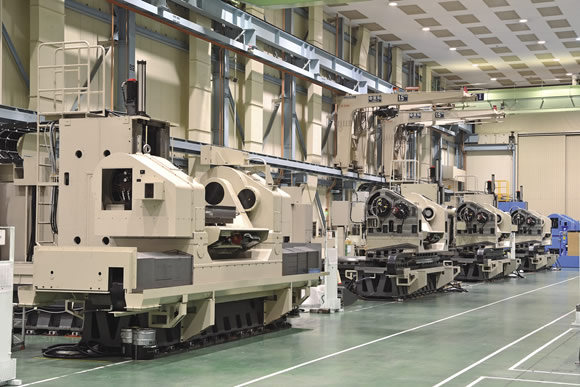
Speculating during a lull in business last year that there would be a demand for them, Mitsui Seiki USA built eight 5-axis, fixed-spindle, trunnion-style machines in 6 months without having purchase orders and sold all of them to aerospace part manufacturers. “It was a good gamble,” Walker said.
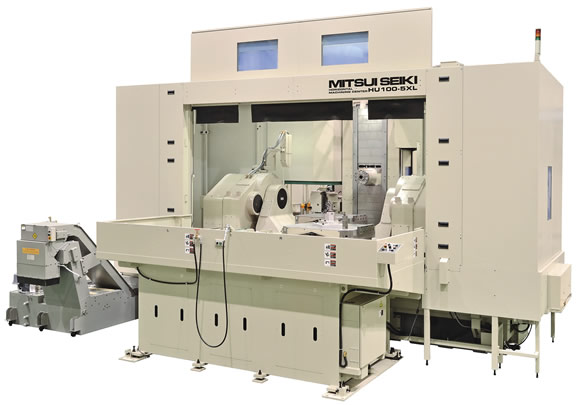
The trunnion machines include three models: HU100-5X with a maximum part swing of 1,500mm (59 “) and a maximum part height of 1,050mm (41 “), HU100-5XL with a maximum part swing of 2,000mm (78 “) and a maximum part height of 1,200mm (47 “) and HU100-5XLL with a maximum part swing of 2,500mm (98 “) and a maximum part height of 1,200mm (47 “).
Courtesy of Mitsui Seiki USA
Four of the eight large 5-axis, fixed-spindle, trunnion-style machines Mitsui Seiki USA built in the last half of 2012 in anticipation of market demand.
Walker pointed out that the increased interest in trunnion-style machines is based on two trends in the aerospace industry. The first is more parts are being designed as monolithic components rather than assembling multiple parts together with rivets, bolts or other means.
“Today, the capability to move stuff around on the screen and convert that design into part programs has given CAD designers a lot more flexibility to make one part instead of bolting three or four parts together,” Walter said, noting those types of parts are a good fit for trunnions.
The other trend is to add more sophisticated geometry to single-piece parts typically made of Ti6Al4V because they are structurally sound, easy to assemble, lightweight and corrosion-resistant, according to Walker. This is accomplished mostly by nonmachining processes, such as sandwiching titanium between composite sheets, heating it to form a die and eliminating rivets from the multiple components fastened together.
Exacta Aerospace is one manufacturer of aerospace structural parts that is machining more monolithic designs. The Wichita, Kan., company produces many parts made of Ti6Al4V and heat-treated 138 stainless steel, as well as a bit of Inconel, for practically all of the aircraft OEMs, noted Kelly Eilerts, 4/5-axis supervisor. Rather than complexity, the size of monolithic parts is more of an issue for Exacta, which recently purchased a Mazak 5-axis Vortex 1400V/160 II vertical machining center with two rotating axes in the spindle head and an X-axis travel of about 65 ” to accommodate the parts being machined and the ones on the horizon.
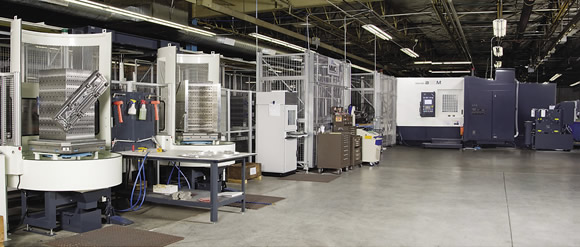
“We purchased it so we could get bigger titanium parts because there are quite a few out there,” Eilerts said. Other machines at Exacta include 4-axis a81M and a82M horizontal machining centers from Makino, which have 8,000-rpm spindles that produce 740 ft.-lbs. of torque and are arranged in a work cell to machine titanium parts up to nearly 40 ” long.
Courtesy of Exacta Aerospace
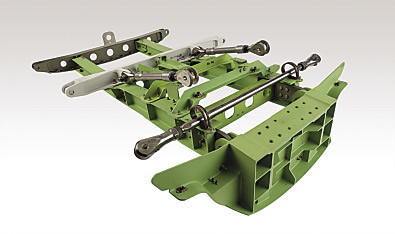
An assembly Exacta manufactures has two titanium details that measure about 3 ‘ in length: one is painted white toward the middle of the assembly and the other is at the back and painted dark green.
As monolithic parts get larger, the challenge of reaching all the machined features increases. For example, combining several parts in one can create deep pockets, Eilerts noted, adding that the company applies cutting tools up to 16 ” long in its Makino HMCs. “That challenge is something we fight—happily,” he said. “It’s fun and something we’re definitely growing with right now.”
Nonetheless, part complexity is a concern with monolithic parts as designers take advantage of the capabilities of the latest 3-D modeling systems, according to Randal Von Moll, director of technical sales for machine builder MAG IAS LLC, Hebron, Ky. “One of the jokes in the aircraft parts making business is we’ve never seen a straight line on any part,” he said. “In the last few years, part shapes have gotten much more exotic, especially on the defense side. This can have a dramatic effect on what types of machine to use to efficiently manufacture the parts.”
Going Gantry
The increasing complexity of aerospace parts practically mandates 5-axis machining. One option to help satisfy the increased demand for titanium and exotic steel alloy parts is MAG’s 5-axis XTi gantry profilers, which have up to five spindles. The machine’s basic configuration includes a pair of floor-mounted rails, which have guide ways, a drive rack and feedback systems for the X-axis, and the foundation-mounted work plate between the rails, Von Moll explained.
In addition to 5-axis contouring, five-sided machining is advantageous to minimize fixturing when producing aerospace components. “Just because you have a 5-axis machine doesn’t mean you can do five-sided machining,” Von Moll said. He pointed out that newer 5-axis horizontal profiling machines, such as MAG’s H series, can do five-sided work because of the A/C-axes spindle head. However, for oversize parts, such as a 50 ‘-long wing span or skin panel, a very large, open vertical machine is required because it has the largest working volume. “To build a horizontal machine of that scale is cost-prohibitive,” Von Moll said.
A MAG gantry machine can have one to five spindles, with a three-, four- or five-spindle arrangement being common. According to Von Moll, having multiple spindles on a machine lowers the cost per part compared to running multiple single-spindle machines. “In many cases, a shop needs a dedicated operator to run each of the single-spindle machines,” he said, “where there is only one person operating the large gantry machine even though it could be producing five identical parts simultaneously.”
Courtesy of Mitsui Seiki USA
Mitsui Seiki’s HU100-5XL machine offers a maximum part swing of 2,000mm and can machine parts up to 1,200mm in height and weighing 2,000 kg (capacity for 3,000-kg parts is optional).
Courtesy of Exacta Aerospace
Exacta Aerospace’s a81M/a82M hard metal Makino Machining Complex produces titanium parts up to 40″ long.
Review the print ads from this magazine to continue
This quick advertiser review unlocks the rest of the article and keeps the full-screen reader focused on the ads instead of the page chrome.
Continue reading
March 2013
Related
 MFGAxis Discussion
Be part of the shop-floor conversation
Like, save, or comment on this CTE story.
MFGAxis Discussion
Be part of the shop-floor conversation
Like, save, or comment on this CTE story.


MFGAxis Discussion