

Hard Made Easier: Trade Shows & Events
Case histories and comments about hard milling in die and mold shops.
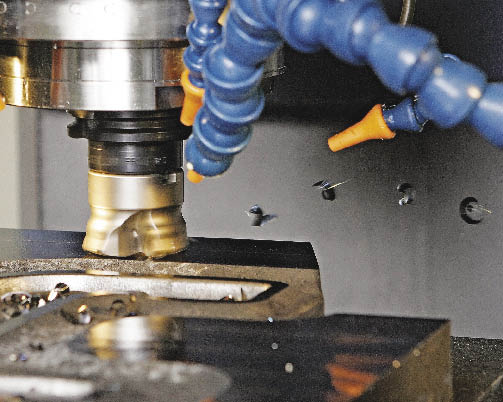
Courtesy of All images: Ingersoll Cutting Tools
Raising the spindle speed and lowering the DOC actually reduced the chip load despite doubling the feed rate and the volumetric removal rate when SPX applied Ingersoll Power Feed Plus tools.
Case histories and comments about hard milling in die and mold shops.
Milling hard die and mold parts can be either a boon or a nightmare, depending on the approach. For one, rigidity of the entire cutting system—from machine base to cutting zone—is essential. For another, inserts with a fine submicron-grain carbide substrate markedly improve edge life because they present uniformly dense carbide right at the cutting edge. Even so, inserts cutting 45-HRC and harder tool steel inevitably wear faster than they would when cutting aluminum.
Beyond that, application-specific factors and how die and mold shops read them can swing the balance in their favor.
With that in mind, this article presents three different case studies involving hard milling at die and mold shops and the lessons they provide.
Protecting a Light-Duty Machine
SPX is a 600-employee, 20-hours-a-day/5-days-a-week steel forging house in Owatonna, Minn. The die shop that services the main plant is small, with a limited inventory of general-purpose machine tools. A substantial part of its workload consists of repairing worn die sets, which by nature are hardened.
One of the mainstay machines is an OKK 40-taper vertical machining center with a 14,000-rpm spindle equipped with ceramic bearings. Being a light-duty machine, it may be great for fine cavity work on new dies before they’re hardened, but it is nobody’s first choice for a steady diet of restoring worn dies in 43-HRC Finkle forging die stock.
The first step in die repair is to skin off about ⅜ ” of a die set’s mating surfaces to create enough stock for resinking the cavities—essentially flat facemilling. The previous standard practice was to run a 2¼ “-dia., 4-flute, positive-rake facemill at a 500-rpm spindle speed, a 50-ipm feed rate and a 0.030 ” DOC. Even at this low feed rate, hammering problems often arose, necessitating a lower feed to protect the machine—especially its ceramic spindle bearings.
“Protecting the machine is our No. 1 priority because we don’t have much backup,” said Cory Pleshcourt, SPX die maker.
The retooling began when Pleshcourt asked Ondrej Lubinski, an Ingersoll field engineer, for tooling ideas that would prevent damage to the light-duty machine in this heavy-duty task.
Because the spindle is capable of much higher speeds, Lubinski suggested a smaller 3-flute Power Feed Plus mill from Ingersoll Cutting Tools with submicron- carbide inserts and feeding it faster but shallower. The cutter is positive radially but negative axially. The shop tested the new cutter at various settings, finally settling on twice the previous feed and one third less depth: 1,000 rpm, 100 ipm and a 0.020 ” DOC. Although the machine removed metal about 10 percent faster, the spindle load meter read 15 percent lower and all signs of hammering disappeared. Insert life doubled.
It may seem counterintuitive to switch to a cutter with fewer flutes to deter hammering, because the total work is spread less widely. But in combination with increasing rpm and feed and reducing the DOC, the chip load per tooth decreased, as did the cutting forces transmitted back into the spindle and machine frame.
The negative axial rake makes double-sided inserts possible, providing more edges in an operation where tools wear quickly.
“With lower-power machines running hard parts, reducing the flute count in the cutter reduces friction, conserving scarce horsepower for actual chipmaking,” explained Lubinski.
Faster Facing
Although the 25-man die shop at Crosby-Lebus Manufacturing Co., Longview, Texas, seems to face basically the same workload as SPX, its tooling solutions are different because C-L has higher-power machines and works on much larger die sets. C-L machines die sets that measure from 12 “×12 ” to 50 “×60 ” and are typically made of Finkle No. 2 forging die stock hardened to 38 to 42 HRC.
C-L was satisfied with a 15-ipm feed rate, at 650 rpm and a 0.100 ” DOC for skin milling using a 2½ ” conventional zero-rake finishing mill. Then, at an Ingersoll customer seminar in Rockford, Ill., C-L machinist Sidney Maxwell saw a Hi Feed Deka cutter feeding at 150 ipm on hardened stock. Back in Longview a week later, Maxwell, programmer Buddy Walston and Ingersoll field engineer Ernie Schooley tested a Hi Feed Deka cutter of the same size on C-L’s hardened stock, and the tool achieved the same result. The new standard settings for skinning the hardened dies rose to 150 ipm, 850 rpm and a 0.035 ” DOC. “We traded off a little cut depth for a tenfold gain in feed, and I’ll take that any day,” Walston said. “A job that used take 90 minutes now takes 12.”
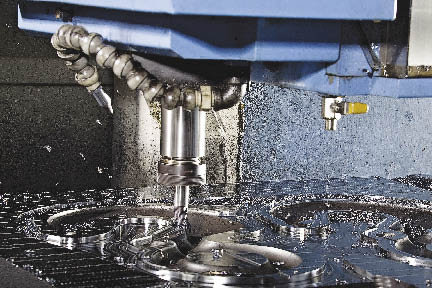
The free-cutting Hi Feed Deka cutter handles 150-ipm feeds when cutting hardened Finkle No. 2 die stock at Crosby-Lebus.
The key physical differences in the cutters include a positive rake for freer cutting and a sturdier insert with a robust wear land that trails the cutting edge. The Hi Feed Deka inserts also provide 10 cutting edges vs. the previous four. Edge life more than tripled.
The faster skinning operation enabled C-L to move it to a separate machine, freeing the more sophisticated CNC machines for cavity work only and streamlining the reconditioning cycle.
Punishing Sandwich
A key part of Precision Mold Base Corp.’s flagship product is a metal sandwich with mild steel or gummy stainless steel as the bread and 4140 steel hardened to 33 to 35 HRC as the filling. PMBC, Tempe, Ariz., has to rough mill the workpiece edge, exposing the cutter to two vastly different metals in the same pass. Worse yet, gaps in the toolpath caused by previous operations leave the tool alternately cutting air and then slamming into the hardest metal. Finally, alignment variations in the sandwich assemblies swing the DOC unpredictably between 0.060 ” and 0.250 “.
Review the print ads from this magazine to continue
This quick advertiser review unlocks the rest of the article and keeps the full-screen reader focused on the ads instead of the page chrome.
Continue reading
January 2009
Related


 MFGAxis Discussion
Be part of the shop-floor conversation
Like, save, or comment on this CTE story.
MFGAxis Discussion
Be part of the shop-floor conversation
Like, save, or comment on this CTE story.


MFGAxis Discussion